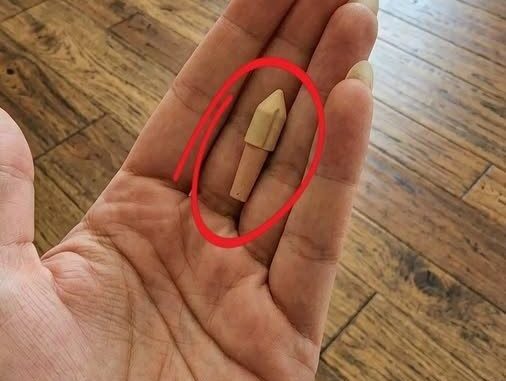
I almost dropped the jeans the moment I felt it.
Buried deep inside my husband’s pocket was a cold, sharp piece of metal unlike anything I’d ever seen before. Heavy. Pointed. Deliberate. The kind of object that instantly makes your stomach tighten before your brain can even catch up.
At first, I thought it might be a tool.
Then I looked closer.
The tip was tapered like a weapon. The base was threaded with mechanical precision. It didn’t look random or harmless—it looked intentional. Secretive.
And suddenly, my mind went somewhere dark.
Why would my husband have something like this hidden in his pocket?
I stood alone in the laundry room gripping the strange object while a hundred terrible possibilities rushed through my head at once. Was he hiding something from me? Was there a side of his life I didn’t know about? Had I missed signs of something bigger happening right in front of me?
When I confronted him, his reaction only made things worse.
He barely looked up.
“I don’t know what that is,” he said casually with a shrug.
No concern.
No explanation.
Nothing.
That answer didn’t calm me—it terrified me.
Because if it wasn’t his… then whose was it?
For the next hour, I sat there turning the object over and over in my hands while my imagination spiraled completely out of control. Every tiny detail suddenly felt suspicious. The metal looked worn from use. There was a faint scratch near the tip. It felt engineered for a purpose I couldn’t understand.
The house became painfully quiet.
Even the ticking clock sounded louder than normal.
I started replaying recent conversations in my head, searching for signs I’d ignored. Small moments suddenly felt loaded with hidden meaning. I convinced myself there had to be an explanation—and that I probably didn’t want to know it.
But then something changed.
As I held the object closer to the light, I noticed tiny markings etched near the base. Small enough to miss unless you were really looking.
I squinted.
Then blinked.
And just like that, the entire mystery collapsed.
It wasn’t a weapon.
It wasn’t evidence of betrayal.
It wasn’t connected to some secret double life.
It was an archery field point—a practice tip that screws onto the end of an arrow for target shooting.
That was it.
I actually laughed out loud from relief before the embarrassment hit me like a wave.
My husband hadn’t been hiding something sinister.
He had quietly taken up archery.
A hobby.
A peaceful one.
Something he apparently enjoyed enough to carry spare parts in his pocket without even thinking about it.
And while he had likely spent his free time aiming at foam targets in silence somewhere… I had spent an hour mentally accusing him of living a secret criminal life.
The shame settled heavily in my chest.
Not because I asked questions—but because of how quickly fear had filled the gaps where communication should have been.
That little piece of metal taught me something uncomfortable about myself.
Sometimes the unknown says more about our insecurities than it does about reality.
We see something unfamiliar, and our minds rush to protect us by imagining the worst possible explanation. Silence becomes suspicion. Privacy becomes secrecy. Innocent details transform into imagined evidence.
And once fear takes over, even ordinary objects start looking dangerous.
Later that night, my husband finally admitted he’d been embarrassed to talk about the hobby because he worried it would seem “weird” or childish. He said archery helped clear his mind after stressful days. It gave him something quiet to focus on when life felt overwhelming.
Suddenly, the object in my hand no longer felt threatening.
It felt human.
A reminder that people sometimes keep parts of themselves private not because they’re deceptive—but because they’re vulnerable.
That realization changed the entire moment for me.
Because the scariest thing I found that night wasn’t hidden inside my husband’s pocket.
It was hidden inside my own assumptions.
Later, after the tension faded and the misunderstanding became something we could finally laugh about, I kept thinking about how fragile trust can feel in quiet moments.
Not because trust is weak.
But because fear is loud.
It fills empty spaces quickly. It takes incomplete information and builds entire stories around it before we even realize what’s happening. And once those stories begin forming in our minds, it becomes difficult to separate reality from imagination.
That night reminded me how easy it is to forget that the people we love are still individuals with private thoughts, hobbies, worries, and little pieces of themselves we may not fully understand yet.
Marriage doesn’t magically erase mystery.
Sometimes we assume that loving someone means knowing everything about them. But real relationships don’t work that way. Even after years together, there are still corners of a person that remain quietly their own.
And maybe that’s okay.
Maybe love isn’t about eliminating every unknown.
Maybe it’s about learning not to fear them immediately.
The next weekend, my husband asked if I wanted to come with him to the archery range.
At first, I almost said no out of embarrassment alone. But something about the invitation felt important. Like he was opening a door he’d quietly kept closed for a long time.
So I went.
And honestly?
It was peaceful.
The steady sound of arrows hitting targets. The concentration in his expression. The calm rhythm of the entire place. I finally understood why he liked it so much.
For the first time, I saw the hobby not as something hidden from me, but as something that helped him feel grounded.
On the drive home, he reached over and squeezed my hand gently.
“You really thought I was hiding something terrible, didn’t you?” he asked with a small laugh.
I looked out the window for a second before smiling.
“Honestly? Yes.”
He laughed harder at that.
And strangely enough, that conversation brought us closer.
Because sometimes relationships grow strongest not after perfect moments—but after the moments where fear, misunderstanding, and honesty all collide… and love stays anyway.
Leave a Reply