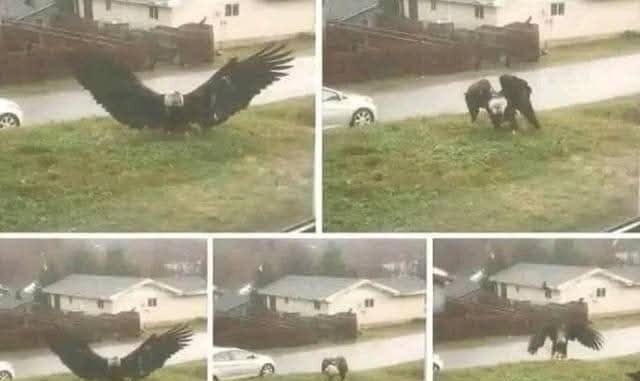
As interest in the sightings continued to grow, birdwatchers from across the country began traveling to southern Texas hoping to catch a glimpse of the mysterious bird for themselves. Observation groups gathered before sunrise near wetlands and open ranchland, scanning the skies with cameras and binoculars while sharing theories about what people may have seen.
Some longtime birders remained skeptical, pointing out that excitement can sometimes influence perception. In the birdwatching world, rare sightings occasionally grow larger in retelling, especially when multiple observers discuss an unusual encounter before official confirmation is made.
But others argued that the repeated reports deserved serious attention.
Several witnesses described seeing the bird glide for long stretches without flapping, using warm air currents to soar effortlessly over the landscape. A few even claimed the shadow passing over them felt “shockingly large,” though scientists cautioned that shadows can appear distorted depending on the angle of the sun.
What made the mystery especially compelling was the lack of clear photographic evidence despite so many modern cameras being available. Most images captured from a distance appeared blurry or grainy, leaving room for debate rather than answers.
Still, researchers did not dismiss the reports outright.
Wildlife experts explained that large birds can sometimes remain surprisingly difficult to identify in the wild. Lighting conditions, cloud cover, distance, and flight posture can all dramatically change how a bird appears in the sky. Even experienced observers occasionally disagree on identification when sightings happen quickly.
Some researchers quietly explored whether changing environmental conditions could also be influencing bird movement across North America.
Habitat disruption, stronger storms, shifting migration routes, and changing food availability have already altered the behavior of many species in recent years. Scientists noted that unusual appearances outside traditional ranges are becoming more common as ecosystems continue adapting to environmental pressures.
Others pointed out that Texas has historically produced surprising wildlife discoveries before. Rare tropical birds, unexpected migratory visitors, and even species believed absent from certain regions have occasionally appeared in the Rio Grande Valley under the right conditions.
For now, however, officials continue emphasizing caution over sensationalism.
No evidence currently suggests anything supernatural, prehistoric, or unknown to science despite dramatic speculation spreading online. Experts stressed that the most likely explanation remains a known species seen under unusual conditions.
Even so, the fascination has not faded.
Nature photographers continue monitoring the area daily, hoping for one crystal-clear image that could finally solve the mystery. Local residents still report occasional sightings at dawn or near sunset, when large silhouettes can sometimes be seen circling high above the wetlands before disappearing into the distance.
And perhaps that uncertainty is part of why the story has captured so much attention.
In a world where nearly everything feels mapped, documented, and explained, moments like this remind people that nature still has the power to surprise us. A single unexplained sighting can awaken curiosity, bring communities together, and inspire people to look more closely at the skies above them.
Whether the giant bird turns out to be a rare visitor, an unusually large raptor, or simply a case of mistaken perception amplified by excitement, the mystery itself has already left a lasting impression.
Because sometimes the most powerful discoveries are not the answers we find—
but the questions that refuse to disappear.
As winter slowly turned toward spring, the mysterious bird became more than just a passing curiosity in southern Texas. It evolved into a regional phenomenon. Local cafés near Brownsville began displaying handwritten signs asking customers if they had “seen the giant bird yet,” while wildlife forums filled with maps, sketches, and personal accounts from people convinced they had witnessed something extraordinary.
For some residents, the sightings became part of their daily routine. Ranchers scanned the skies while checking fences. Fishermen paused along quiet riverbanks hoping for another glimpse overhead. Even schoolchildren started bringing binoculars on family outings after hearing stories from parents and neighbors.
The mystery also created an unusual partnership between scientists and ordinary citizens.
Wildlife researchers encouraged locals to report sightings responsibly, asking for precise locations, weather conditions, flight direction, and estimated size comparisons. Rather than dismissing eyewitnesses, experts explained that public observations often play an important role in tracking rare wildlife activity.
Soon, dozens of reports were being submitted every week.
One retired pilot described seeing a “massive dark-winged silhouette” gliding near a thermal current at sunset. Another witness claimed the bird’s wings appeared “almost impossibly broad” against the orange evening sky. A farmer outside Harlingen reported livestock becoming strangely agitated moments before the bird passed overhead.
Of course, not every account could be verified.
Some stories grew increasingly dramatic online, with exaggerated claims about impossible wingspans or strange sounds echoing through the sky at night. Scientists repeatedly reminded the public that excitement can unintentionally distort memory, especially after a story gains widespread attention.
Still, one detail continued to stand out.
Even experienced birdwatchers—people familiar with hawks, vultures, eagles, and condors—admitted the bird did not immediately resemble anything they recognized with confidence.
That uncertainty kept the investigation alive.
Then came a development that renewed public fascination all over again.
In early February, a wildlife photographer reviewing hours of footage captured several distant frames of a huge bird soaring above marshland near the Laguna Atascosa region. The images remained frustratingly unclear, but experts noted several unusual characteristics in the bird’s flight pattern and wing shape.
The photographs spread rapidly across social media.
Some viewers insisted the bird resembled a condor. Others believed it looked more like an oversized eagle. A few even compared it to extinct prehistoric birds, though scientists strongly rejected those theories.
Ornithologists analyzing the footage emphasized that perspective can dramatically affect perceived size, especially when objects are photographed against open skies without reference points. Even so, they admitted the bird appeared “impressively large” compared to known regional species.
Meanwhile, tourism quietly increased throughout parts of the Rio Grande Valley.
Birdwatchers traveled from neighboring states, bringing cameras, spotting scopes, and field journals. Local guides began offering early-morning wildlife tours specifically focused on areas where sightings were most common.
Hotels, diners, and outdoor shops benefited unexpectedly from the surge of visitors.
But beyond the excitement and speculation, the story seemed to awaken something deeper in people.
For many, the giant bird represented a reminder that nature still contains mystery. In an age where satellites map the planet and smartphones provide instant information, people were captivated by the idea that something unidentified could still glide silently above the American landscape without easy explanation.
And perhaps that is why the fascination continues.
Not because people necessarily believe the bird is something impossible—
but because it reminds them how thrilling it feels when the natural world still refuses to give up all its secrets.
Leave a Reply