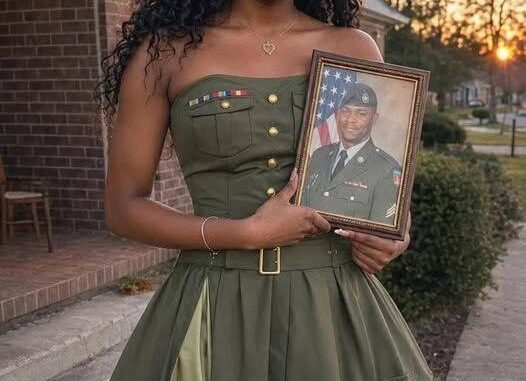
Prom night was never something I looked forward to.
It wasn’t supposed to be a big moment for me—just another evening to get through quietly, smile when necessary, and return home as soon as it was over.
But that plan changed the moment I walked down the stairs.
I was wearing a dress I had made myself. It wasn’t bought from a store or designed to impress anyone. It was stitched carefully from my late father’s old military uniform.
Every piece of fabric carried meaning. Every seam reminded me of him.
He had been the one who taught me how to sew when I was younger. Back then, life still felt stable. Home still felt like home. Before everything changed.
After he passed away, the silence in our house became heavier. Not peaceful—just empty. I learned to keep my head down, to stay unnoticed, and to move through each day without drawing attention to myself.
At night, I worked on the dress slowly and carefully. It became something personal, almost like a way of holding onto him. Not just clothing—but memory, comfort, and connection stitched into one.
When I finally finished it, I knew it wasn’t meant to impress anyone. It was simply the last piece of him I still had.
When I stepped into the living room, the reaction was immediate.
My stepmother’s expression tightened. My stepsisters exchanged looks before breaking into quiet laughter—enough to make me feel smaller without a single loud word being spoken.
One of them finally spoke. “Is that what you’re wearing?”
I didn’t answer. I couldn’t. I already knew nothing I said would matter in that moment.
Then there was a knock at the door.
Everything paused.
My stepmother opened it, and a man stood outside in a formal uniform. His presence was calm but serious, and the atmosphere in the room shifted immediately.
He asked for me by name.
Everyone turned to look.
He handed me an envelope.
Inside were official documents—arrangements my father had made before his passing. Plans for my care, my education, and my future. Things he had prepared quietly, ensuring I would not be left without support.
My hands shook as I held the papers.
But something inside me also steadied.
For the first time in a long while, I understood something important: I was not as alone as I had been made to feel.
When I eventually walked out of that house, nothing about the building had changed—but everything felt different.
The laughter, the judgment, the silence I had lived under for so long—it no longer defined me in the same way.
That night wasn’t about a dress anymore.
It was about identity. Memory. And the quiet strength of a father who had planned ahead to protect his child, even when he knew he might not be there.
And for the first time since losing him, I didn’t feel invisible.
I felt grounded.
I felt seen.
And I felt like I could finally move forward.
I stepped outside and the night air hit differently than I expected. It didn’t feel cold in the way I remembered—it felt open. Like something had been unlocked inside me that I didn’t even realize had been sealed shut for years.
The man in uniform stayed only long enough to confirm I understood everything in the envelope. He didn’t say much beyond what was necessary. But there was something in his eyes that felt understanding, almost gentle, like he had seen moments like this before—moments where people received not just documents, but a kind of permission to breathe again.
When he left, I stood on the porch for a long time.
Behind me, I could still hear faint laughter from inside the house. It had resumed as if nothing important had happened. As if I was still the same person who walked in hours earlier.
But I wasn’t.
I looked down at the dress again. The fabric didn’t feel like something fragile anymore. It felt steady. Like armor that had been softened by memory rather than hardened by fear.
For so long, I had believed that what people thought of me in that house defined me. Every comment, every glance, every dismissive laugh had slowly shaped how small I allowed myself to become. I didn’t even notice it happening—it was gradual, like water wearing down stone.
But now, standing there with my father’s last arrangement in my hands, something shifted.
It wasn’t sudden confidence. It wasn’t some dramatic transformation.
It was quieter than that.
It was the realization that I didn’t need permission to exist fully.
I walked down the steps slowly, not rushing, not hiding, not shrinking. For the first time, I wasn’t trying to make myself smaller to avoid discomfort in others.
At the edge of the yard, I paused and looked back at the house. It didn’t look different. The windows still glowed. The same voices still carried through the walls.
But I understood something I hadn’t before: a place can feel like home to others and still never be home to you.
And that was okay.
Because home wasn’t something I was going to keep searching for inside people who never made space for me. It was something I would build differently from here on out—with my own boundaries, my own choices, and the memory of someone who had loved me enough to prepare for a future he might never see.
I folded the envelope carefully and held it against my chest for a moment.
Then I turned away.
Each step down the street felt lighter than the last, not because the world had changed, but because I had.
And somewhere in that quiet walk forward, I finally understood something simple but life-changing:
I wasn’t leaving because I was rejected.
I was leaving because I was ready.
Leave a Reply