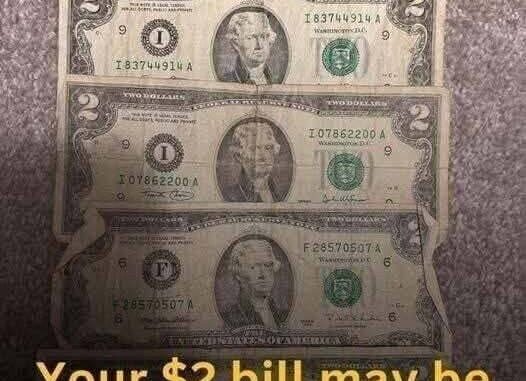
For decades, the $2 bill has carried a strange reputation.
Some people considered it unlucky.
Others treated it like fake money.
Many tucked them away in drawers, wallets, or old envelopes simply because they looked unusual compared to everyday cash.
But what most people never realized is that some $2 bills can actually be worth far more than their face value.
In some cases, collectors have paid hundreds—or even thousands—of dollars for rare versions hiding quietly in ordinary homes across America.
And the surprising part?
Many people still have them without knowing what to look for.
The Curious Reputation of the $2 Bill
The $2 bill has always stood apart from other U.S. currency.
Because it appears less frequently in circulation, generations of Americans began treating it almost like a novelty rather than real money. Over time, myths and superstitions followed.
Some people believed carrying one brought bad luck.
Others thought they were no longer printed.
Some even refused to accept them in stores because they seemed suspicious or unfamiliar.
But despite the rumors, the $2 bill has never disappeared completely.
In fact, the U.S. Treasury still prints them today.
They simply circulate less often than other bills, which gives them an unusual mystique that continues to fascinate collectors and casual observers alike.
Why Some $2 Bills Are Valuable
Not every $2 bill is worth a fortune.
Many are still only worth two dollars.
But certain features can dramatically increase a bill’s collector value, especially when combined with rarity and excellent condition.
Collectors usually focus on several key factors:
Rare Series Years
Older bills are often more valuable, particularly those printed decades ago.
Some highly sought-after years include:
- 1862
- 1890
- 1928
- 1953
- 1963
- Early 1976 Bicentennial editions
The older and rarer the series, the greater the potential value.
Fancy Serial Numbers
One of the biggest factors collectors look for is the serial number printed on the bill.
Certain patterns can make an otherwise ordinary bill surprisingly valuable.
Collectors especially love:
- Repeating numbers
- Low serial numbers
- Ladder patterns (12345678)
- Solid numbers (77777777)
- Radar numbers that read the same backward
- Binary patterns using only two digits
A rare serial number can sometimes turn a $2 bill into a serious collector’s item overnight.
Printing Errors Increase Value
Mistakes made during printing can also raise a bill’s value dramatically.
Examples include:
- Misaligned printing
- Ink smears
- Double prints
- Missing seals
- Off-center cuts
Because these errors are uncommon, collectors often pay premium prices for authentic examples.
Condition Matters More Than People Think
A crisp, uncirculated bill is usually worth far more than one that has been folded repeatedly or damaged over time.
Collectors often describe condition using terms like:
- Poor
- Fine
- Extremely Fine
- About Uncirculated
- Mint Condition
Even common $2 bills can become significantly more valuable if preserved in pristine condition.
That’s why many collectors store rare bills inside protective sleeves to prevent damage.
The 1976 $2 Bill Craze
One of the most recognizable modern versions is the 1976 Bicentennial $2 bill.
Released to celebrate America’s 200th birthday, these bills featured a redesigned reverse side showing the signing of the Declaration of Independence.
Many people saved them believing they would become valuable someday.
Today, most circulated 1976 bills are still only worth slightly above face value.
However, uncirculated versions, star notes, rare serial numbers, or printing errors can sometimes sell for much higher amounts.
What Is a “Star Note”?
Some bills contain a small star symbol at the end of the serial number.
These are known as replacement notes, printed to replace damaged bills during production.
Because fewer star notes are produced, collectors often seek them out.
Depending on rarity and condition, star notes can command strong prices in collector markets.
Why People Still Love Collecting Currency
Money collecting—also known as numismatics—is about far more than profit.
For many collectors, old bills represent pieces of history.
A single $2 bill may have passed through:
- Decades of American commerce
- Historic events
- Family generations
- Forgotten wallets and old cash registers
Each crease, stamp, or signature can feel like part of a larger story.
That emotional connection is part of what keeps rare currency so fascinating.
Could You Have One Worth Money?
Many valuable bills are discovered accidentally.
People often find them:
- Inside inherited collections
- In old family photo albums
- Hidden inside books
- In forgotten drawers
- Inside birthday cards or envelopes
- Mixed into ordinary cash
That’s why experts recommend taking a closer look before spending any unusual bill casually.
A quick inspection could reveal something surprisingly valuable.
How to Check Your $2 Bill
If you find a $2 bill, examine:
- The series year
- The serial number
- Any unusual printing features
- Whether it includes a star note
- Its overall condition
Even if the bill is not extremely rare, it may still carry modest collector value beyond face value.
The Psychology Behind the Mystery
Part of the $2 bill’s appeal comes from rarity in everyday life.
Because people rarely see them, they feel mysterious.
That mystery creates curiosity.
And curiosity creates collectibility.
Over time, the bill developed an identity larger than its actual denomination—a piece of American culture surrounded by myths, stories, and superstition.
A Small Bill With a Big Reputation
The irony is hard to ignore:
For years, people avoided the $2 bill because they thought it was strange or unlucky.
Yet some versions are now worth far more than ordinary currency sitting in circulation every day.
The same bill people once stuffed into junk drawers or ignored at cash registers has quietly become one of the most talked-about pieces of collectible U.S. money.
Final Thoughts
Most $2 bills are still worth exactly two dollars.
But certain rare examples—with unusual serial numbers, printing mistakes, old series dates, or pristine condition—can become surprisingly valuable to collectors.
That’s why experts recommend checking carefully before spending one casually.
Because hidden among ordinary currency could be:
- A rare collector’s item
- A forgotten historical piece
- Or even a small fortune hiding in plain sight
So the next time you come across a $2 bill, don’t dismiss it too quickly.
You may be holding far more than just pocket change.
Leave a Reply