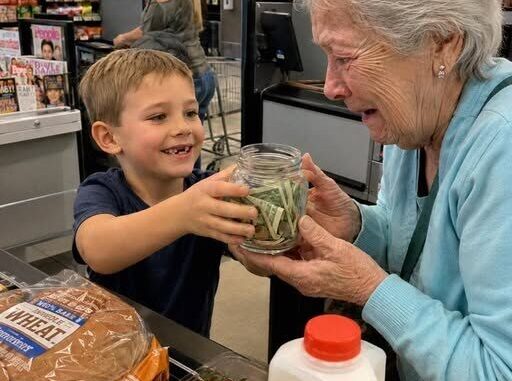
As a parent, I’ve experienced countless moments that filled me with pride, but one ordinary trip to the grocery store became a memory I will carry for the rest of my life. What happened afterward was so unexpected, so deeply moving, that even years later I still find myself thinking about it.
My son, Eli, was six years old when he lost his front tooth.
Like most children his age, he was excited about the visit from the Tooth Fairy. But unlike many kids, he wasn’t dreaming about toys or candy. He was fascinated by the money.
The Tooth Fairy had left him four dollar bills and seventy-five cents in coins.
To an adult, it wasn’t much.
To Eli, it was a fortune.
He carefully stored every penny inside an old mason jar that sat on his nightstand. Every evening before bed, he would dump the contents onto his blanket, count everything with great concentration, and proudly announce the total.
“Four dollars and seventy-five cents!”
Then he’d carefully place every coin and dollar bill back into the jar before falling asleep.
My husband Ryan and I thought it was adorable.
That little jar quickly became his treasure chest.
The following Saturday, I planned a routine grocery trip.
Nothing special.
Just milk, bread, vegetables, and a handful of items we’d forgotten during the week.
As I gathered my purse and keys, Eli suddenly ran through the front door clutching the jar.
“Just in case,” he said.
I laughed.
“Just in case what?”
He shrugged with the confidence only a six-year-old can possess.
“You never know.”
I smiled and buckled him into his car seat.
At the time, it felt like one of those random childhood moments that would be forgotten by the end of the day.
Looking back, that was the moment everything began.
The grocery store was crowded.
Families pushed carts through busy aisles. Children argued about snacks. Cashiers worked quickly to keep lines moving.
Eli happily helped me shop.
He selected apples.
Debated cereal choices.
Spent several minutes explaining why one yogurt flavor was clearly superior to every other option.
It was a perfectly ordinary afternoon.
Eventually we reached the checkout lanes.
I was tired and ready to go home.
That’s when we noticed her.
Standing directly ahead of us was an elderly woman.
She appeared to be somewhere in her late sixties or early seventies. Her silver hair was neatly combed, and she carried herself with quiet dignity.
At first glance, there was nothing unusual about her.
Then I noticed her eyes.
She was trying very hard not to cry.
The cashier scanned her groceries.
A loaf of bread.
Milk.
A small container of strawberries.
Nothing extravagant.
Nothing unnecessary.
Then came the beep.
The card was declined.
The cashier tried again.
Another beep.
The woman’s shoulders sagged.
She swallowed hard and stared at the card reader.
“I’m so sorry,” she whispered. “I thought I had enough.”
The cashier offered a sympathetic smile.
“It’s okay.”
Then she began setting items aside.
The strawberries.
The milk.
The bread.
The woman looked devastated.
Not embarrassed.
Heartbroken.
Before I could reach for my wallet, movement beside me caught my attention.
Eli.
My son had stepped forward.
At first, I assumed he was simply curious.
Then I saw the mason jar in his hands.
My stomach dropped.
“Eli…” I said softly.
But he was already moving.
He approached the conveyor belt and carefully placed the jar down.
The entire checkout area seemed to fall silent.
The cashier stopped.
The woman stared at him.
Even people in neighboring lines turned to watch.
Eli looked up at her with complete sincerity.
“I have four dollars and seventy-five cents,” he said.
Then he pointed toward the strawberries.
“Is that enough?”
For a moment, nobody spoke.
The woman stared at him.
Then her face crumpled.
Tears spilled freely down her cheeks.
Slowly, she knelt in front of him.
“Oh, sweetheart…”
She wrapped her arms around him.
The hug was so tight that it caught me off guard.
For a brief second, I considered stepping forward.
Instead, I watched my son hug her back.
The woman began crying openly.
“Thank you,” she whispered.
Then she repeated it.
Again.
And again.
Her voice breaking every time.
“You don’t understand what you’ve done for me.”
The cashier wiped away tears.
Someone behind us sniffled.
My own throat tightened.
Eventually, the woman stood.
The cashier accepted Eli’s money.
The strawberries remained with her groceries.
A few minutes later, she left the store carrying her bags.
I watched her disappear through the automatic doors.
Something about the entire interaction stayed with me.
It felt bigger than a few dollars.
Bigger than strawberries.
Bigger than a simple act of kindness.
But I couldn’t explain why.
As we walked toward the parking lot, I glanced down at Eli.
“That was all your Tooth Fairy money.”
He shrugged.
“She needed it more.”
There was nothing else to say.
I squeezed his shoulder and drove us home.
I assumed the story ended there.
I was wrong.
Life returned to normal.
Sunday passed.
Then Monday.
By Tuesday morning, I had almost forgotten about the woman entirely.
I was making coffee when I remembered the mailbox.
The morning air was cool and quiet.
Ryan had already left for work.
Eli sat at the kitchen counter eating cereal.
I opened the front door.
And froze.
Something was sitting on our welcome mat.
At first, I couldn’t make sense of what I was seeing.
Then I stepped outside.
It was a suitcase.
An old, deep-red leather suitcase with worn edges and faded corners.
It looked ancient.
Attached to the handle was an envelope.
Written across the front in shaky handwriting was a single name.
Eli.
My heartbeat quickened.
Then I heard it.
Tick.
Tick.
Tick.
The sound was faint but unmistakable.
And it was coming from inside the suitcase.
Every instinct immediately went on alert.
My stomach tightened.
Behind me, Eli appeared in the doorway.
“Mom?”
I raised a hand instantly.
“Stay inside.”
His eyes widened.
“Why?”
“Just stay back.”
The ticking continued.
I pulled out my phone and called Ryan.
As calmly as possible, I explained the situation.
After listening, he asked a simple question.
“Did you read the envelope?”
“No.”
“Then read it.”
I hesitated.
Then slowly stepped forward.
The handwriting didn’t look threatening.
It looked sad.
Careful.
Deliberate.
With trembling fingers, I opened the envelope.
Then I unlocked the suitcase.
The ticking grew louder.
I lifted the lid.
And immediately exhaled.
Inside was no bomb.
No danger.
Just an old brass clock.
Its hands moved steadily.
Tick.
Tick.
Tick.
Surrounding it were toys.
Books.
A teddy bear.
Several toy cars.
Everything had been packed with extraordinary care.
Confused, I unfolded the letter.
The very first sentence drained the color from my face.
“Your son saved my grandson that day.”
I stared.
Then read it again.
The letter continued.
“My name is Margaret. I am the woman from the grocery store.”
Suddenly everything felt different.
I sat down right there on the porch and kept reading.
Margaret explained that she hadn’t been buying groceries only for herself.
She had been shopping for her grandson, Leo.
A seven-year-old boy who was gravely ill.
For months, she had cared for him alone.
His parents were no longer present in his life.
Leo was everything she had.
According to the letter, that grocery trip had been one of the hardest days she’d ever experienced.
That morning, Leo had asked for one thing.
Strawberries.
His favorite food.
By then, illness had stolen much of his appetite.
Most foods upset his stomach.
But for some reason, he couldn’t stop talking about strawberries.
Margaret rushed to the store, believing she had enough money.
She didn’t realize medical payments had emptied her account overnight.
Leave a Reply