Long before she ever stepped onto a real dock, June Prescott had been dreaming about boats.
She grew up in a small Mississippi town surrounded mostly by dry fields, cracked roads, and long stretches of farmland where the closest thing to open water was a muddy pond that shrank every summer beneath the heat.
Yet somehow, from the time she was old enough to hold crayons, she drew boats constantly.
Small boats.
Large boats.
Fishing boats.
Sailboats with crooked masts and uneven sails.
Every drawing showed movement — people heading somewhere, leaving something behind, chasing something beyond the edge of the page.
At the time, nobody thought much about it.
Children draw strange things all the time.
But years later, June would look back and wonder if some part of her had been searching for the water long before she understood why.
A Childhood Marked by Sudden Loss
June’s childhood changed permanently when she was eleven years old.
Her mother died unexpectedly after suffering a sudden medical emergency at home.
One week life felt ordinary.
By the next, everything inside their house had shifted into silence.
For weeks afterward, the kitchen still carried the faint smell of tomato sauce from the last dinner her mother cooked before being taken to the hospital.
June never decided whether that smell felt comforting or heartbreaking.
Maybe both.
Loss has a strange way of attaching itself to ordinary details.
A scent.
A chair.
A hallway.
A favorite song playing unexpectedly in a grocery store years later.
After her mother’s passing, the entire emotional atmosphere of the household changed.
Especially her father.
The Quietness That Took Over the House
June’s father, Cal Prescott, worked maintenance at the local high school.
He was not a cruel man.
He wasn’t angry or abusive.
In many ways, that made the situation harder to explain.
He simply became emotionally distant in a way that slowly spread through the house like winter frost across glass.
Before losing his wife, he had been quiet but present.
Afterward, something inside him seemed to shut down permanently.
Conversations became shorter.
Silences grew longer.
Emotion disappeared from the rooms almost entirely.
Neighbors often said:
“He’s doing his best.”
And perhaps he was.
But grief can hollow people out so gradually that even they don’t notice it happening.
By the time June reached seventeen, she had stopped trying to pull him emotionally back into her life.
Not because she stopped loving him.
But because repeated emotional disappointment eventually becomes exhausting.
Discovering the Marine Supply Store
At sixteen, June took a job at a marine supply store outside Jackson.
The commute took nearly an hour by bus each direction, but she didn’t mind.
The moment she first walked through the doors of the store, something inside her clicked into place.
The entire building smelled faintly of rope, motor oil, old wood, and salt air despite being hundreds of miles from the nearest coastline.
To most people, it was simply a cluttered shop selling fishing equipment and boat supplies.
To June, it felt like possibility.
For the first time in years, she felt genuinely curious about the future again.
The Man Who Noticed Her Potential
The store owner, a former Coast Guard rescue swimmer named Thad Mercer, quickly noticed something different about June.
She asked questions constantly.
Not performative questions meant to impress adults.
Real questions.
She wanted to understand how engines worked.
How hulls were repaired.
Why certain knots held under pressure while others slipped.
Why marine wood rotted differently than standard lumber.
Most teenagers treated the job like temporary work.
June treated it like education.
And Thad respected that immediately.
Learning a Different Kind of Life
Over the next several years, Thad taught June skills most people her age never considered learning.
She learned:
- Basic engine maintenance
- Hull patching and fiberglass repair
- Rope work and knot systems
- Dock safety
- Electrical wiring basics
- Water pump repair
- Marine navigation terminology
More importantly, she learned confidence.
For the first time since her mother died, an adult looked at her not with pity or obligation, but with genuine belief in her capabilities.
That changed something fundamental inside her.
Becoming Homeless at Nineteen
Shortly after turning nineteen, June’s life shifted again.
Her father announced he planned to move in with relatives out of state after losing the house financially.
There was no dramatic fight.
No screaming.
Just exhaustion.
He offered to let June come with him, but by then their relationship felt more like two strangers sharing grief than family sharing connection.
So she stayed behind.
At nineteen years old, with little savings and nowhere permanent to go, June quietly became homeless.
For several weeks, she slept in her aging car behind the marine supply store.
Thad knew almost immediately, though she tried hiding it.
The Rusted Houseboat
One rainy afternoon, Thad mentioned an abandoned houseboat sitting near an old marina outside town.
Technically, it barely qualified as livable.
The hull needed repair.
The windows leaked.
Rust covered nearly every metal surface.
Most people considered it junk.
The owner simply wanted it gone.
Price:
ten dollars.
When June first stepped aboard, the floor creaked dangerously beneath her boots.
Rainwater dripped through part of the ceiling.
The cabin smelled damp and abandoned.
But beneath the damage, she saw something others didn’t.
Potential.
Freedom.
A place that could become hers.
So she handed over ten wrinkled dollars and bought the houseboat.
Building a Home From Almost Nothing
The first weeks aboard were brutal.
The boat had no reliable electricity.
No proper heating.
And barely functioning plumbing.
June spent nights bundled beneath blankets listening to wind hit the sides of the hull while wondering whether she had made the worst decision of her life.
But every day after work, she repaired something.
A pipe.
A window frame.
A section of flooring.
Slowly, the broken boat began transforming.
And in many ways, so did she.
Why Water Felt Different to Her
Something about life near the water calmed June emotionally in a way land never had.
The marina carried a rhythm unlike the silence of her childhood home.
Water moved constantly.
Boats arrived and departed.
Nothing remained frozen emotionally the way grief had frozen her father.
Even difficult days felt temporary beside the movement of tides and weather.
For the first time in years, she no longer felt trapped inside someone else’s sadness.
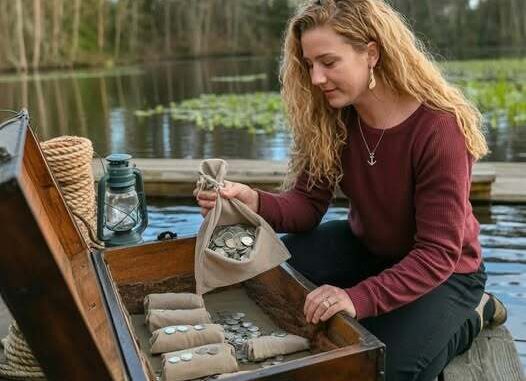
The Hidden Compartment
Several months after moving aboard, June began repairing part of the lower cabin flooring damaged by water.
While removing warped boards near an old storage bench, she discovered something unexpected underneath.
A hidden compartment.
At first, she assumed it was ordinary storage space.
But inside sat several carefully sealed metal boxes protected from moisture.
And what she found inside would completely change her understanding of the boat’s history — and eventually her own future.
The Discovery Nobody Expected
Inside the containers were journals, photographs, navigation maps, and handwritten letters dating back decades.
The boat had once belonged to a retired marine biologist named Arthur Bennett who spent years documenting coastal ecosystems and river restoration projects throughout the Gulf region.
The journals contained detailed observations, sketches, photographs, and personal reflections spanning nearly twenty years.
But that wasn’t the most surprising part.
Tucked between the papers were also legal documents connected to a long-forgotten conservation trust fund established before Arthur’s death.
A fund no one had apparently claimed.
Why the Journals Mattered So Much
Most people might have focused immediately on the possibility of financial value.
But June became fascinated by the journals themselves first.
Arthur wrote about water the way poets write about love.
He described rivers, wetlands, storms, and marine life with extraordinary care and emotional depth.
For someone who spent most of her life emotionally disconnected from the world around her, reading those journals felt transformative.
They reminded her that people could dedicate entire lives to protecting fragile things rather than simply surviving them.
The Unexpected Opportunity
With legal assistance arranged through marina contacts, June eventually learned that the trust connected to Arthur Bennett’s research had become dormant after administrative failures and missing heirs.
After a lengthy legal process involving the boat ownership transfer and historical records, portions connected to the abandoned materials were eventually awarded legally through settlement arrangements.
The financial amount wasn’t enormous by celebrity standards.
But to a nineteen-year-old former homeless girl living on a repaired houseboat, it felt life-changing.
More Than Just Money
Ironically, the discovery changed June’s life less through wealth and more through direction.
Inspired by Arthur’s journals, she eventually enrolled in environmental science courses while continuing marina work.
Years later, she began working with coastal restoration projects and marine conservation programs across the Gulf Coast.
The abandoned houseboat became not just shelter, but the unexpected starting point for an entirely different future.
Why the Story Resonates With So Many People
People connect deeply with stories like June’s because they reflect something universal:
the idea that hope sometimes appears in unlikely places.
An abandoned boat.
A hidden compartment.
A second chance arriving quietly rather than dramatically.
Life rarely changes all at once through perfect cinematic moments.
More often, transformation begins with small decisions:
- Taking a difficult job
- Learning new skills
- Repairing broken things slowly
- Refusing to give up completely
June’s story reflects that kind of quiet resilience.
The Boat That Became Home
Years later, June kept the restored houseboat long after she could afford better living situations.
Friends often asked why.
Her answer remained simple:
“Because it saved me first.”
And perhaps that was true.
The rusted old vessel gave her shelter during the loneliest period of her life.
But it also gave her purpose.
Direction.
And proof that damaged things can still carry extraordinary value beneath the surface.
What She Learned About Survival
Looking back, June eventually realized survival isn’t always dramatic.
Sometimes survival looks like:
- Learning skills quietly
- Showing up to work exhausted
- Repairing things one piece at a time
- Continuing forward despite uncertainty
The abandoned boat mirrored her own life in many ways.
Weathered.
Neglected.
Misjudged.
Yet still capable of carrying something meaningful forward.
The Discovery That Changed Everything
Most people would have walked away from the rusted houseboat immediately.
It leaked.
It creaked.
It looked hopeless.
But June saw possibility where others saw failure.
And because of that, she discovered far more than hidden documents beneath damaged floorboards.
She discovered an entirely new future for herself.
One built not on perfect beginnings, but on resilience, curiosity, and the courage to believe broken things can still become beautiful again.
And somehow, in the end, that may have been the greatest discovery hidden inside the boat all along.
Leave a Reply