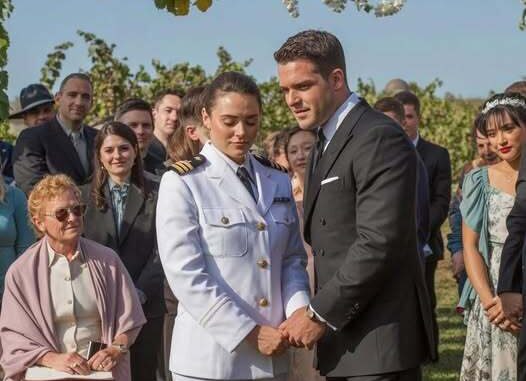
I never intended for my wedding day to become a defining moment in my relationship with my mother.
Honestly, I wanted the exact opposite.
After years in the military, I had learned to appreciate order, preparation, and simplicity. I planned the wedding the same way I approached everything else in life: carefully, intentionally, and without unnecessary drama.
The ceremony took place at a vineyard just outside Fayetteville, North Carolina, in late October. The weather was perfect — crisp air, golden light stretching across the fields, and the kind of sunset photographers dream about capturing.
Marcus stood waiting at the altar wearing a tuxedo and the same joyful grin he wore whenever he was genuinely happy. Which, thankfully, was often.
I wore my formal military dress uniform.
Every ribbon aligned perfectly.
Every detail pressed and prepared.
It wasn’t a political statement.
It wasn’t for attention.
It was simply who I was.
What I didn’t prepare for was my mother’s reaction.
The Walk Down the Aisle
The moment I turned the corner at the far end of the vineyard aisle, I saw her immediately.
Not because she stood out visually.
But because I recognized her expression instantly.
My mother, Eleanor Turner, sat in the third row leaning toward my aunt Diane with one hand partly covering her mouth.
She was laughing.
Not nervous laughter.
Not emotional laughter.
Real laughter.
The kind that comes from genuine disbelief.
Even from that distance, I could read her lips perfectly. After thirty-seven years, I had become an expert at understanding her expressions long before words fully formed.
“She really showed up dressed like that.”
I kept walking.
Years of emotional discipline made that possible.
Because when you grow up learning how to remain composed around criticism, eventually composure becomes instinct.
My Mother Wasn’t a Cruel Person — Just a Difficult One
To understand what happened that day, you need to understand my mother.
She wasn’t openly cruel.
She wasn’t dramatic or explosive.
In many ways, she was admired by nearly everyone around her.
Eleanor Turner was intelligent, polished, organized, and deeply invested in appearances. She worked for years as a private school administrator in Connecticut and carried herself with the kind of confidence that made people instinctively straighten their posture when she entered a room.
She believed strongly in standards.
Presentation mattered.
Image mattered.
Success mattered.
And somewhere along the way, she developed a very specific idea of what my life was supposed to look like.
The military had never been part of that vision.
The Daughter She Expected
Growing up, my mother imagined I would become something elegant and traditionally impressive.
A lawyer.
A professor.
Perhaps a diplomat.
Something polished and intellectually prestigious.
Instead, I joined the military at twenty-two.
To her, it felt like rejection.
Not simply of career expectations — but of the entire world she had carefully constructed around achievement and social perception.
She never openly forbade my choice.
That would have been too direct.
Instead, she perfected a quieter form of disapproval.
Subtle comments.
Raised eyebrows.
Polite silence.
The occasional carefully worded criticism disguised as concern.
Over time, I learned that disappointment can be communicated very effectively without raising one’s voice.
Why the Uniform Mattered to Me
My uniform represented far more than employment.
It represented years of sacrifice, discipline, leadership, exhaustion, growth, and responsibility.
It represented deployments, long nights, difficult decisions, and the people beside whom I had served.
Every insignia carried meaning.
Every ribbon reflected experiences most civilians would never fully understand.
Wearing that uniform on my wedding day felt deeply personal because it acknowledged the life that shaped me into the person standing at the altar beside Marcus.
I wasn’t wearing it to impress anyone.
I wore it because I was proud of the path I had chosen.
Even if my mother never fully understood it.
The Silence Beside Me
As I continued walking down the aisle, Captain Reyes walked beside me as part of the wedding procession.
Without looking directly at me, she quietly whispered:
“You okay?”
Military people develop a unique ability to notice tension without openly reacting to it.
I answered the only way I could.
“Keep moving.”
So we did.
The Ceremony Continued Beautifully
Despite the moment with my mother, the ceremony itself was beautiful.
Marcus looked at me with complete certainty — the kind that steadies you instantly.
Our vows were personal, imperfect, and honest.
The vineyard glowed beneath the fading autumn sunlight while guests listened quietly.
And for most of the ceremony, I successfully pushed my mother’s comments out of my mind.
Almost.
But pain has a strange way of lingering quietly beneath important moments.
The Reception Conversation
The real turning point came later during the reception.
The atmosphere had softened into warmth and celebration. Glasses clinked, music drifted across the outdoor terrace, and guests moved between conversations and dancing.
I was speaking with several service members near one of the tables when my mother approached holding a champagne glass.
At first, her expression looked calm.
Then she glanced toward my uniform again.
And she said, casually enough for only nearby people to hear:
“I still think it’s unfortunate you chose to wear that instead of looking like an actual bride.”
The conversation around us stopped instantly.
Thirty-Seven Years of Practice
Some people imagine moments like this trigger dramatic emotional reactions.
But that’s rarely how emotionally complicated family relationships work.
When criticism becomes familiar over decades, you don’t explode.
You go quiet.
Very quiet.
Because part of you already expected it.
I looked at my mother for several seconds without speaking.
And honestly, I think what hurt most wasn’t the insult itself.
It was the timing.
Even here.
Even now.
Even on my wedding day.
She still couldn’t separate her expectations from my happiness.
What Marcus Did Next
Before I could respond, Marcus stepped beside me.
He gently placed his hand against the small of my back — not controlling, not performative, simply supportive.
Then he looked directly at my mother and said calmly:
“She looks exactly like a bride to me.”
Simple.
Quiet.
Certain.
And somehow, that brief sentence carried more emotional protection than all the arguments I’d imagined having over the years.
The Unexpected Moment That Followed
What happened next was something I never could have planned.
One of Marcus’s former military colleagues, seated nearby, quietly stood up.
Then another person stood.
Then another.
Within seconds, dozens of service members throughout the reception area rose to their feet simultaneously.
Men and women from different branches.
Different ranks.
Different backgrounds.
Some in uniform.
Some in civilian clothes.
All standing silently.
The movement spread across the vineyard until hundreds of guests were standing together in complete quiet.
No speeches.
No shouting.
No confrontation.
Just visible respect.
The Power of Silent Support
The silence became overwhelming in the most emotional way possible.
Nobody needed to explain what the gesture meant.
The people standing understood something my mother never fully grasped:
The uniform was not a costume.
It represented service.
Sacrifice.
Responsibility.
Commitment.
And for those who wore it or served beside those who did, it carried emotional meaning far beyond appearance.
I suddenly realized I wasn’t standing alone at all.
My Mother’s Expression Changed
For the first time that entire day, my mother looked uncertain.
Not embarrassed exactly.
More surprised.
As though she had suddenly realized the room saw something very differently than she did.
She looked around slowly at the people standing.
At the veterans.
At the active-duty service members.
At the spouses and families who understood military life intimately.
And I think, perhaps for the first time, she recognized that my life carried dignity even if it did not resemble the version she originally imagined.
Why the Moment Mattered So Much
The standing ovation wasn’t about revenge or humiliation.
That’s important.
No one was attacking my mother.
No one shouted at her.
The moment mattered because it represented validation.
For years, I quietly carried the feeling that my accomplishments existed slightly outside my mother’s approval system.
The military was always treated as “less than” the futures she envisioned for me.
But in that vineyard, surrounded by people who understood service deeply, I finally stopped needing her permission to feel proud of my life.
The Reality of Military Families
Military service shapes not only careers, but identities.
Service members miss holidays, birthdays, anniversaries, and ordinary life moments many civilians take for granted.
Families carry constant uncertainty.
Relationships survive distance, stress, relocation, and sacrifice.
Uniforms represent all of that history.
That’s why so many military weddings include dress uniforms — not for spectacle, but for meaning.
The uniform reflects the path both partners agree to walk together.
Marcus understood that completely.
Which is one reason I married him.
My Mother and I Finally Talked Honestly
Later that evening, after many guests had left, my mother approached me privately.
For once, neither of us hid behind politeness.
She admitted she worried the military had hardened me.
I admitted her constant disappointment had hurt me for years.
The conversation wasn’t magically healing.
Real family dynamics rarely resolve in one emotional speech.
But it was honest.
And honesty, even delayed honesty, matters.
What I Realized That Night
Standing there in my dress uniform beneath string lights and autumn sky, I understood something important:
Not everyone will understand your choices.
Even the people who love you sometimes struggle to accept lives that look different from what they expected.
But misunderstanding does not invalidate your path.
And pride does not require universal approval.
Why the Standing Ovation Still Stays With Me
Years later, people still ask about that moment at the wedding.
They expect me to describe it as dramatic.
But honestly, what I remember most is the feeling.
The feeling of being seen clearly.
Not as someone’s disappointing daughter.
Not as a woman failing to fit expectations.
But as myself.
Fully.
Without apology.
And surrounded by people who understood exactly why that mattered.
The Difference Between Image and Identity
My mother spent much of her life focused on appearances, presentation, and social expectations.
The military taught me something entirely different.
Identity is built through actions.
Through loyalty.
Through resilience.
Through showing up for people even when circumstances are difficult.
No elegant dress could have represented my life more honestly than the uniform I wore that day.
And eventually, I stopped feeling the need to explain that.
A Wedding I’ll Never Forget
When I think back on my wedding now, I don’t focus on the criticism anymore.
I remember Marcus smiling at the altar.
I remember autumn light across the vineyard.
I remember Captain Reyes walking beside me in silent support.
And most of all, I remember the sound of hundreds of chairs moving at once as service members rose quietly to their feet.
Not because I demanded respect.
But because they understood what the uniform meant.
And in that moment, after years of feeling misunderstood by the person whose approval I chased longest, I finally understood something freeing:
I never needed permission to be proud of who I became.
Leave a Reply