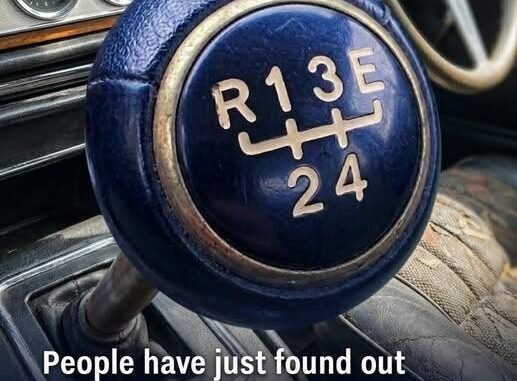
Modern cars are packed with advanced technology, from digital dashboards to intelligent driving systems that handle many tasks automatically. But decades ago, driving was far more mechanical, and every gear selection played a direct role in how a vehicle performed on the road.
Alongside the familiar letters like “P” for Park, “R” for Reverse, and “D” for Drive, some older cars featured another symbol that many younger drivers may not recognize today: the letter “E.” While it may have looked mysterious, its meaning was actually very simple. The “E” stood for “Economy,” a driving mode designed to improve fuel efficiency.
During the 1970s, 1980s, and early 1990s, fuel economy became an increasingly important concern for both drivers and car manufacturers. Rising gas prices and fuel shortages pushed automakers to look for ways to reduce fuel consumption while still maintaining comfort and reliability. One of the solutions introduced in certain vehicles was the Economy mode.
When a driver selected “E,” the car’s transmission changed its shifting behavior. Instead of allowing the engine to rev higher before switching gears, the transmission shifted earlier and more smoothly. This helped keep engine speeds lower, which reduced fuel usage and created a quieter, more relaxed driving experience.
Cars operating in Economy mode typically felt less aggressive compared to normal driving settings. Acceleration became gentler because the vehicle prioritized efficiency rather than quick bursts of power. Drivers who wanted stronger performance or faster acceleration could switch to another mode, while “E” was mainly intended for everyday commuting and long-distance travel.
For many motorists at the time, this feature represented one of the first opportunities to actively choose between fuel savings and performance. Rather than the vehicle making every decision automatically, drivers could control how the car behaved depending on their needs.
Some manufacturers added even more features to Economy mode. In certain models, the throttle response was adjusted so the car reacted more gradually when the accelerator pedal was pressed. This encouraged smoother driving habits that naturally consumed less fuel over time.
Back then, these systems were considered innovative. Unlike today’s vehicles, older cars relied heavily on mechanical engineering rather than advanced computers and sensors. Drivers could physically feel the difference when changing modes, making the experience more interactive and hands-on.
As automotive technology improved, however, the dedicated “E” setting slowly disappeared from many vehicles. Modern transmissions became far more intelligent, capable of adjusting gear changes automatically based on speed, road conditions, throttle input, and engine load. Cars no longer needed a separate gear position solely focused on economy because onboard computers could optimize fuel efficiency continuously in the background.
Even though the traditional “E” position faded away, the idea behind it never truly disappeared. Many modern vehicles now include Eco driving modes controlled through buttons or touchscreen menus. These systems are far more advanced than the earlier versions, often adjusting engine performance, transmission behavior, air conditioning usage, and fuel management systems all at once to maximize efficiency.
Interestingly, the meaning of “E” has also evolved in the age of electric vehicles. In many modern EVs, the letter is associated with electric driving systems, energy-saving features, or regenerative braking functions that help recharge the battery while slowing down.
In a way, the symbol has come full circle. Decades ago, “E” represented efforts to conserve gasoline in traditional cars. Today, it is often linked to vehicles designed to reduce dependence on gasoline altogether.
The history of the “E” gear setting highlights how much automotive technology has changed over the years. Older cars required drivers to make deliberate choices about efficiency and performance, while modern vehicles handle many of those decisions automatically using sophisticated software and real-time data.
Still, many longtime drivers and classic car enthusiasts remember the original “E” with a sense of nostalgia. It serves as a reminder of a time when driving felt more mechanical and connected, when every shift and dashboard symbol carried a direct purpose.
Although modern cars are quieter, smarter, and more automated, the original goal behind the “E” remains the same: helping drivers travel farther while using less energy. Even if the physical gear position has mostly disappeared, the philosophy behind it continues to influence the vehicles being built today.
Leave a Reply