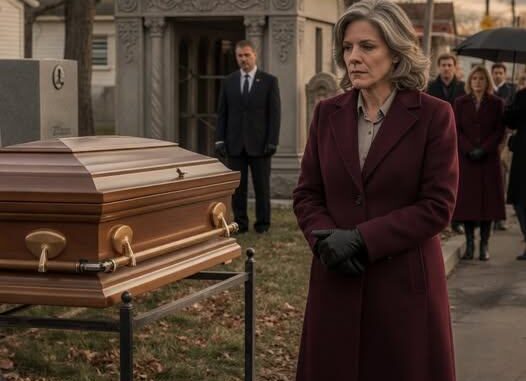
No One Came to My Husband’s Funeral—By Sunrise, I Made a Choice That Changed My Life

The house felt different that night—like it had exhaled and never taken another breath. Every corner still carried George’s presence, but without him, it was only memory filling the space. The hum of the refrigerator, the faint creak of old wood, even the ticking clock in the hallway felt louder than usual, as if the world itself was trying to compensate for the absence.

I sat at the kitchen table long after the wine had gone warm in my glass. That table had seen everything—birthdays, arguments, reconciliations, late-night conversations whispered over coffee. Now it only reflected back my solitude.

On my laptop screen, my children’s lives continued as if nothing had changed.

Peter had uploaded another post—smiling at the golf course, sunglasses tilted just right, captioning it something about “making the most of the weekend.” Celia had added a second set of brunch photos, this time showing dessert, the kind carefully arranged for attention rather than appetite.

There was no mention of George. Not a single acknowledgment. Not even a symbolic gesture.

It wasn’t just absence anymore—it was erasure.

I closed the laptop slowly, my hands steady in a way my heart was not.


What George Left Behind

Later that night, I walked through the house, touching the things he had touched without realizing it. His jacket still hung by the door. His shoes were still aligned neatly beneath the bench. Even the faint scent of his aftershave lingered in the hallway, refusing to disappear completely.

George had always believed in order—not just in his surroundings, but in people. He believed that if you raised children with love, structure, and patience, they would eventually carry those values forward.

“I don’t need perfect kids,” he once told me. “Just decent ones who show up when it matters.”

I had believed him.

Now I wasn’t so sure.

On his desk, I found the notebook he always kept for lists. Repair schedules, grocery reminders, little sketches of things he planned to fix around the house. At the bottom of the page, written in his careful handwriting just days before he passed, were three words:

I pressed my fingers against the page longer than I expected to.


The Morning After

Sleep didn’t come easily. When it finally did, it was shallow and restless, filled with fragments of memory rather than rest.

By dawn, I was awake again.

The sky outside was still dim, a pale gray that hadn’t yet decided what kind of day it wanted to become. The house was quiet, but no longer passive. Something in me had shifted overnight—quietly, but permanently.

I made coffee I didn’t want and didn’t drink.

Instead, I opened my laptop again.

This time, I didn’t scroll.

I started planning.

Not out of anger alone, and not out of grief either. It was something more precise—clarity. The kind that arrives when disappointment has finally stopped hurting and starts becoming instruction instead.

If they could live as if nothing had happened, then I would stop waiting for them to behave as if it had.


A Decision Forms

I began gathering everything—photos, messages, timestamps, the digital traces of lives lived loudly in public while remaining absent in private. Not to shame them. Not yet. But to understand the pattern.

There was something undeniable in the way absence repeated itself: missed calls, unanswered invitations, postponed visits, forgotten holidays. It wasn’t one moment. It was years of smaller choices building into something irreversible.

George had always said people reveal who they are in what they choose consistently, not occasionally.

I had seen enough.

By the time the sun finally broke through the clouds, I had already made my decision.

Not revenge.

Not confrontation.

Something quieter than both.

A line drawn at last.


The Shift

I stood by the window, watching morning light settle across the yard where George used to work with his tools scattered like extensions of his hands. For the first time in months, I didn’t feel like I was waiting for anything.

The grief was still there, but it no longer controlled the shape of the day. It had settled into something steadier—something I could carry without breaking.

I thought about my children again, not as disappointments, but as people shaped by choices they had made without realizing the cost.

And I realized something I hadn’t allowed myself to accept before:

Love doesn’t require endless access.

It requires respect.

And respect, once withdrawn too many times, eventually stops asking to be restored.


What Comes Next

I set my coffee down untouched and closed the laptop.

There was nothing dramatic about the moment. No music. No sudden realization. Just a quiet understanding that life would not continue in the same direction it had been moving for years.

George had lived with structure. With intention. With presence.

Maybe it was time I did the same—not for him anymore, but for myself.

And for the first time since the funeral, I felt something other than loss.

I felt movement.

The Line I Finally Drew

I stood there for a long time after closing the laptop, my reflection faint in the darkened screen. The house around me had begun to settle into evening silence, the kind that doesn’t feel empty so much as final.

Something in me had changed during those hours. It wasn’t loud. It wasn’t dramatic. It was more like a weight shifting from one shoulder to the other—subtle, but undeniable.

For years, I had been the person who kept everything together. The one who called first. The one who softened disappointments into understanding. The one who filled gaps no one else bothered to notice.

But that morning, standing alone after burying George, I understood something I hadn’t allowed myself to see before.

I was not responsible for carrying the emotional consequences of everyone else’s absence.

Not anymore.


A Different Kind of Morning

The next morning arrived without urgency. No buzzing phone. No incoming messages. No sudden reminders of obligations I had been silently maintaining for years.

Just stillness.

I made tea instead of coffee, almost without thinking. The simple act felt unfamiliar, like I was doing something for myself instead of for habit. I sat by the window George used to favor, where the light came in gently through the trees, and I allowed myself to just… exist.

No checking notifications.

No refreshing screens.

No waiting.

And for the first time in a long while, I noticed how much of my life had been shaped around waiting.

Waiting for calls that never came.

Waiting for visits that were always postponed.

Waiting for acknowledgment that rarely arrived in full.

George had been the only person who consistently showed up without needing to be reminded how.

Now he was gone.

And the imbalance was impossible to ignore.


The First Message I Didn’t Send

That morning, I drafted a message to Peter without sending it.

It started the way so many of our conversations had begun over the years:

“Just checking in…”

Then I stopped.

My fingers hovered over the keyboard.

I read it once, then twice.

And I deleted it.

Not out of anger.

Not out of punishment.

But because something in me finally understood that checking in on people who never checked back had become a pattern I was continuing more out of habit than hope.

I closed the laptop.

The silence that followed didn’t feel like rejection.

It felt like space.


Realizations That Don’t Come All at Once

Grief doesn’t reveal everything at once. It comes in layers, peeling back slowly, sometimes gently, sometimes painfully.

That morning, another layer surfaced.

It wasn’t just that my children hadn’t come to the funeral.

It was that I had spent years minimizing that same behavior in smaller moments.

Every missed birthday call had been excused.

Every skipped holiday had been explained away.

Every absence had been softened until it stopped feeling like absence at all.

But George’s death had stripped away the softness.

There was no longer any room to blur what had been happening.

And I couldn’t unsee it.


The House Without Apology

As the day went on, I moved through the house differently.

Not avoiding memories—but no longer apologizing for them either.

I didn’t rush past George’s chair in the living room. I didn’t turn away from his shoes by the door. I didn’t avoid the quiet hum of his absence.

Instead, I acknowledged it.

Fully.

There was a difference between living in grief and living alongside it.

For so long, I had been trapped in the first.

Now I was beginning to understand the second.


When Silence Becomes Answer Enough

By late afternoon, I checked my phone once.

There was a notification. A message from Celia.

Short. Casual.

“Hey Mom, just saw your call yesterday. Everything okay?”

No mention of George.

No acknowledgment of the funeral.

Just the kind of delayed attention that arrives only after convenience allows it.

I stared at the message for a long time.

Once, I would have responded immediately. I would have explained. Reassured. Protected her from discomfort.

But this time, I didn’t reply.

Not because I was trying to teach a lesson.

But because I finally understood that silence can be an answer too.


The Shift That Can’t Be Undone

That evening, I sat again in George’s chair—not as a replacement, not as a gesture, but simply because it was the place where the house felt most honest.

The leather still carried the imprint of his presence, faint but unmistakable. I let myself sit with that for a while, not trying to fill the space he had left behind.

Instead, I let it remain empty.

There was something grounding about that emptiness now. It no longer felt like loss alone. It felt like truth.

George had lived his life expecting consistency, effort, and presence from the people he loved.

He had given all of that in return.

And somewhere along the way, the balance had quietly disappeared.


A New Kind of Strength

As night approached, I realized I wasn’t searching for closure anymore.

Closure implies something neatly finished.

This wasn’t finished.

It was understood.

And understanding changes how you carry things, even when it doesn’t remove them.

I still loved my children.

That hadn’t changed.

But love, I was learning, did not require self-erasure.

It did not require endless pursuit.

And it did not require pretending that absence didn’t have meaning.


The First Step Forward

Before going to bed, I did something small but deliberate.

I placed George’s reading glasses on his nightstand where he always left them.

I straightened the blanket on his side of the bed.

And then, for the first time since the funeral, I turned off the light without feeling like I was leaving something unfinished behind me.

As darkness settled over the room, I realized something quietly profound.

I was no longer waiting for my children to become different people.

I was finally beginning to become someone who no longer needed them to.

Be the first to comment

Leave a Reply

Your email address will not be published.


*