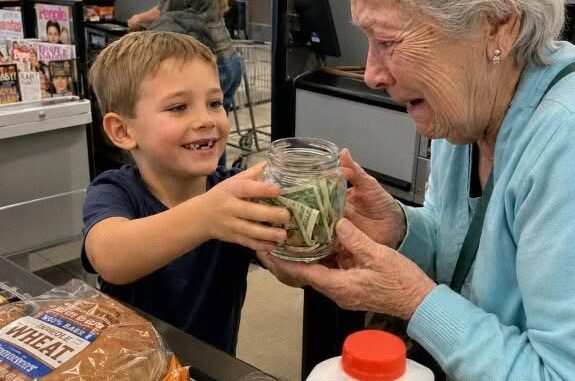
My son, Eli, six, lost his front tooth two weeks ago.
For most kids, that would’ve been the exciting part, but my son was excited about the money.
The tooth fairy left him $4.75 in four wrinkled dollar bills and three shiny quarters. He kept it all in an old jelly jar on his nightstand and treated it like a savings account.
Every night before bed, my son dumped the money onto his blanket and counted it.
“Four dollars and 75 cents,” Eli announced proudly. Then he’d put it all back into the jar and go to sleep. My husband, Ryan, and I thought it was adorable.
Last Saturday morning, I took Eli grocery shopping.
As we were heading for the car, he came running out of the house holding the jar.
“Just in case,” he said.
“Just in case what?” I asked.
“You never know,” he shrugged. I laughed and buckled him into his seat. Looking back, that was the moment the whole thing started.
The store was busy that day.
We grabbed a cart and worked our way through the aisles. Eli helped me pick apples, argued passionately about cereal, and spent five minutes deciding which yogurt flavor was objectively superior.
By the time we reached the checkout lanes, I was ready to head home.
That’s when we noticed the woman. She was probably in her late 60s, maybe early 70s. She had gray hair, a thin frame, and tears she was trying to hide.
The cashier scanned her groceries while the woman stared at the card reader. Then the machine beeped. The cashier tried again, and there was another beep.
“I’m so sorry,” the woman said quietly. “I thought I had enough.”
The cashier gave her a sympathetic look. She started setting aside items: a loaf of bread, milk, and strawberries. The woman looked devastated.
Before I could reach for my wallet, Eli stepped forward. At first, I thought he was just curious. Then I noticed the jar in his hands.
“Eli…” I whispered. But he was already moving.
He walked up to the conveyor belt and carefully set the jar down.
“I have $4.75,” he said carefully. “Is that enough for the strawberries?”
The woman stared at him. Then her face crumpled, and she dropped to her knees.
“Oh, sweetheart…” she whispered, hugging Eli tightly. “You don’t understand what you just did for me… You really don’t.”
The cashier accepted the money, and the strawberries remained in her order. She picked them up and hurried out. Eli smiled as if he’d just done something normal.
Life returned to normal.
Sunday came and went. By Tuesday morning, I had almost forgotten about the woman.
I opened the front door. Something sat on our welcome mat.
It was a suitcase. Deep red, old leather, worn corners. A white envelope taped to the handle.
On it, written in shaky handwriting, was one word: Eli.
Tick. Tick. Tick. The sound came from inside the suitcase.
Inside was just an old brass clock. Its hands moved steadily. Surrounding it were toys and books: a stuffed bear, toy cars. They looked lovingly packed.
Inside the envelope was a folded letter.
The first line read: “Your son saved my grandson that day.”
“My name is Margaret. I’m the woman from the grocery store.”
She explained that the shopping trip had been for her grandson, Leo, seven, who was very sick. That morning, he had requested his favorite thing in the world: strawberries. Her card declined at the checkout, and Eli used his tooth fairy money to help them.
Because of Eli, Leo got to enjoy strawberries that day, bringing him joy in his final hours. Later, Leo passed away peacefully.
Margaret left the suitcase on our porch filled with Leo’s favorite things: his race cars, books, teddy bear, and the brass clock.
She wrote: “Every tick reminded me of a heartbeat. Leo’s time ran out, but kindness keeps people alive long after they’re gone. I hope Eli remembers that.”
At the bottom was a phone number and a message: “If Eli would ever like to hear stories about Leo, please call.”
I called Margaret. We talked for an hour. She explained how she had found our address and delivered the suitcase to us.
The following weekend, Eli and I met Margaret at a small park. She brought photo albums, and my son brought Leo’s teddy bear. For hours, she shared stories about Leo—the funny, mischievous, and heartfelt ones.
Over the following months, we stayed close. Whenever grief felt heavy, we visited. Whenever Margaret needed company, Eli was the first to volunteer.
Years later, the brass clock still sits in my son’s room. Every night, its steady ticking fills the quiet.
Whenever someone asks why he keeps that old clock, he tells them about a boy named Leo. A boy he’d never met. A boy who loved strawberries.
And every time I hear that clock ticking, I’m reminded of something my son taught me: you never know how far a small act of kindness will travel. Sometimes it crosses a grocery store or a lifetime. And sometimes it returns to your front porch in a worn red suitcase, carrying a heartbeat that never fades.
Leave a Reply