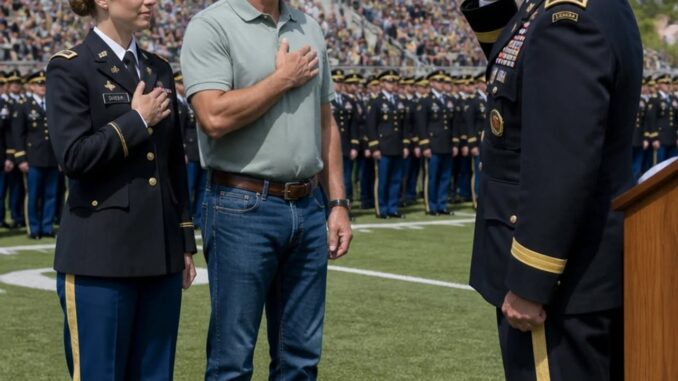
I had just completed an eighteen-hour drive in my old freight truck to Tennessee, heading to my daughter Emma Carter’s commissioning ceremony as a newly appointed Army officer. Exhausted and dusty from the long road, I arrived wearing the same clothes I had driven in for nearly a full day. Around me, families were dressed for the formal occasion, and for a moment, I felt slightly out of place. But that feeling melted away the moment I saw Emma.
She stood proudly in her dress uniform, greeting me with a smile that erased every mile I had just traveled. Her expression carried a mix of joy and gratitude for the journey I had undertaken. Together, we walked toward the stadium, sharing a quiet moment of pride between father and daughter—an unspoken acknowledgment of the hard work and dedication it took for her to reach this milestone.
On my wrist was an old leather wristband I had worn for years. To most, it appeared ordinary, just a piece of worn leather. But to me, it was a symbol of camaraderie, a connection to men I had served with and memories I rarely spoke of.
The ceremony began with remarks from Lieutenant General Daniel Mercer, who spoke eloquently about service, duty, and the sacrifices that often go unseen. His attention, however, briefly shifted to the family section during his speech, and later, one of his aides approached me with an unusual request: would I speak with the general after the ceremony? Initially, I assumed there had been a misunderstanding—but there wasn’t.
After the ceremony, as the general greeted Emma and congratulated her, he noticed the leather band on my wrist. His eyes lingered on it for a moment before he asked me where I had obtained it. For a brief second, I considered giving a simple answer, but instead, I shared the truth: the band had belonged to Sergeant Holloway.
The general’s reaction was immediate. He remembered the name clearly, and what followed was a conversation neither of us had expected that day.
Years before, during a challenging operation, several men had become separated during a chaotic extraction. The records of the mission were incomplete, and certain details were never fully clarified. Like so many military documents created under extreme conditions, the story had been simplified, leaving important pieces untold.
As we spoke, old photographs and records helped reconstruct events that had remained fragmented for decades. The conversation wasn’t about heroism—it was about accuracy, remembrance, and honoring those who had carried burdens together. It was a quiet acknowledgment of service, far from the spotlight, and a recognition of the men whose dedication had mattered deeply in the moment, even if history had largely overlooked them.
Emma stood nearby, listening carefully. These were parts of my service I had rarely discussed—not to hide them, but because some experiences are difficult to explain, especially to those you most want to protect. The general shared what he remembered of Sergeant Holloway and the other men who had served alongside us. His words carried gratitude for men whose names were no longer widely known, but whose actions had left an indelible mark on those who were there.
In that moment, the emphasis was not on individual accolades but on collective effort. Emma began to understand why I had always worn that old leather band: it wasn’t a token of personal achievement, but a reminder of loyalty, teamwork, and shared experience.
Before parting ways, General Mercer presented me with a copy of an old unit photograph. Though worn by time, the faces in the image remained clear. Some of the men went on to long careers, others chose quieter paths, and a few were no longer with us. Holding that photograph, I was reminded that true service rarely comes with recognition. The sacrifices most meaningful are often witnessed only by those standing closest to them.
The general thanked me for my part in those events, and I thanked him for remembering. No further words were necessary. The shared understanding was enough.
As Emma and I walked back to my truck, she began asking questions I had never heard before. Not about medals, ranks, or missions—but about friendships, fear, responsibility, and the men whose names appeared in the photograph. For years, I had carried these stories mostly in silence. That evening, I began sharing them. Not because the past had changed, but because Emma was starting a life of service herself, and some lessons can only be passed from one generation to the next.
The commissioning ceremony had celebrated a new officer. The conversation afterward reminded me that every uniform, whether newly earned or decades old, carries a history far larger than any single individual. Every leather strap, badge, and photograph represents countless moments of courage, dedication, and quiet sacrifice, often unseen but always remembered by those who stood together.
Leave a Reply