People often imagine abandonment as loud.
Arguments.
Slamming doors.
Screaming.
But the day my husband left me was almost completely silent.
And somehow, that made it hurt even more.
I was twenty-four hours into motherhood, exhausted and overwhelmed, holding my newborn son against my chest while machines beeped softly around the hospital room.
The doctors had just delivered news that changed our lives forever.
Our son had a severe neurological condition.
The specialists believed he would likely spend his life in a wheelchair.
I remember staring at the doctor while trying desperately to process the words.
Wheelchair-bound.
Permanent mobility limitations.
Years of treatment ahead.
The room felt smaller with every sentence.
I expected fear.
Questions.
Confusion.
What I did not expect was my husband quietly reaching for his car keys.
The Moment He Walked Away
Warren didn’t yell.
Didn’t cry.
Didn’t even look at our son.
He simply stood beside the hospital bed with a distant expression and said the sentence I will never forget.
“I’m not doing this.”
At first, I genuinely thought he meant the hospital conversation.
The stress.
The shock.
But then he shook his head slowly.
“I didn’t sign up for this kind of life.”
And before I could even react properly, he walked out of the delivery room.
No goodbye.
No promise to return.
Nothing.
Just silence.
The automatic hospital door closed behind him softly, and suddenly I understood something terrifying:
I was completely alone.
Becoming a Single Mother Overnight
People love describing stories like mine as inspirational afterward.
They say things like:
“You were so strong.”
“You handled it with grace.”
But honestly?
The years that followed did not feel heroic.
They felt exhausting.
Heavy.
Relentless.
There were nights I cried quietly in hospital bathrooms because I didn’t want my son hearing me break down emotionally.
There were weeks where I barely slept.
Months where I felt buried beneath medical paperwork, appointments, insurance calls, therapy schedules, and fear about the future.
Nothing about it felt graceful.
It simply felt necessary.
Learning a New Reality
My son, Ethan, spent much of his early childhood surrounded by doctors, therapists, specialists, and medical equipment.
Our lives revolved around routines:
- Physical therapy sessions
- Specialist appointments
- Mobility evaluations
- Exercises at home
- Adaptive equipment fittings
I learned medical vocabulary I never expected to understand.
Our home slowly filled with braces, therapy bands, support equipment, and stacks of hospital paperwork.
And through it all, Ethan kept growing.
The Weight of Other People’s Expectations
One thing I learned quickly was how often people quietly limit children with disabilities before those children ever discover their own potential.
Doctors spoke carefully around me.
Teachers lowered expectations automatically.
Even strangers sometimes looked at Ethan with pity instead of possibility.
I hated that look more than anything.
And eventually, Ethan did too.
Ethan Refused to Be Defined by Limitations
By the time he was ten years old, Ethan had developed an astonishing determination.
If someone told him something was impossible, he immediately wanted to prove otherwise.
He asked endless questions.
Read constantly.
Memorized medical terms most adults struggled pronouncing.
At fifteen, he was reading advanced neurological journals simply because he wanted to understand his own condition better.
And perhaps most importantly:
He hated being pitied.
Not because he denied his challenges.
But because he refused allowing limitations to become his entire identity.
Small Progress Became Miracles
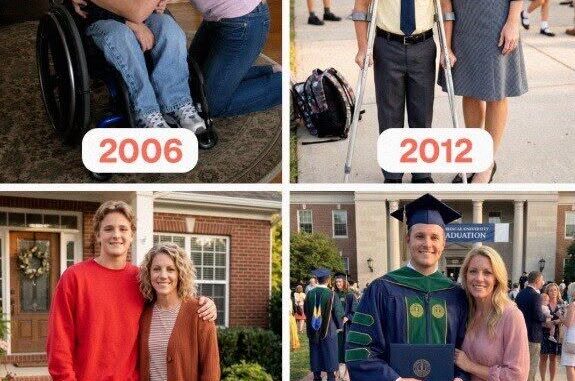
For years, doctors predicted Ethan would remain dependent on a wheelchair permanently.
But therapy slowly created progress nobody fully expected.
First came stronger muscle control.
Then assisted standing.
Then walking with heavy support devices.
Eventually a cane.
Then shorter distances without assistance at all.
Every tiny improvement felt enormous.
Not because walking alone defined his worth.
But because each milestone represented freedom Ethan fought incredibly hard to achieve.
Watching Him Become Extraordinary
Somewhere during all those years of struggle, my son transformed into someone extraordinary.
Not because he “overcame” disability dramatically like inspirational movies portray.
But because he developed resilience, discipline, empathy, and intelligence through every difficult experience.
By seventeen, Ethan already knew he wanted to become a doctor.
Not out of revenge.
Not to prove anyone wrong.
But because he genuinely wanted other patients to feel understood the way he once needed understanding himself.
And somehow, despite every challenge, he succeeded.
He earned acceptance into medical school.
Then graduated near the top of his class.
The Phone Call
A few days before graduation, I found Ethan sitting silently at the kitchen table unusually still.
Something felt wrong immediately.
“What happened?” I asked carefully.
He hesitated before answering.
“Dad called.”
The word alone made my stomach twist.
For twenty-five years Warren barely existed in our lives.
Occasional birthday cards during childhood.
Rare messages.
Mostly silence.
But now, suddenly, he wanted contact again.
“He found out I’m walking now,” Ethan said quietly.
Of course he had.
Success attracts people who disappeared during struggle.
The Invitation I Didn’t Want
When Ethan told me he invited Warren to graduation, I felt immediate anger.
Protective anger.
The kind only mothers understand.
I wanted to say no immediately.
I wanted to remind Ethan exactly who disappeared when life became difficult.
But my son simply looked at me calmly and said:
“I need to do this.”
There was no bitterness in his voice.
No rage.
Just certainty.
And somehow, that frightened me more.
Graduation Day
The graduation ceremony arrived quickly.
The auditorium overflowed with proud families holding flowers, cameras, and balloons.
Students laughed nervously in graduation gowns while music played softly overhead.
Then Warren arrived.
And immediately, I hated how comfortable he looked.
Confident.
Smiling.
As though he belonged there naturally.
As though he had participated in the twenty-five brutal years leading to that moment.
He waved casually toward Ethan.
My son acknowledged him politely but distantly.
And suddenly I realized Ethan had prepared emotionally for this meeting far more carefully than I had.
Watching My Son Walk Across the Stage
When Ethan’s name was announced, the entire room applauded loudly.
And then my son walked onto the stage.
Steady.
Confident.
Strong.
Not perfectly.
Not effortlessly.
But proudly.
Every single step represented years of pain, therapy, discipline, and determination.
I cried before I even realized tears had started falling.
Because suddenly every difficult year flashed through my mind at once.
Hospital rooms.
Wheelchairs.
Exercises.
Fear.
Hope.
And now this moment.
The Speech That Changed Everything
After receiving his diploma, Ethan approached the podium unexpectedly.
Apparently several top graduates had been selected to speak briefly.
He adjusted the microphone calmly.
Then he looked directly toward Warren.
And he said:
“Father, I’ve rehearsed this moment for years.”
The entire room became silent instantly.
Even Warren’s smile shifted uncertainly.
The Truth Ethan Finally Spoke
Ethan did not scream.
He did not humiliate his father cruelly.
What he did was far more powerful.
Calmly, clearly, and publicly, he thanked every single person who stayed.
His therapists.
Doctors.
Teachers.
Friends.
And finally, me.
Then he said something I will never forget.
“My mother spent twenty-five years proving that love does not disappear when life becomes difficult.”
The room erupted into applause immediately.
But Ethan wasn’t finished.
The Lesson Warren Couldn’t Escape
Then my son looked directly at Warren again.
And with complete calmness, he said:
“The man who left when doctors predicted I’d never walk taught me something important too.”
The auditorium fell silent.
“He taught me exactly the kind of doctor — and father — I never want to become.”
You could physically feel the air change in the room.
Warren’s face lost all color instantly.
Because suddenly everyone understood the truth.
This graduation was not a celebration he earned.
It was a moment he abandoned decades earlier.
Grace Instead of Revenge
What struck me most afterward was Ethan’s composure.
He wasn’t angry anymore.
That surprised me deeply.
Somewhere over the years, he had transformed pain into clarity instead of bitterness.
And honestly, that required more strength than rage ever could.
Why Absence Leaves Permanent Marks
Parents sometimes underestimate how deeply abandonment shapes children.
Even when children grow successfully into adulthood, the emotional questions remain:
- Why wasn’t I enough?
- Why did they leave?
- Would they have stayed if things were easier?
Those questions don’t disappear automatically with achievement.
The Difference Between Parenthood and Presence
One important truth became painfully obvious that day:
Biology alone does not make someone a parent.
Presence does.
Consistency.
Sacrifice.
Patience.
Love during difficult seasons.
That’s what parenthood truly requires.
Ethan’s Greatest Victory
Ironically, Ethan’s greatest triumph was never learning to walk more independently.
It was becoming compassionate despite everything.
He could have become angry.
Bitter.
Cruel.
Instead, he became someone dedicated to helping others heal.
And honestly, I think that mattered far more.
Final Thoughts
Twenty-five years earlier, my husband walked out of a hospital room because he feared a difficult future.
He believed our son’s condition would define his entire life permanently.
But life unfolded differently than anyone predicted.
The newborn doctors once described with limitations grew into a brilliant young doctor who stood proudly on his own two feet — emotionally and physically.
And on graduation day, the son his father abandoned finally gave him the one thing he truly deserved:
The truth.
Leave a Reply