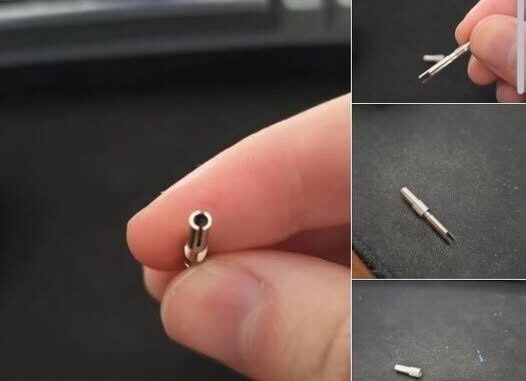
At first glance, it doesn’t look like much.
A small, silver piece of metal. Slightly curved. Two narrow prongs extending from one end. No buttons, no wires, no obvious function. It’s the kind of object you might find at the bottom of a drawer, in an old toolbox, or tucked away in a forgotten box of school supplies.
Most people who come across it for the first time are puzzled.
Is it part of a gadget? A broken mechanical piece? Something from a bicycle or an old appliance?
The truth is far simpler—and far more nostalgic.
That tiny, overlooked object is a compass lead holder, a once-essential component of the classic geometry set that nearly every student used at some point in their education.
And while it may seem insignificant today, this small tool once played a crucial role in classrooms around the world.
The Mystery of the Unfamiliar Object
The confusion surrounding this object is understandable.
Unlike modern tools, which are often clearly labeled or designed with obvious functionality, older educational instruments relied on simplicity. They were built to serve a specific purpose, not to explain themselves.
So when someone finds a compass lead holder outside its original context, it can feel like a puzzle.
Its compact size makes it easy to overlook. Its shape doesn’t immediately suggest its use. And without the rest of the geometry set, it seems incomplete—like a missing piece from a larger story.
But once you recognize it, everything clicks into place.
A Small Piece with a Big Purpose
The compass lead holder may be tiny, but its role is essential.
In a traditional geometry set, the compass is one of the most important tools. It’s used to draw circles, arcs, and precise measurements—fundamental elements in mathematics and design.
But the compass itself cannot function without something to draw with.
That’s where the lead holder comes in.
It attaches to one arm of the compass and securely holds a thin piece of graphite (lead). This allows the compass to create clean, accurate lines as it rotates around a fixed point.
Without the lead holder, the compass is incomplete—and essentially useless.
Remembering the Classic Geometry Set
For many people, this small tool is a gateway to memories of school days.
Geometry sets were once a standard part of education. They came in compact plastic or metal cases, neatly organized and filled with carefully designed instruments.
Inside, you would typically find:
- A compass
- A ruler
- A protractor
- Set squares
- Spare leads
- A small sharpener
- And, of course, the tiny lead holder
Each item had its place, and each served a purpose.
Opening that case felt almost ceremonial. The tools were precise, delicate, and required careful handling. Using them wasn’t just about completing assignments—it was about learning discipline, patience, and attention to detail.
The Piece That Always Went Missing
Despite its importance, the compass lead holder had a reputation.
It was the one item that seemed to disappear the most.
Small enough to slip through fingers. Easy to misplace. Difficult to replace on short notice. Many students remember the frustration of opening their geometry set only to realize that this crucial piece was gone.
And once it was missing, everything changed.
Improvisation and Frustration
Without the lead holder, students had to get creative.
Some tried inserting a small piece of a pencil directly into the compass. Others attempted to secure the graphite with tape or by wedging it awkwardly into place.
A few borrowed parts from classmates. Others simply struggled through their assignments with imperfect tools.
But no workaround truly replaced the original function.
The compass would wobble. Lines would break. Circles would come out uneven or incomplete. What should have been a precise task became an exercise in frustration.
It was a clear reminder of how something so small could have such a big impact.
Precision and Design: Why It Matters
The purpose of the lead holder goes beyond simply holding a piece of graphite.
It ensures stability.
Geometry depends on accuracy. Even the slightest shift in position can affect the final result. The lead holder keeps the graphite firmly in place, allowing the compass to produce smooth, consistent lines.
Some designs even included a tiny screw mechanism, allowing users to adjust the grip. This level of detail ensured that the lead remained secure while still being easy to replace when needed.
It’s a perfect example of thoughtful design—simple, effective, and essential.
A Symbol of Hands-On Learning
In today’s digital world, many tasks that once required physical tools are now completed with software.
Perfect circles can be drawn with a click. Measurements are calculated instantly. Mistakes can be undone with ease.
But there was something unique about doing it by hand.
Using a compass required:
- A steady grip
- Careful positioning
- Focus and patience
You had to feel the movement, control the pressure, and guide the tool with precision. It wasn’t just about the result—it was about the process.
The compass lead holder, though small, was at the center of that experience.
The Shift to Digital Tools
As technology has advanced, traditional geometry tools have become less common.
Students today often rely on digital devices for drawing and measurement. While these tools offer convenience and efficiency, they also change the nature of learning.
The tactile experience—the sensation of holding a compass, adjusting its arms, and drawing a perfect circle by hand—is slowly fading.
And with it, small components like the lead holder are becoming relics of a different time.
Why Objects Like This Still Matter
Even though it’s no longer widely used, the compass lead holder still holds value.
It represents:
- A time when learning was more hands-on
- The importance of precision and craftsmanship
- The idea that even the smallest parts can be essential
It also reminds us that not everything needs to be complex to be meaningful.
Sometimes, the simplest tools leave the strongest impressions.
Rediscovering the Past Through Everyday Objects
Finding a compass lead holder today can feel like uncovering a piece of history.
It’s a reminder of classrooms, lessons, and moments of concentration. Of small frustrations and quiet achievements. Of a time when learning required both effort and attention.
Objects like this connect us to our past in a tangible way.
They tell stories—not through words, but through function and memory.
Final Thoughts
At first glance, it may seem like just a random piece of metal.
But the compass lead holder is much more than that.
It’s a symbol of precision, a tool of learning, and a reminder that even the smallest components can play a vital role in something much bigger.
In a world that often values speed and convenience, it stands as a quiet testament to patience, detail, and the beauty of simple design.
And perhaps, the next time you come across one, you won’t see it as a mystery—but as a small, meaningful piece of a much larger story.
Leave a Reply