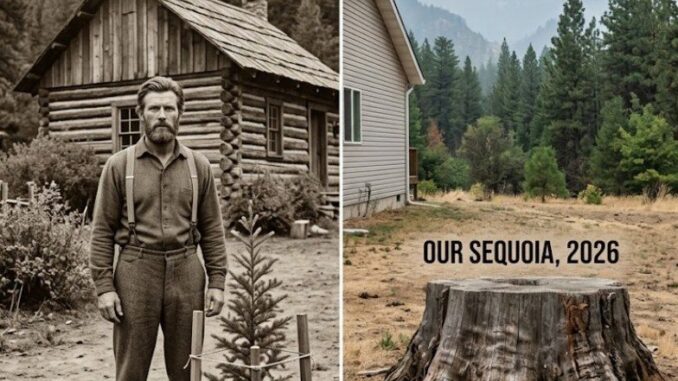
In the weeks that followed, life didn’t immediately return to normal. The absence of the tree wasn’t something that could be ignored or quickly adjusted to. It changed the way the yard looked, the way the light moved through the space, and even how we used it day to day.
Where there had once been shade, there was now openness.
Where there had once been a natural gathering place, there was now a gap that felt difficult to define.
My daughters noticed it in their own way. They didn’t talk about it constantly, but every now and then, one of them would pause near the stump and look at it quietly, as if trying to reconcile memory with reality.
That was the hardest part—not just losing something meaningful, but watching others process that loss too.
A Different Kind of Conversation
What surprised me most was how the situation shifted without confrontation.
I hadn’t organized anything. I hadn’t tried to turn it into a larger issue. But once the story was shared, people began to reflect on it in their own way.
Neighbors started talking—not in anger, but in understanding.
They remembered their own connections to the tree. Moments they had experienced in that yard. Small interactions that had seemed ordinary at the time, but now carried more weight.
It became clear that the tree hadn’t just belonged to our family.
It had quietly become part of the community.
And that realization changed how people saw what had happened.
The Power of Perspective
What Roger experienced wasn’t public criticism or direct conflict.
It was perspective.
Before, he had seen the tree as a problem—something that interfered with his space, his preferences, his sense of control.
Afterward, he began to see it as something else entirely.
Not because someone argued with him.
But because he was shown what it meant to others.
That shift didn’t happen instantly. It didn’t come with dramatic apologies or emotional statements.
It came slowly, through reflection.
And sometimes, that kind of change lasts longer.
Rebuilding Without Replacing
Planting the new tree was not about fixing what had been lost.
That wasn’t possible.
No matter how carefully we chose the spot, no matter how much effort went into the process, it wouldn’t carry the same history. It wouldn’t hold the same memories.
But that didn’t make it meaningless.
It made it different.
And different doesn’t have to mean less.
The act of planting something new became its own kind of statement—not about erasing the past, but about continuing forward with intention.
Small Actions That Carry Meaning
That weekend, as we worked together, something else became clear.
No one was there out of obligation.
They were there because they understood.
Some brought tools. Others brought water or snacks. A few simply stood nearby, offering quiet company.
There were no speeches. No formal moments.
Just people showing up.
And in that simplicity, there was something powerful.
It reminded me that support doesn’t always need to be structured or planned. Sometimes, it’s just about being present and contributing in whatever way feels natural.
A Subtle Change in Everyday Life
Over time, the yard began to feel less empty.
Not because the space had changed dramatically, but because our relationship to it had.
The new tree, small and fragile at first, became a quiet focal point. It required care, attention, and patience—things that naturally brought us back into the space in a different way.
My daughters started checking on it regularly, making sure it had enough water, watching for new leaves.
They gave it a kind of attention that hadn’t been necessary with the old tree, which had always seemed self-sufficient.
And in that process, something shifted.
Instead of only remembering what had been lost, they began to engage with what was growing.
Understanding Responsibility
This experience also changed how I thought about responsibility.
Not in terms of blame, but in terms of awareness.
It highlighted how individual actions—even those that seem small or justified in the moment—can have wider effects than we expect.
Roger didn’t initially see that.
But eventually, he began to understand.
Not because someone forced him to, but because he was given the space to reflect on it.
And once that understanding took hold, his actions began to change as well.
Growth That Takes Time
The new tree didn’t grow quickly.
It wasn’t meant to.
Growth like that takes time, consistency, and care.
But in a way, that made it more meaningful.
Every new branch, every sign of progress, became something we noticed.
Something we appreciated.
Something we didn’t take for granted.
And that, perhaps, was one of the most important outcomes of everything that had happened.
A Lasting Lesson
Looking back, the situation could have unfolded very differently.
It could have turned into conflict, resentment, or something that divided neighbors permanently.
Instead, it became something else.
A lesson—not just for one person, but for everyone involved.
A reminder that understanding often comes not from arguments, but from perspective.
That actions carry meaning beyond their immediate impact.
And that even after something is lost, there is still an opportunity to create something meaningful in its place.
Moving Forward
The yard will never be exactly what it once was.
And that’s okay.
Because it now holds something new—not just a young tree, but a story that includes loss, reflection, and change.
A story about how people respond when something important is taken away.
And how those responses can shape what comes next.
In time, the new tree will grow.
It will provide shade.
It will become part of future memories.
Not as a replacement, but as a continuation.
And maybe, years from now, someone will stand beneath it and feel the same quiet certainty I once felt—that some things, when cared for properly, can last far longer than we expect.
Just in a different way.
The Space Between What Was and What Will Be
As the months passed, the new tree slowly began to settle into its place. At first, it looked almost too small for the space it occupied, as if it were aware of the history it could never fully match. But over time, its presence became more natural—not because it replaced what had been there before, but because it started to create its own quiet identity.
The yard, once defined by something towering and permanent, now felt more open to change.
And that shift, while subtle, carried its own kind of meaning.
Learning to See Value Differently
One of the most unexpected outcomes of everything that happened was how it changed the way I noticed things.
Before, I had taken comfort in what felt stable—things that had always been there, things I assumed would continue without question. The old tree represented that kind of certainty.
But after losing it, I began to pay more attention to things that were still forming.
Things that required care.
Things that depended on time.
The new tree wasn’t impressive in the same way. It didn’t draw attention or create a sense of permanence.
But it invited something else: involvement.
A Different Kind of Connection
My daughters adapted in ways that surprised me.
Instead of comparing the new tree to the old one, they began to build their own connection with it. They talked about how tall it might grow, what it would look like in different seasons, and how long it might take before it provided shade.
They asked questions.
They made guesses.
They imagined the future in a way that felt hopeful rather than nostalgic.
And in doing that, they shifted the focus from loss to possibility.
Quiet Changes in the Neighborhood
The impact of what happened didn’t stay limited to our yard.
Over time, I noticed small changes around the neighborhood.
People became more mindful of shared spaces. Conversations about boundaries and maintenance felt more balanced, less reactive. There was a sense that everyone had become slightly more aware of how their choices affected others.
It wasn’t a dramatic transformation.
No one announced it.
But it was there—in the way people spoke, the way they approached disagreements, and the way they considered perspectives beyond their own.
Accountability Without Conflict
Roger’s role in all of this also evolved quietly.
He didn’t try to undo what had been done—that wasn’t possible. But he did begin to approach things differently.
He became more considerate in small ways.
More willing to listen.
More aware of how his actions might be perceived.
There were no long conversations about it, no formal attempts to revisit the past.
Just a noticeable shift in behavior.
And sometimes, that kind of change speaks louder than any apology.
The Meaning of Starting Again
Planting something new after losing something old can feel uncertain.
There’s always a question in the background: Will this ever matter in the same way?
The answer, I realized, is no—and that’s not a bad thing.
It doesn’t have to matter in the same way to be meaningful.
The new tree represents a different chapter.
Not one that erases the past, but one that exists alongside it.
A continuation, not a replacement.
Patience as Part of the Process
Watching something grow teaches patience in a very direct way.
There’s no way to rush it.
No shortcut that leads to immediate results.
Each stage takes the time it needs.
And in a world where so much happens quickly, that kind of slow progress can feel grounding.
It becomes a reminder that not everything valuable appears fully formed.
Some things need time to develop.
Carrying the Story Forward
The story of the old tree didn’t end when it was cut down.
It continued—in photographs, in conversations, in memory.
And now, it continues in a different form as well.
In the way we care for the new tree.
In the way we approach shared space.
In the way we think about what matters and why.
Stories like that don’t disappear.
They evolve.
A Quiet Understanding
If there’s one thing this experience made clear, it’s that meaning isn’t always tied to physical things alone.
Objects, places, and spaces can hold importance—but that importance comes from the experiences connected to them.
When those objects are gone, the meaning doesn’t vanish.
It shifts.
It finds new ways to exist.
Looking Ahead
Now, when I look out into the yard, I don’t just see what’s missing.
I see what’s growing.
I see the care being put into something new.
I see the potential for future memories that haven’t happened yet.
And that perspective makes a difference.
Because it turns the focus forward, without ignoring what came before.
Losing something meaningful will always leave a mark.
That part doesn’t change.
But what we do after that loss—that’s where something new begins.
Whether it’s rebuilding, replanting, or simply rethinking how we move forward, those choices shape what comes next.
And sometimes, the most important lesson isn’t about what was taken.
It’s about what we choose to grow in its place.
Leave a Reply