For three years, no one in the neighborhood knew what had happened to David Marshall.
One day, he was simply there—part of the familiar rhythm of the street. The next day, he was gone without warning. There were no signs of a planned move, no moving trucks, no boxes being carried out, no notice to neighbors, and no “For Sale” sign placed in the yard. It was as if he had quietly vanished overnight.
At first, the sudden disappearance became a topic of conversation among neighbors. People exchanged theories and tried to make sense of what had happened. Some assumed he had received an unexpected inheritance and decided to relocate somewhere far away, possibly even abroad. Others believed he might have chosen to start over in a different city for personal reasons. A few more dramatic guesses suggested he could have been involved in something that forced him to leave quickly.
But as time passed, speculation faded. Life in the neighborhood continued, as it always does. The house slowly became part of the background—still standing, but no longer actively noticed. Grass grew longer each season. Flyers and advertisements filled the mailbox. Newspapers occasionally piled up near the door. Eventually, the property stopped feeling like a home that had been abandoned and started feeling like just another quiet structure on the street.
Years went by like this, and the mystery of David Marshall’s disappearance was gradually forgotten by most people.
That changed one evening last week.
It had been an ordinary day. The sun was setting, casting warm orange and pink tones across the sky. I had just finished dinner and stepped outside to place my trash bins at the curb for pickup the following morning.
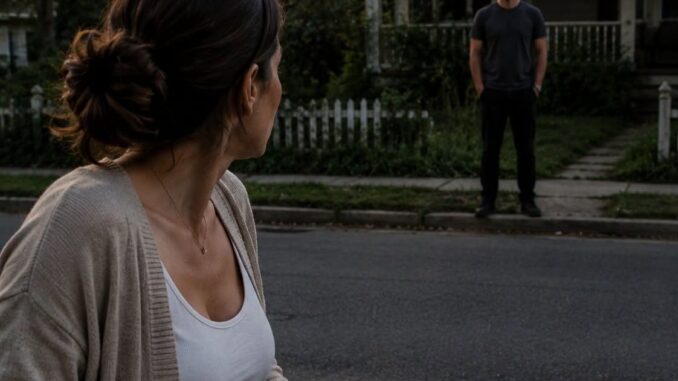
As I pulled the bin toward the street, my attention drifted across to the house directly opposite mine—the same house David once lived in.
At first, I didn’t think anything unusual was happening. But then I noticed a figure standing in front of the property.
He wasn’t moving. He wasn’t doing anything that suggested he was working on the house or inspecting it. There were no tools, no bags, no signs of preparation or return. He simply stood there, facing the property, completely still.
Something about the posture made me pause.
My first assumption was that perhaps a new owner had finally purchased the home and was evaluating it. But even that explanation didn’t fully feel right. The longer I looked, the more unsettled I became, as though I recognized something familiar in the figure’s stance.
I squinted, trying to see more clearly.
Then my breath caught.
The realization came slowly at first, and then all at once.
It looked like David.
The same man who had disappeared three years earlier without any explanation.
For a moment, I questioned my own judgment. After so long, it seemed unlikely. People change, and memory can blur details. I considered the possibility that it was simply someone with a similar appearance.
But then the man turned slightly and smiled.
That smile—familiar, unchanged, unmistakable—removed any remaining doubt.
It was him.
I stood still beside the trash bin, unsure of what I was seeing.
Across the street, David noticed me. He raised a hand in greeting, as though this were an ordinary encounter rather than a sudden reappearance after years of silence. Then, without hesitation, he began walking toward me.
As he crossed the street, a flood of questions filled my mind. Where had he gone? Why had he left without telling anyone? Why had he never returned or made contact? And most confusing of all—why was he back now, standing in front of the very house he had vanished from?
When he reached the sidewalk near me, he appeared calm, almost as if nothing unusual had occurred at all.
“Good evening, Sarah,” he said.
Hearing my name spoken so casually after so many years made the situation feel even stranger.
“David?” I replied, still unsure.
He gave a small laugh. “Last time I checked.”
I stared at him, trying to process what I was seeing. “Where have you been all this time?”
His expression softened slightly. “That’s not a short answer.”
“Three years isn’t a short absence either,” I responded.
He nodded slowly. “Fair enough.”
For a brief moment, he looked down the street, as if gathering his thoughts. Then he explained.
Three years earlier, David had traveled out of state to assist his father, who had suffered a serious medical emergency. What was intended to be a short visit turned into a prolonged period of caregiving. His father’s condition required ongoing attention, appointments, and support, and David gradually became the primary person responsible for helping him recover.
Over time, weeks turned into months, and months turned into years. Life became centered entirely around caregiving duties and medical needs. According to David, everything else in his life slowly fell away in the process, including his connection to the neighborhood he had left behind.
He admitted that he often thought about returning or reaching out to explain his absence, but circumstances kept changing. Just as things seemed to stabilize, new challenges would appear, keeping him occupied and away longer than expected.
Eventually, his father’s condition improved enough for independent living again. Only then did David finally have the opportunity to return home.
As I listened, the long-standing mystery of his disappearance began to lose its shadowy quality. What had once seemed strange and unexplained started to sound far more grounded and human.
There was no hidden scandal or dramatic secret. No criminal involvement. No elaborate escape. Just life unfolding in an unexpected and demanding way.
Over the next few days, word spread quickly through the neighborhood that David had returned. The same street that had quietly accepted his absence suddenly became active again with curiosity. People who had not spoken in a long time found reasons to walk by his house. Neighbors slowed down their routines, glancing toward the property as if checking that it was truly real.
Many eventually approached him directly. Conversations that followed revealed a mix of surprise and reflection. Some neighbors admitted they had assumed he left intentionally and permanently. Others had imagined financial troubles or personal conflict. A few even believed more extreme explanations over the years.
The actual reason, however, was much simpler than any of those assumptions.
David had been caring for a family member during a difficult period, and in doing so, had unintentionally disappeared from the community around him.
Within a short time, the house began to look lived-in again. The yard was maintained. The porch was repaired. Small signs of activity returned to the property. What had once felt abandoned slowly regained a sense of presence.
One evening, several neighbors gathered casually while David prepared food on a grill in his backyard. As conversations flowed, the topic eventually turned to the years of speculation surrounding his disappearance.
There was laughter as people shared the more imaginative theories that had circulated. One neighbor admitted she had thought he might have joined some kind of secret organization. Another confessed she believed he had moved overseas and never intended to return.
David listened, shaking his head with a light laugh. “I promise my life isn’t that interesting,” he said.
In truth, the reality was not dramatic—but it carried its own significance. It reflected how easily uncertainty can grow when information is missing, and how quickly people fill in those gaps with assumptions.
As the evening ended and I returned home, I noticed David sitting quietly on his porch, watching the sky shift into night.
The house that had once felt empty no longer did.
What had been a neighborhood mystery for years turned out not to be a mystery at all, but a reminder of something simple: that absence does not always come from choice or secrecy. Sometimes it comes from responsibility, circumstances, and the quiet demands of real life.
And often, the truth is far less dramatic than the stories we create in its place.
Leave a Reply