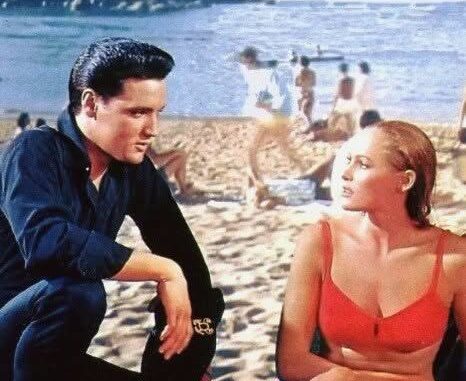
When Elvis Presley arrived on the set of Fun in Acapulco in 1963, he was already more than a performer—he was an institution. The world knew him as the King of Rock ’n’ Roll, a box-office magnet whose films could turn even the simplest scripts into global events. Yet on this particular production, another presence quietly shifted the atmosphere: Ursula Andress, fresh off her explosive rise to fame as the original Bond girl in Dr. No.
What unfolded in Acapulco wasn’t a scandal in the traditional sense. There were no confirmed affairs, no public confrontations, no dramatic betrayals captured by the press. Instead, it was something more elusive—a triangle defined by attraction, restraint, and the invisible weight of personal boundaries. A story less about what happened, and more about what almost did.
A Perfect On-Screen Match
On screen, Elvis and Andress seemed almost deliberately paired by cinematic design. In Fun in Acapulco, Andress played Marguerita Dauphin, a poised and slightly mysterious social director, while Elvis portrayed Mike Windgren, a performer trying to rebuild his life under the Mexican sun. Their scenes together carried an easy rhythm—light banter, lingering glances, and a playful tension that suggested something just beneath the surface.
Audiences responded immediately. The pairing felt natural, even inevitable, as if Hollywood had stumbled onto a combination too visually compelling to ignore. Andress brought elegance and international allure, while Elvis brought warmth, humor, and an effortless screen magnetism that had defined his career since the 1950s. Together, they created a dynamic that felt more charged than the script itself.
Off screen, however, the tone shifted. Andress, already established as one of the most photographed women in the world, carried a reputation that preceded her. Elvis, meanwhile, was navigating a carefully managed image, one shaped by management decisions, studio expectations, and an ever-watchful fanbase. Any spark between them would have existed inside a tightly controlled environment.
When the Tables Turned
According to accounts from production insiders often grouped under Elvis’s informal circle—the so-called “Memphis Mafia”—this was one of the rare moments when Elvis wasn’t actively pursuing attention from a leading lady. Instead, observers suggested it was Andress who initially showed curiosity about him.
Their early interactions were reportedly cautious. Andress, aware of the tabloid narratives surrounding Elvis, kept a professional distance at first. But as filming progressed, that distance appeared to soften. Those on set described Elvis as unexpectedly grounded—polite, attentive, and far removed from the exaggerated persona often attached to his fame. In turn, Andress’s composure reportedly gave way to a more relaxed rapport.
The attraction, by most accounts, was mutual enough to be noticeable—but not enough to break established boundaries.
The Invisible Third Person
Hovering over this dynamic was John Derek, Andress’s partner at the time. His presence—sometimes physical on set, sometimes only implied—created an unspoken constraint that shaped every interaction.
Elvis, known for his personal code regarding relationships, reportedly avoided pursuing women who were already attached. Whether out of respect, caution, or self-imposed discipline, it was a boundary he rarely crossed in his public life. That principle alone may have been enough to prevent any escalation.
The result was a strange equilibrium: attraction acknowledged but contained, chemistry visible but restrained. In a Hollywood environment where relationships often ignited quickly, this one remained suspended in possibility.
Elvis’s Private Reservations
Adding another layer to the story are later recollections from individuals close to Elvis, including Priscilla Presley. These accounts suggest that Elvis, despite Andress’s global status as a beauty icon, did not necessarily see her as an ideal match for his personal preferences.
Whether that reflected genuine disinterest or a psychological distancing strategy is impossible to confirm. What is clear is that Elvis maintained a careful emotional separation during the production, even as rumors began to circulate informally among crew members.
Hollywood has always thrived on speculation, and Fun in Acapulco was no exception. But in this case, speculation outpaced reality.
A Film Shaped by Constraints
Beyond interpersonal dynamics, Fun in Acapulco carried its own unusual production circumstances. Although set in Mexico, Elvis never actually filmed on location. Political tensions and earlier controversies surrounding his international image meant that principal photography was completed in Hollywood, with stand-ins and second-unit footage used to simulate Acapulco’s coastal vibrancy.
These limitations shaped the final product more than audiences may realize. The film’s sunny aesthetic, musical numbers, and romantic undertones were carefully constructed rather than organically captured. Even the chemistry between characters existed within a controlled studio environment, carefully lit and edited to maintain Elvis’s broad appeal.
A Carefully Managed Image
By the early 1960s, Elvis’s career had become tightly interwoven with audience expectations. His films were designed to appeal to teenagers, families, and international viewers alike. This meant romance had to remain suggestive rather than explicit, flirtation had to remain playful rather than provocative
Andress, accustomed to more daring roles following Dr. No, later expressed frustration with these constraints. Her image in Fun in Acapulco was softened, her wardrobe and character presentation adjusted to align with the studio’s commercial priorities.
In this environment, even natural chemistry had to pass through layers of editorial restraint.
Chemistry Without Consequence
What makes the Elvis-Andress dynamic notable is not what it became—but what it didn’t become. There was no confirmed romance, no scandal, no lasting entanglement. Instead, there was a carefully contained interaction shaped by timing, circumstance, and personal boundaries.
It is precisely this absence that has allowed the story to endure. Hollywood history is often remembered for its excesses, but equally compelling are the stories defined by restraint—moments where something almost shifted, but ultimately did not.
A Moment in Cultural Transition
Fun in Acapulco arrived at a turning point in popular culture. While Elvis still commanded global attention, the musical landscape was beginning to shift. Within a year, the rise of The Beatles would signal a generational change in music, fandom, and celebrity culture.
Seen in hindsight, the film sits at the edge of that transition: one of Elvis’s final major cinematic vehicles before the industry began moving in new directions.
The Legacy of an Unwritten Story
The story of Elvis Presley and Ursula Andress is not one of romance fulfilled or scandal revealed. It is something more subtle—a study in possibility.
Their connection exists primarily in film reels, promotional stills, and the lingering sense that two magnetic personalities briefly shared a space charged with potential. Not every story needs resolution to be remembered. Some endure precisely because they stop short of becoming reality.
And in that sense, the Acapulco “love triangle” is less about what was missed—and more about how Hollywood often creates stories that live forever in the space between fact and imagination.
Leave a Reply