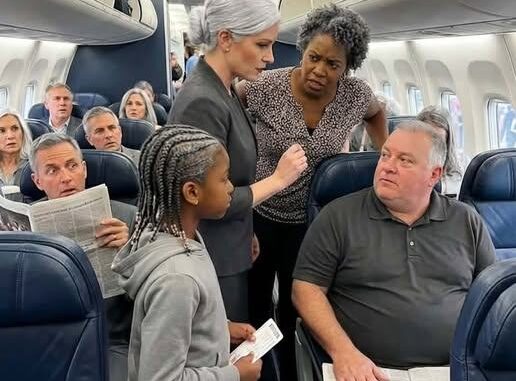
The aircraft climbed steadily, shaking off the last traces of ground tension as it pushed through the clouds. For most passengers, the cabin gradually returned to its familiar rhythm—soft announcements, the hum of engines, the rustle of seatbelts loosening, and the quiet return to personal space.
But something had changed.
Even without words, people weren’t fully settling back into their routines. Conversations stayed lower than usual. Laughter came slower. A few passengers kept glancing toward row 3, where Amani sat calmly in her seat, her hands resting neatly on her lap, as if she hadn’t just been at the center of a confrontation that had frozen an entire aircraft minutes earlier.
She wasn’t crying. She wasn’t upset.
She was watching the clouds drift past the window like nothing extraordinary had happened at all.
Lorraine Parker, the senior flight attendant, moved through the aisle with practiced composure, but even she felt the shift. In all her years working flights, she had seen arguments over seats, upgrades, delays, and luggage—but rarely had she seen an entire cabin unify so quickly against one person.
And almost never had she seen a child remain so still afterward.
Kimberly joined her near the galley.
“She’s unusually calm,” Kimberly murmured.
Lorraine nodded. “That’s not just calm. That’s control.”
Kimberly glanced toward row 3 again. “Or she’s processing it later.”
Lorraine didn’t answer right away. Experience had taught her that children reacted to stress in different ways—some immediately, some delayed, and some not visibly at all until much later when the world felt safe again.
But Amani didn’t seem shaken.
She seemed… thoughtful.
Halfway through the flight, the cabin service resumed. Drinks were offered, trays were distributed, and the earlier incident slowly transformed into a story passengers would tell later rather than a living moment they were part of.
Still, some details refused to fade.
The man who had been removed was no longer on board, but his absence left behind a strange kind of imprint—like a chair still warm after someone stands up.
One passenger, seated two rows behind Amani, leaned slightly toward her companion.
“I’ve never seen them stop a flight for seating before,” she whispered.
Her companion responded quietly, “He didn’t just sit in the wrong seat. He lied to get there.”
Across the aisle, another passenger added, “And picked the wrong child to try it on.”
That last line lingered.
Not because Amani had done anything outwardly dramatic—but because she hadn’t needed to. Her refusal to back down had been quiet, steady, and unshakable.
In the cockpit, the pilot had already been briefed. The incident was logged formally with aviation security protocols. Airline procedures required documentation any time a passenger was removed due to fraudulent seating claims or noncompliance with crew instructions.
It would be reviewed later, assessed, and categorized.
But none of that mattered in the moment the plane was airborne again.
What mattered was that order had been restored—but not without being tested.
In row 3, Amani finally shifted slightly in her seat.
Lorraine, passing by, noticed and slowed.
“You doing okay back here?” she asked gently.
Amani looked up.
“Yes,” she said simply.
Then, after a pause, she added something softer. “He didn’t even look at me when I spoke.”
Lorraine understood immediately what she meant.
It wasn’t the argument that stayed with her—it was the dismissal.
“That happens sometimes,” Lorraine said carefully. “People decide what they think before they listen.”
Amani considered that.
“That seems… inefficient,” she replied.
Lorraine almost smiled. “It is.”
Amani nodded as if confirming a fact she would remember later.
At cruising altitude, the flight smoothed out further. The earlier turbulence—both literal and emotional—had passed.
Lorraine returned to the galley where Kimberly was reviewing the incident report on a tablet.
“We’ll have to file a detailed account,” Kimberly said.
“Already expected,” Lorraine replied. “Security will want timestamps, seat verification, boarding discrepancies…”
She paused, then added quietly, “And witness statements.”
Kimberly leaned against the counter. “There were a lot of witnesses.”
“Yes,” Lorraine said. “But not all of them saw the same thing.”
Kimberly looked up.
Lorraine continued, “Some saw a man in the wrong seat. Some saw entitlement. Some saw a child standing her ground.”
“And what do you see?” Kimberly asked.
Lorraine hesitated only briefly.
“I see what happens when someone assumes no one will challenge them,” she said. “And I see a child who didn’t let that assumption stand.”
Back in row 3, Amani had opened a small notebook from her backpack.
She wrote slowly, carefully—more like someone documenting than doodling.
Her father had given it to her for travel journaling, encouraging her to write down “things worth remembering.”
Most of her entries were simple:
Airports are loud.
Clouds look closer from above.
Coffee tastes different on planes.
But today, she wrote something longer.
She paused before finishing the sentence, then added:
“People don’t always follow rules when they think they won’t be stopped.”
She closed the notebook.
Then reopened it and added one more line.
“But sometimes they are.”
Two rows ahead, an older passenger who had witnessed everything leaned over to his seatmate.
“I feel like that kid just taught a lesson without saying she was teaching one,” he said.
His seatmate nodded. “That’s usually how it works. The quiet ones don’t need to raise their voice.”
At the front of the cabin, Lorraine made one final pass through the aisle before service began its second round.
When she reached Amani, she paused again.
“Can I get you anything?” she asked.
Amani looked thoughtful for a moment.
Then she said, “Do people usually give up their seats that easily?”
Lorraine considered the question.
“No,” she said honestly. “Not usually.”
Amani nodded slowly.
“Then I guess today was unusual.”
Lorraine smiled gently. “Very.”
As the flight continued, something subtle had shifted across the entire cabin.
It wasn’t fear. It wasn’t tension.
It was awareness.
Passengers were more attentive now—not just to announcements or service, but to each other. Small acts of courtesy appeared more deliberate. People waiting their turn. Saying thank you more often. A kind of quiet recalibration had taken place.
One moment had reminded everyone that boundaries weren’t abstract—they were real, and they only held if people respected them.
Near the end of the flight, the captain made a brief announcement about their expected descent.
As the aircraft began its gradual downward path, Amani pressed her forehead lightly against the window.
Below, the clouds began to break apart, revealing land in soft, distant shapes.
Her seat—3A—remained unchanged. Still hers. Still steady. Still there.
And for reasons she might not fully understand yet, that mattered more than the argument itself.
Not because of the seat.
But because of what it represented.
The idea that even when someone tries to take something from you simply because they think they can…
It doesn’t always work.
When the wheels finally touched down, the cabin gave the usual collective shift forward—seatbelts tightened, bags reached for, overhead bins clicked open.
But something lingered in the air longer than usual as passengers gathered their belongings.
A story had happened here.
Not a loud one.
A quiet one.
The kind people remember not because it was dramatic—but because it revealed something simple and uncomfortable about human behavior.
As Amani stood with her father waiting at arrivals later, he noticed her expression.
“You alright?” he asked again, softer this time.
She thought for a moment before answering.
“Yes,” she said.
Then added, “I think I understand something now.”
He smiled slightly. “What’s that?”
Amani adjusted her backpack.
“That fairness doesn’t always defend itself,” she said. “Someone has to speak first.”
Her father nodded slowly.
“Exactly,” he said. “And you did.”
They walked forward together into the terminal, disappearing into the moving crowd.
Behind them, the flight was already becoming a memory for most passengers.
But for a few, it stayed.
Not as conflict.
Not as inconvenience.
But as a reminder that even in small, ordinary spaces—like a seat on a plane—truth has a way of surfacing when someone refuses to look away.
Leave a Reply