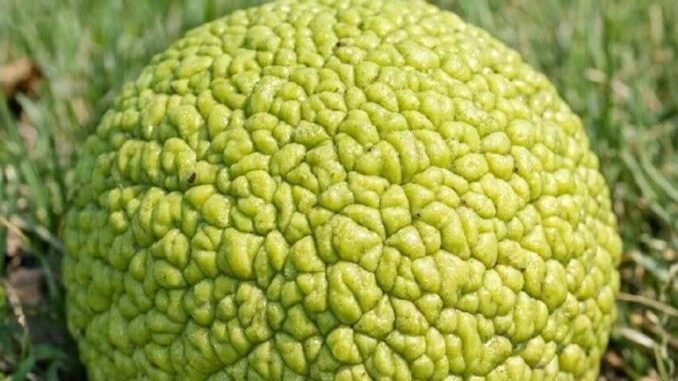
If you’ve ever walked through a park, forest edge, or old farm area and suddenly spotted a strange, bright green object sitting under a tree, you’re not alone. Many people have reported finding a weird, bumpy, almost brain-like green ball on the ground—sticky to touch, heavy, and oddly out of place in nature.
At first glance, it looks like something unnatural. Some people even assume it might be a fungus, an alien plant, or some kind of poisonous growth. But the truth is far more interesting—and completely natural.
What you’re looking at is most likely a Osage orange fruit, also commonly called a hedge apple.
What Is the Green Bumpy Ball?
The object in the image is the fruit of the Osage orange tree (Maclura pomifera). Despite the name, it is not actually an orange and not closely related to citrus fruits at all.
It grows on a deciduous tree native to parts of North America, especially the south-central United States. The tree itself is hardy, thorny, and often planted in rural areas.
The fruit is:
- Bright green when fresh
- Rough, bumpy, and wrinkled in texture
- Roughly softball to grapefruit-sized
- Sticky or latex-like when cut or damaged
- Strongly scented when opened
Because of its unusual surface pattern, people often say it resembles a brain, a lump of clay, or even a dinosaur egg.
Why Does It Look So Strange?
The unusual appearance of the hedge apple comes from its tightly packed surface structure. Each bump on the fruit corresponds to part of its internal seed system.
Unlike smooth fruits such as apples or oranges, Osage orange fruit grows in a dense, compound structure made up of many small fused segments. This creates its signature “brain-like” texture.
The sticky feeling comes from a milky latex sap inside the fruit. When the fruit is damaged or broken, this latex can ooze out, making it feel tacky or rubbery to the touch.
Is It Dangerous?
Despite its odd appearance, the Osage orange fruit is not dangerous to touch, although it is not recommended to eat it.
Here’s what you should know:
 Not poisonous to touch
- Not edible for humans
- Can cause mild skin irritation in some people due to latex sap
 Safe to observe and handle briefly with clean hands
While not toxic, the fruit is considered inedible because it is extremely bitter and dense. Most animals avoid eating it as well.
Why Do These Fruits Fall Under Trees?
Osage orange trees produce large fruits in late summer and fall. Once mature, the fruit simply drops to the ground naturally.
Because the fruit is heavy and not eaten by most wildlife, it often:
- Falls and stays in one place
- Collects under the tree canopy
- Remains intact for weeks or months
- Slowly breaks down over time
This is why people often discover them suddenly while walking through wooded or grassy areas.
The History Behind the Osage Orange Tree
The Osage orange tree has a surprisingly important place in American history.
Long before modern fencing, settlers in the 1800s used this tree to create natural barriers. Its wood is extremely strong and flexible, and its thorny branches made it ideal for forming living fences.
In fact, before barbed wire became common, many farms across the United States used Osage orange hedges to keep livestock contained.
This is where one of its nicknames—“hedge apple”—comes from.
Why Do People Still Talk About It Today?
Even though it is not a common food or commercial fruit, hedge apples continue to attract curiosity for several reasons:
1. Unusual Appearance
Its brain-like surface makes it one of the most visually unusual fruits in North America.
2. Folk Beliefs
There are many myths surrounding it. One of the most common is the idea that hedge apples repel insects like spiders. However, there is no strong scientific evidence supporting this claim.
3. Landscaping Presence
Older farms and rural properties still have Osage orange trees growing naturally or as remnants of old hedgerows.
4. Seasonal Mystery
Every fall, people rediscover them and post photos online asking, “What is this strange green ball?”
Can You Eat It or Use It?
Despite its citrus-like name, Osage orange is not typically used as food.
However, it has had some historical uses:
- The wood is highly valued for fence posts and tool handles
- The fruit was sometimes used for decoration or novelty purposes
- Seeds inside the fruit can be extracted, but are not commonly consumed
Modern use is mostly limited to landscaping, ecological restoration, or historical preservation.
Why It Feels Sticky
The sticky texture comes from a natural latex compound inside the fruit. This latex is part of the plant’s defense system, helping protect seeds from insects and animals.
When the fruit is cut, bruised, or begins to break down, the latex becomes more noticeable. This is what gives it that unusual “sticky brain” sensation when touched.
How Long Do They Last on the Ground?
One of the interesting traits of Osage orange fruits is their durability.
They can remain intact for:
- Several weeks in warm weather
- Several months in cooler conditions
Eventually, they dry out, crack, and decompose naturally, blending back into the soil.
What Should You Do If You Find One?
If you come across one of these strange green balls in nature:
- Observe it rather than handling it too much
- Avoid cutting it open unless necessary
- Wash hands after touching it
- Enjoy the discovery—it’s completely natural and harmless
It’s a great example of how nature can still surprise us with shapes and textures that feel almost artificial.
Final Thoughts
What first looks like something mysterious—or even alarming—is actually just one of nature’s most unusual fruits. The Osage orange may not be edible or widely used today, but it carries a fascinating history and a truly unique appearance that continues to confuse and intrigue people.
So the next time you find a strange, bumpy green “brain ball” under a tree, you’ll know exactly what it is:
A hedge apple—nature’s own odd little sculpture, quietly falling from a tree that has been part of North American landscapes for centuries.
Leave a Reply