I’ve lived next door to Harold Peterson for over thirty years. Long enough to remember when his life still felt full of movement—when his mornings started early, his truck came and went with purpose, and that porch of his wasn’t just part of the house, but something he built with his own hands.
He wasn’t the kind of man who talked much about what he knew. He just showed it. You could see it in the way he measured twice before cutting once, in the way he fixed things without being asked, in the way the porch boards lined up with quiet precision. It wasn’t showy. It was solid. The kind of work that lasts because it was done right the first time.
Back then, the porch wasn’t just an entrance. It was a place where life happened. Coffee in the morning. Shade in the afternoon. Quiet evenings watching the neighborhood settle down. It held decades of small moments that never made it into photos, but somehow still defined a life.
Now Harold is ninety-one.
He’s in a wheelchair most days. His movements are slower, his voice softer, and the house that once felt alive with care has started to reflect the passage of time in ways that are harder to ignore.
After his wife passed away, something in the rhythm of his life changed. Not all at once, but gradually. First, fewer cars in the driveway. Then longer gaps between visits. Then holidays that used to bring family suddenly passed without anyone coming at all. His children didn’t cut ties loudly—they just drifted, the way people sometimes do when distance becomes easier than responsibility.
And the house responded in its own quiet way.
The porch was the first thing to show it.
A few boards started to give slightly under weight. Then the railing loosened. A ramp was added later, not built properly, just enough to make getting in and out possible. It worked, but barely. Every time I saw Harold use it, I found myself watching a little too closely, wondering how long it would hold.
Eventually, the city got involved. An inspection notice came. Then a warning. The house, they said, could be condemned if the issues weren’t addressed.
That’s when Harold called his children.
He didn’t ask for much. Just help fixing what was falling apart. A way to keep living in the place he had built his life around.
Their answer, according to him, was simple. It wasn’t worth the cost. It could wait. Maybe after. Maybe later. Maybe when he was gone and it stopped being a question anyone had to deal with.
There are sentences that stay with you longer than you expect them to. That was one of them.
That night, I couldn’t let it go.
I didn’t have the tools, and I didn’t have the skills to fix something like that myself. But I knew people who might.
So I went to a local motorcycle club a few towns over. Not because I expected anything, but because I didn’t know who else would listen.
I told them the truth as I understood it. An old man. A broken porch. A house he had built with his own hands, now left to fall apart while the people who should have cared simply stepped away.
They didn’t ask many questions at first. Just listened.
Then something shifted.
One of them asked his name.
When I said it, there was a pause I didn’t expect. A few of them exchanged looks. And then one of them said they knew him.
Years ago, Harold had helped one of their families. Not in any dramatic way. No stories worth retelling at length. Just small acts of help when it mattered, done without asking for anything in return.
By the next morning, they were there.
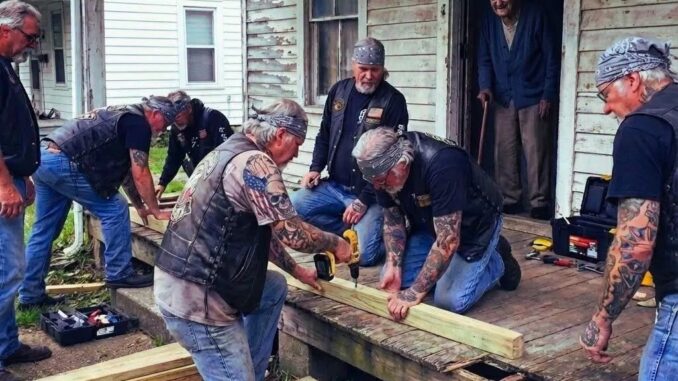
Trucks pulled up early, carrying lumber, tools, and whatever else they needed. There was no announcement, no discussion of payment, no expectation of recognition. They just got to work.
What happened over the next three days felt almost unreal when you watched it unfold from the sidewalk.
Old boards came off. New supports went in. The structure that had started to fail was slowly rebuilt into something strong again. Not decorative. Not fancy. Just solid in the way something should be when it is meant to keep someone safe.
Harold sat outside for most of it, watching quietly.
At first, he didn’t say much. Just observed, as if trying to understand whether what he was seeing was real or temporary. But as the work continued, something in his expression changed. Not dramatically. Just a softening. A release of something he had been carrying without naming it.
People came and went. Sawing, hammering, measuring. Conversations mixed with the sound of tools. And through it all, the porch began to look like itself again—only stronger.
On the third day, it was finished.
The new porch wasn’t just repaired. It felt restored. Safe again. Steady again. The kind of structure you don’t think twice about stepping onto, which is exactly how it should be.
Harold rolled out onto it slowly.
He tested it without saying a word. Then he just stayed there.
And for the first time in a long while, he didn’t look like someone waiting. He looked like someone present.
Later, I saw him talking with them. Not long conversations, just moments. Small exchanges that didn’t need to be deep to matter. There was laughter at one point. Quiet, but real.
What stayed with me wasn’t just the repair itself. It was what it changed.
Not only the porch, but the man using it.
Because in the end, it was never really about wood or nails or structural beams. It was about what happens when someone who has quietly disappeared from other people’s priorities is suddenly seen again.
And sometimes, that is enough to hold everything together.
Leave a Reply