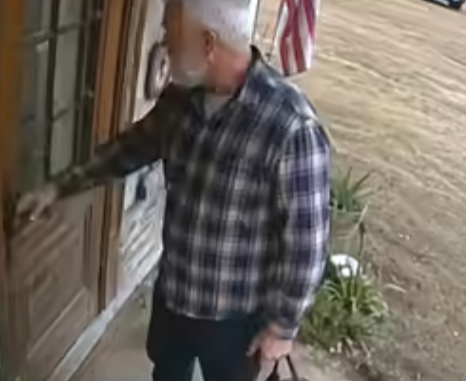
When I inherited my late wife’s old farm, I thought I already knew what grief looked like. I had lived with it for months—sometimes quietly, sometimes like a weight pressing against my chest that made even ordinary days feel unfamiliar. But nothing prepared me for the moment I discovered that the inheritance she left behind was not just land, not just memories, and not even the strange division between what my son and I received.
My son had been given something symbolic, almost dismissive at first glance: five dollars tucked into an envelope, a detail that felt almost cruel in its simplicity. Meanwhile, I was left with an entire farm—soil, buildings, silence, and questions. At first, I couldn’t understand her intention. It felt uneven, like a puzzle missing context, or a final message written in a language I no longer spoke fluently.
But as I stood at that worn wooden table, staring at the envelopes she had left behind, I felt something shift. Beneath the confusion and grief, there was something else—something quieter. A sense that she hadn’t abandoned us. She had prepared something.
On the table sat an olive-wood trunk I had never seen before. It didn’t belong to the house as I remembered it. It looked older, more intentional, like it had been placed there for a reason rather than forgotten. I approached it slowly, as if movement alone might disturb whatever fragile truth it contained.
Inside was an envelope marked clearly in her handwriting: “FOR YOU FIRST.”
My hands shook as I opened it.
The letter inside was unmistakably hers. The looping script, the careful spacing between words, the sense that she had written it not in haste but in a kind of quiet certainty.
She began by acknowledging everything I was feeling—confusion, sadness, even anger. She knew me well enough to anticipate all of it. But what struck me most was not what she apologized for, but what she refused to apologize for. She told me plainly that nothing she had done was accidental.
She wrote that the farm was not simply property. It was a foundation—one she had been preparing long before I understood its purpose. She asked me not to judge my son too quickly, to understand that different people process inheritance in different ways, and that what looks like imbalance at first may reveal intention later.
And then she directed me to the barn.
That single instruction changed everything.
The Barn That Held More Than Dust and Time
The barn had always been part of the property, but I had never paid attention to it. Like many old structures on forgotten land, it had become something you look at without truly seeing. Its doors hung slightly open, as though it had been waiting for me all along.
Inside, the air was cooler, thick with the scent of hay, wood, and time itself. Dust floated through thin beams of light that cut through cracks in the walls, illuminating everything in a soft, suspended haze.
At first glance, it looked like any abandoned rural structure—tools left behind, crates stacked in uneven corners, a sense of life paused rather than ended. But as I moved deeper inside, I noticed something carefully preserved beneath a tarp in the far corner.
I hesitated before lifting it.
What I found beneath was not what I expected from grief or inheritance or even memory.
A vintage tractor sat beneath the cover, worn but intact, as if it had been preserved rather than abandoned. But beside it—neatly arranged, intentionally placed—were blueprints.
Not just any blueprints.
Plans for a community center.
A Dream I Never Knew She Was Building
At first, I couldn’t process what I was looking at. The drawings were detailed, professional, and carefully annotated. They showed gathering spaces, learning rooms, shared gardens, and open halls designed for people to come together rather than stay apart.
Alongside the plans were lists of names. Contacts. Notes. Conversations I had never been part of. People from the community—builders, organizers, neighbors—individuals my wife had quietly connected with while I was still living my own version of daily life, unaware of the foundation she was laying beneath it.
It became clear in that moment: she hadn’t been preparing to leave us behind. She had been preparing something for us to step into.
The inheritance was not divided carelessly between me and my son. It was structured. Symbolic. Intentional. The five dollars my son received wasn’t dismissal—it was direction. A reminder that value isn’t always financial, and that responsibility sometimes begins with something small enough to carry in your hand.
The farm, on the other hand, was not a gift of possession. It was a responsibility of creation.
Understanding What She Left Behind
As I stood there in the barn, surrounded by dust and blueprints, I began to understand what she had been trying to do. She had taken something that could have been purely private—a piece of land, a memory, a wound—and turned it into something outward-facing. Something alive.
She wasn’t asking me to preserve the past.
She was asking me to build from it.
That realization shifted something deep inside me. The grief was still there, but it no longer felt like an ending. It felt like a threshold I had been standing in front of without realizing it.
The farm was no longer just an inheritance. It was a beginning disguised as an ending.
And for the first time since her death, I felt something I had almost forgotten was possible: direction.
The Beginning of Something Larger Than Loss
When I walked back toward the house, the weight I had been carrying felt different. Not lighter exactly—but transformed. Grief still existed, but it was no longer the only thing occupying space inside me.
There was purpose now. Not clarity in the complete sense, but enough to take the next step.
Back at the table, I looked again at the second envelope. I didn’t open it. Not yet. Something told me it wasn’t meant for this moment. Some things, I realized, are revealed only after you begin moving forward.
For now, there was work to do. Conversations to have. Plans to understand. Bridges to repair—especially with my son, who was now part of something I was only beginning to see clearly.
And beneath it all was the quiet presence of my wife’s intention, not as a voice from the past, but as a structure still unfolding in the present.
The farm was not a mystery to solve.
It was a future to build.
And for the first time in a long time, I was ready to start.
Leave a Reply