It was the kind of night that never feels dangerous until it suddenly is. The sky outside had already been unsettled, the air heavy in a way that makes windows rattle for no clear reason and sleep come uneasily. For Sydney Moore and Aramis Youngblood, it began like any other late evening in their quiet Tennessee home—two exhausted parents trying to settle their children, unaware that the world outside was about to turn violently against them.
No warning feels sufficient for a tornado. Even when sirens sound, there is often a disbelief that anything truly catastrophic will happen here, in your neighborhood, in your home, to your family. But when the storm arrived, disbelief was the first thing it destroyed.
The wind didn’t just rise—it surged. In seconds, the house began to shake as if something massive had grabbed hold of it. Walls groaned. Windows strained. The sound outside wasn’t just loud; it was overwhelming, like the world itself had turned into motion and noise without structure.
Then the roof gave way.
It wasn’t gradual. It didn’t peel or crack slowly. It lifted as though it had been designed to be removed, exposing everything inside in an instant to the raw, violent force above. Rain, debris, and wind flooded in together, turning a familiar home into something unrecognizable.
Inside, survival became instinct.
Sydney moved without thinking, reaching for their one-year-old son and pulling him close with a strength born only from panic. Aramis lunged toward their four-month-old baby, Lord, who lay in his bassinet—an object that, only moments earlier, had represented safety and routine. But nothing in that moment obeyed routine anymore.
The wind pressed harder. Objects inside the home became airborne hazards. Furniture shifted, shattered, disappeared. The structure itself seemed to be dissolving around them.
And then, in a moment that would later define everything that followed, Aramis lost his grip.
The bassinet was torn away.
Not tipped. Not slid. Torn—lifted and pulled into the chaos outside as if the storm had singled it out. In the same instant, the house began to fail completely, leaving Sydney and Aramis exposed to the full force of the tornado as it passed through and beyond them, leaving destruction in its wake.
When it was over, the world didn’t immediately return to normal. It never does. Instead, there was silence—an unnatural, ringing quiet that feels heavier than the storm itself. The kind of silence that forces reality to settle in all at once.
Their home was gone in the way tornado destruction often leaves nothing recognizable. What had once been shelter was now fragments scattered across mud and debris. And in that wreckage, one truth stood out above everything else: their four-month-old baby was missing.
There is a particular kind of terror that comes with not knowing. It is sharper than confirmed loss because it leaves room for hope and fear to exist simultaneously, each feeding on the other. Sydney and Aramis were not just grieving—they were searching.
Sydney, still in shock but driven by something deeper than exhaustion or pain, began walking through the aftermath. The landscape had changed into something unfamiliar, where trees and broken structures blended into one chaotic field of debris. She moved toward help, toward anyone who could understand what had just happened, covering more than a mile through rain and wreckage.
Aramis stayed behind.
He couldn’t leave the space where his child had last been seen. He moved through nearby woods and scattered debris, calling out into the dark, his voice breaking through the remnants of the storm. Every sound felt like possibility. Every shadow felt like hope reshaping itself into something recognizable.
Minutes passed like hours.
And then, something changed.
Deep in the treeline, Aramis heard something that didn’t belong to the wind or the aftermath. Not a cry. Not a call. Something smaller, more fragile—something that demanded attention rather than announced itself.
He followed it.
What he found defied the logic of everything that had just happened.
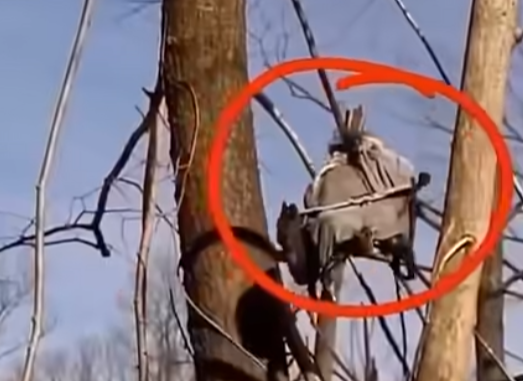
There, in the aftermath of a tornado strong enough to tear a home apart, was his son—alive. Lord had been carried from the destruction and somehow placed into the fork of a tree, protected just enough by position and chance to survive the storm. Injured, yes—a small concussion and minor ear trauma—but alive.
In that moment, relief doesn’t arrive gently. It crashes in, overwhelming everything else. Aramis held his child and walked back through the wreckage in disbelief, the reality of survival settling in only slowly, as if even his mind couldn’t immediately accept what had happened.
What remained of the family’s home, however, told a different part of the story. Survival had come at a cost. There was no structure left to return to, no intact belongings, no preserved normality waiting on the other side of the storm. Everything that defined their daily life had been erased in minutes.
They were alive—but starting over completely.
In the days that followed, something remarkable began to happen beyond the immediate disaster. News of the baby’s survival spread, and with it came something equally powerful: response. People who had never met the family felt compelled to act. Not out of obligation, but out of recognition of how fragile survival can be and how quickly life can change.
Support arrived in many forms. A fundraising campaign brought in over $105,000 to help rebuild what had been lost. Neighbors showed up with supplies—clothing, diapers, food, and comfort in physical form. Strangers contributed what they could, forming a network of aid that extended far beyond the boundaries of the storm’s path.
In the middle of devastation, a second force appeared: human connection.
For Sydney and Aramis, the experience became something layered. The trauma of what had been lost did not disappear, nor did the fear of what could have happened. But alongside it existed something else—an awareness that survival, in its most unexpected form, had been accompanied by a kind of collective compassion they had not anticipated.
In time, the story stopped being only about destruction and began to include what followed it: rebuilding, support, and the slow return of stability.
What happened that night will never be reduced to a simple explanation. Tornadoes do not offer clarity, only aftermath. But within that aftermath, a child survived against overwhelming odds, and a family began again from nothing.
And perhaps that is what makes the story linger.
Not just the force of the storm, but the fragile, improbable fact that even in its wake, life continued.
Leave a Reply