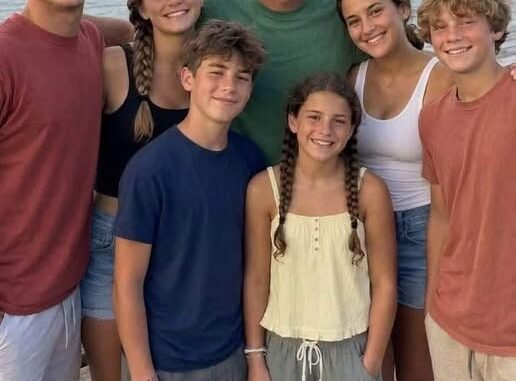
I still remember the day I chose not to leave.
It wasn’t dramatic. There was no speech, no life-altering revelation in the moment itself. Just six children standing in a living room that suddenly felt too big for them, and a silence that seemed to ask a question no one else wanted to answer.
Claire was gone. Not slowly, not gently—just gone. One day there was laughter in the kitchen, half-finished conversations, the smell of coffee she never finished drinking, and the next there was paperwork, condolences, and a house that no longer knew how to sound like a home.
Her family was overwhelmed. Mine was distant. And the children—her children—were left in the space between adults who didn’t know what to do with grief that complicated itself into logistics.
I wasn’t their father. Not legally. Not biologically. Not anything that made sense on paper.
But I stayed anyway.
At first, it was practical. Someone had to make meals, sign school forms, explain why the world suddenly felt different. Then it became routine. Then it became identity. Somewhere along the way, I stopped thinking of it as temporary.
Years passed in ways I didn’t fully notice until I tried to count them later. First school days. Broken bones. Late-night fevers. Birthday candles multiplied so many times I stopped remembering which number belonged to which year. I learned their rhythms, their fears, the way each of them went quiet when they were thinking too hard.
And I learned how to carry absence without letting it define the room.
They called me “Dad” long before I ever felt I had earned it.
I never corrected them.
Because correcting them would have meant admitting I was still afraid of leaving.
A decade has a way of making illusions feel like history.
By the time the oldest—Evan—was nearly grown, I thought we had settled into something stable. Not perfect. Not healed. But steady in the way families become when they stop waiting for life to restart and start living inside what remains.
Then, one evening, he came home later than usual.
He didn’t speak immediately. He just stood in the doorway, keys still in his hand, like he had walked in carrying something heavier than he knew how to put down.
“Dad,” he said finally.
And I knew from his voice that whatever came next wasn’t going to be small.
“I think you deserve to know the truth about Mom.”
The room didn’t change, but everything in it felt rearranged.
He told me he had found things—letters, old records, fragments of conversations between adults who had assumed children wouldn’t notice patterns. At first, I didn’t want to hear it. Not because I doubted him, but because I wasn’t sure I could survive having the image I had built of Claire reshaped by information I had never been given a chance to prepare for.
But he kept going.
And I listened.
What emerged wasn’t the clean story I had carried for ten years. Not betrayal in the simple sense. Not innocence either. Something far more complicated: a life she had partially hidden, choices made under pressure I had never seen, and a version of events that made room for explanations I had never been offered.
Not everything became clearer.
Some things became heavier.
And yet, strangely, something else shifted too.
Because truth doesn’t always erase love. Sometimes it just changes its outline.
A few days later, I met someone I had never expected to see.
Her name was Matilda.
She stood in the doorway of my home like a sentence halfway finished—familiar in a way that made my chest tighten, but unfamiliar enough to make my mind hesitate before assigning meaning. When she spoke, her voice carried something I couldn’t place at first. Not Claire exactly. Not imitation either. Something in between memory and inheritance.
The children saw her before I fully processed her presence.
And in that moment, I understood something I wasn’t prepared for.
They weren’t just meeting someone new.
They were meeting a possibility they had never been given the language to imagine.
Matilda didn’t come with answers. She didn’t arrive to replace anything or correct anything. If anything, she looked like someone standing at the edge of a story she had only recently learned she was part of.
We didn’t have a reunion.
We had an introduction to a missing piece that refused to behave like a solution.
At the table that night, no one knew how to sit correctly. The children kept glancing between her face and mine, as if checking whether the world had changed positions without warning. Matilda asked questions carefully, like someone stepping through fragile ground. I answered what I could. Left what I couldn’t.
Grief was still there. It didn’t vanish to make room for discovery.
But something else began to form beside it.
Not closure.
Accommodation.
Over the following weeks, we learned how to exist in the expanded version of a story none of us had chosen but all of us now had to live inside. The children began to understand that love doesn’t always come from one source, or one version of truth. That people can belong to a family even when they arrive late, or indirectly, or through the fractured edges of memory.
And I began to understand something quieter, but just as difficult:
I hadn’t just raised six children.
I had been raised by them too—into someone capable of holding contradiction without breaking it immediately into certainty.
One evening, Evan sat beside me on the porch, the same place where everything had started shifting years ago.
He didn’t repeat what he had said before.
Instead, he just asked, “Are you okay with all this changing?”
I looked at him for a long time before answering.
“No,” I said honestly. “But I think I can live with it.”
Because some truths don’t arrive to end a story.
They arrive to widen it.
And sometimes, that widening is the only way love keeps going without turning into something smaller than what it really was.
Leave a Reply