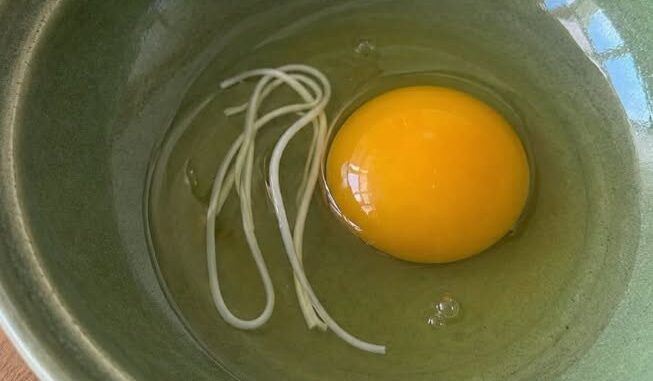
One morning while preparing breakfast, I cracked an egg into a bowl and noticed a thin white strand attached to the yolk. At first, it stood out because it looked different from what I usually see, and I paused to take a closer look.
Since unusual details in food can sometimes raise concerns, I briefly wondered whether the egg was safe to eat. To be cautious, I checked the remaining eggs in the carton, but none of them showed the same feature. That made me even more curious about what I had found.
Rather than making assumptions, I decided to look for information from reliable food safety and cooking sources. After a bit of research, I learned that the structure is called the chalaza.
What Is the Chalaza?
The chalaza is a natural part of an egg. It consists of twisted strands of protein that help keep the yolk suspended in the center of the egg white. This structure plays an important role in maintaining the stability and internal organization of the egg.
It is not a sign of spoilage or contamination—in fact, it is a normal feature found in fresh, healthy eggs.
Why It Can Be More Visible in Fresh Eggs
One interesting detail I came across is that the chalaza is often more noticeable in fresher eggs. As eggs age, this structure can become less visible, which is why many people may never observe it unless they are using very fresh eggs.
A Common but Overlooked Detail
Many people are unfamiliar with the chalaza simply because it blends into the egg white and is not usually noticeable during everyday cooking. However, it is a completely natural part of the egg’s structure and is safe to consume.
A Simple Reminder About Food Awareness
This small experience highlighted how easy it is to misinterpret unfamiliar details in everyday food. What initially seemed unusual turned out to be a normal biological feature with a useful function.
By learning a bit more about it, the concern quickly turned into a better understanding of how eggs are naturally formed. It served as a reminder that not everything unfamiliar is a cause for concern—sometimes it is just something we haven’t noticed before.
Leave a Reply