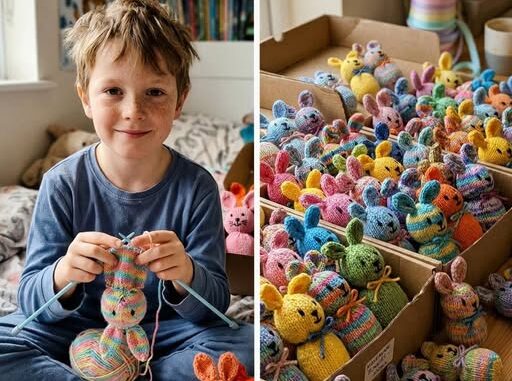
Grief, I’ve come to understand, doesn’t end when the hardest moment passes. It reshapes itself. It lingers in unexpected ways, in quiet corners, and sometimes in the hands of a child trying to make sense of loss the only way they know how. What happened in our family didn’t just expose pain—it revealed something deeper about love, memory, and the fragile process of blending lives after loss.
In the days after the incident, the house felt different. Not tense in the same sharp way as before, but cautious—like everyone was learning how to move around one another again. Claire kept her distance at first. She spoke softly, asked before touching anything, and most importantly, she paid attention. Not just to Liam’s words, but to the spaces between them.
Liam, for his part, didn’t return immediately to the boy he had been before the bunnies were thrown away. Trust, once shaken, doesn’t rebuild overnight—especially in a child who has already lost so much. But there were small signs. He no longer guarded the box as tightly. He allowed Claire to sit beside him while he worked. Once, I even saw him hand her a piece of yarn without hesitation. It wasn’t forgiveness in words, but it was something just as meaningful.
Claire began to change in ways that couldn’t be mistaken for performance. She asked Liam to teach her how to knit. At first, her stitches were clumsy, uneven—much like his had been in the beginning. But she didn’t give up. Night after night, she sat at the table, quietly practicing. Not to impress anyone. Not to fix what had happened overnight. But because she finally understood that being part of Liam’s world meant respecting what mattered to him, even if she didn’t fully understand it at first.
Daniel watched all of this carefully. He didn’t intervene often, but when he did, it was with clarity. He made it known—gently but firmly—that love in this house wasn’t conditional. That no one needed to erase the past to make room for the present. That Emily’s memory wasn’t a barrier; it was part of the foundation.
Over time, something new began to form—not a replacement for what had been lost, but a coexistence. A shared space where memories and new beginnings could exist side by side.
The bunnies, once nearly destroyed, became something even more meaningful. Some were imperfect from being discarded, slightly worn or reshaped. But Liam insisted on keeping them that way.
“They’re still okay,” he said once. “They just went through something.”
It was a simple statement, but it carried a truth many adults struggle to articulate.
They delivered the remaining bunnies to the hospital a week later. This time, Claire came prepared—not just to help, but to participate. She had finished knitting one herself. It wasn’t perfect. The ears didn’t match. The stitching was uneven.
But Liam smiled when he saw it.
At the hospital, the children didn’t care about perfection either. They held the bunnies close, smiled, and for a moment, forgot where they were. Watching them, I realized something profound: love doesn’t need to be flawless to be meaningful. It just needs to be sincere.
On the way home, there was a quiet peace in the car. Not the heavy silence of grief, but something lighter—something that felt like healing.
Claire glanced at Liam in the rearview mirror.
“Thank you for letting me help,” she said.
He shrugged slightly, then looked out the window.
“You can help again,” he replied.
That was all.
But it was everything.
In the months that followed, the house slowly found its rhythm again. Not the same as before—never that—but something steady, something real. Claire no longer tried to replace Emily. Instead, she learned how to stand beside her memory, not in competition, but in respect.
And Liam? He kept knitting.
Not because he was holding on to the past—but because he had found a way to carry it forward.
If there’s anything this experience taught me, it’s this: love isn’t proven by grand gestures or perfect words. It’s revealed in the willingness to understand, to admit when you’re wrong, and to rebuild what you once broke—piece by piece, with care.
Because sometimes, the most important lessons don’t come from what we hold on to.
They come from what we learn not to throw away.
Leave a Reply