Some places seem ordinary until you stop and really pay attention.
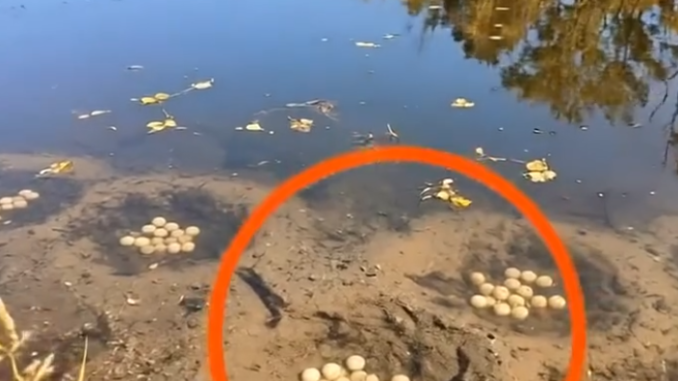
Near my village is a small artificial lake that most people barely notice. It sits quietly among trees, homes, and country roads, blending naturally into the landscape despite being man-made. On most days, it’s simply a peaceful spot where the water reflects the sky and surrounding greenery.
One afternoon, however, something beneath the surface caught my eye.
The water was unusually calm and remarkably clear. As I looked across the lake, I noticed dozens of pale, rounded shapes scattered across the bottom. From a distance, they appeared clustered together in an unusual pattern.
At first glance, I couldn’t tell what they were.
Letting My Imagination Take Over
Standing there in complete silence, I started coming up with explanations.
Could they be unusual rocks? Some kind of underwater plants? Debris arranged by the movement of the water? For a few moments, my imagination wandered far beyond the most likely answer.
The stillness of the lake only added to the mystery. Without ripples or movement, everything beneath the surface seemed frozen in place, making the shapes appear even more unusual.
Curiosity got the better of me.
I moved closer to the edge and changed my viewing angle, hoping for a clearer look.
The Simple Truth
As the sunlight shifted and the water became easier to see through, the answer suddenly became obvious.
They weren’t mysterious objects at all.
They were golf balls.
Dozens of them.
Some still looked almost new, while others had become faded after spending years underwater. A few even had faint logos that were still visible.
The nearby golf course had provided the explanation all along. Over time, countless missed shots had landed in the lake, gradually collecting on the bottom until they formed the unusual clusters I had noticed.
A Reminder About First Impressions
I couldn’t help but laugh.
Only a few minutes earlier, I had been imagining all kinds of unusual possibilities. In reality, the explanation was completely ordinary.
That experience reminded me how quickly our minds try to make sense of incomplete information.
When we don’t immediately understand what we’re seeing, it’s natural to begin filling in the gaps with assumptions. Sometimes those assumptions are accurate—but other times, the real answer turns out to be much simpler.
Why Our Brains Look for Patterns
Psychologists have long observed that people naturally search for patterns and explanations. It’s one of the ways we learn about the world.
When information is limited, the brain often builds a story using the clues available. Lighting, distance, reflections, and viewing angles can all influence what we think we’re seeing.
That’s exactly what happened to me.
The calm water, unusual shapes, and quiet surroundings made an everyday scene feel much more mysterious than it actually was.
The Beauty of Ordinary Discoveries
Looking back, I’m glad the lake didn’t contain anything extraordinary.
Instead, it gave me a simple reminder: not every mystery has an unexpected explanation.
Sometimes a strange-looking object is exactly what it appears to be once you see it from the right angle.
The lake hasn’t changed since that afternoon, but the experience changed the way I pay attention to everyday moments. It reminded me to stay curious while also keeping an open mind before jumping to conclusions.
Final Thoughts
It’s easy to create stories when we don’t have all the information. Whether it’s something we see in nature or a situation in everyday life, our first impression isn’t always the complete picture.
That quiet village lake turned out to hold nothing more than years of lost golf balls. Yet the experience left me with something far more valuable—a reminder that curiosity is important, but so is taking a closer look before deciding what we’re really seeing.
Sometimes the most memorable discoveries aren’t about finding something extraordinary. They’re about learning how easily our perspective can change once the full picture comes into view.
Leave a Reply