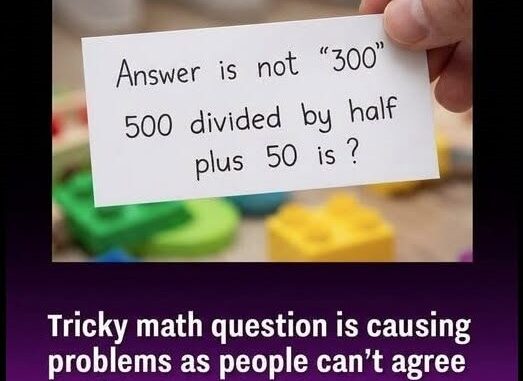
Mathematical puzzles often capture our attention, especially when they appear deceptively simple yet lead to varied answers. One such puzzle that has sparked widespread discussion involves the expression: 500 divided by half, plus 50. While it might seem straightforward at first glance, the solution challenges common assumptions and highlights the importance of interpreting mathematical language correctly.
Understanding Division by Fractions
Division is a fundamental arithmetic operation, but its application with fractions can sometimes confuse even those comfortable with basic math. When dividing by a fraction less than one, the result is counterintuitive to many—it actually becomes larger, not smaller. This is because dividing by a fraction asks, “How many of these fractional parts fit into the whole number?” Rather than reducing the number, it determines how many smaller parts make up the original quantity.
For example, consider dividing 10 by ½. Instead of halving 10, this operation asks how many halves are in 10. Since each whole contains two halves, there are twenty halves in ten, so 10 ÷ ½ equals 20. This principle applies universally: dividing by ¼ multiplies the number by four, dividing by ⅕ multiplies it by five, and so on.
Common Misinterpretations in Math Puzzles
The confusion often arises because the phrase “divide by half” is misread as “divide by two.” People tend to associate “half” with the number two since two halves make a whole. This mental shortcut leads many to calculate 500 ÷ 2 instead of 500 ÷ 0.5. The difference is significant: 500 ÷ 2 results in 250, whereas 500 ÷ 0.5 equals 1000.
Applying this to the original puzzle, the correct calculation should be:
500 ÷ 0.5 + 50 = 1000 + 50 = 1050.
However, a common incorrect approach is:
500 ÷ 2 + 50 = 250 + 50 = 300.
This discrepancy illustrates how subtle wording can change the entire outcome.
Mental Shortcuts and Their Impact
Our brains often use heuristics—mental shortcuts—to process information quickly. This mechanism helps in everyday decision-making but can lead to errors when details are overlooked. In math puzzles, the tendency to skim and rely on familiar patterns rather than carefully analyzing each term can result in incorrect answers.
The phrase “divide by half” triggers an automatic association with dividing by two, causing many to stop at the wrong conclusion. This puzzle serves as a useful reminder of the importance of deliberate reading and understanding the exact meaning of mathematical expressions.
Practical Tips to Avoid Similar Mistakes
- Read Carefully: Always take time to read math problems thoroughly, especially when fractions or unusual phrasing are involved.
- Translate Words to Numbers: Convert terms like “half” or “quarter” into their numerical equivalents before performing calculations.
- Understand Division by Fractions: Remember that dividing by a fraction is equivalent to multiplying by its reciprocal.
- Double-Check Work: Verify calculations by considering if the result makes sense logically.
These strategies help ensure accuracy not only in puzzles but also in real-world scenarios involving measurements, finances, and data interpretation.
The Role of Such Puzzles in Learning
Math puzzles that rely on language nuances encourage critical thinking beyond numerical operations. They require readers to engage with the problem statement carefully and question instinctive responses. This approach strengthens problem-solving skills and promotes a deeper understanding of mathematical concepts.
Moreover, puzzles like this highlight the interplay between language and math, demonstrating that comprehension is as vital as computation.
Broader Applications Beyond Mathematics
The lesson from this puzzle extends into everyday life. Misunderstandings often arise from assumptions and rushed interpretations, whether reading instructions, contracts, or technical documents. Developing habits of attentive reading and thoughtful analysis can prevent errors in various fields.
In workplaces, education, and personal decisions, taking a moment to clarify and confirm details can lead to better outcomes and fewer misunderstandings.
Exploring Similar Challenges
Many popular brain teasers and puzzles utilize similar principles, such as:
- Ambiguities in wording
- Order of operations (PEMDAS/BODMAS)
- Hidden meanings or double entendres
- Visual or spatial reasoning tricks
Engaging with these puzzles improves attention to detail and nurtures a mindset open to questioning initial impressions.
Conclusion
The expression “500 divided by half plus 50” exemplifies how mathematical language can be misinterpreted, leading to widely different answers. The correct approach, dividing 500 by 0.5 and then adding 50, results in 1050. This outcome underscores the importance of understanding what division by a fraction entails and recognizing the influence of mental shortcuts on problem-solving.
Beyond mathematics, this puzzle encourages a broader lesson: careful reading and critical thinking are essential tools in navigating information accurately. Whether tackling math problems or everyday tasks, slowing down to interpret details can prevent mistakes and enhance comprehension.
By appreciating the nuances of language and numbers, we can approach challenges with clarity and confidence, turning simple puzzles into valuable learning experiences.
The Importance of Precision in Mathematical Language
Mathematics is often praised for its precision and clarity, yet the language used to describe mathematical operations can sometimes introduce ambiguity. Phrases like “divide by half” are examples where everyday language and mathematical terminology intersect in ways that can confuse even experienced learners. In formal mathematics, expressions are typically written using symbols that leave little room for misinterpretation, but when translated into words, the meaning can become less clear.
This puzzle highlights the necessity of precise language, especially in educational settings. Teachers and textbooks strive to use consistent terminology to minimize confusion. For example, saying “divide by one-half” or “divide by 0.5” is clearer and less likely to be conflated with “divide by two.” Developing a habit of using specific and unambiguous language can help learners and educators alike avoid misunderstandings.
The Role of Mathematical Notation
Mathematical notation serves as a universal language designed to communicate ideas clearly and efficiently. Symbols like ÷, /, and fractions written as numerators over denominators help eliminate the ambiguities that can arise from verbal descriptions. For instance, writing the problem as 500 ÷ (1/2) + 50 immediately clarifies the intended operation.
This notation also reinforces the concept that dividing by a fraction is equivalent to multiplying by its reciprocal. Understanding and using proper notation can therefore aid in internalizing mathematical principles, making problem-solving more intuitive and less prone to errors.
Common Misconceptions About Fractions
Fractions often pose challenges because they can represent parts of a whole, division, ratios, or even operators in calculations. Confusion arises when these different interpretations overlap or when terminology is used loosely. The idea that dividing by a fraction increases the number is counterintuitive to many because it seems contradictory to the notion of division as a process of making something smaller.
Addressing these misconceptions requires reinforcing the conceptual understanding of fractions as numbers that can be greater than, less than, or equal to one, and recognizing how operations involving fractions behave differently than those involving whole numbers. Visual aids, such as pie charts or number lines, can help illustrate why dividing by a fraction results in a larger quotient.
Mental Math Strategies and Their Limitations
Many people rely on mental math shortcuts for efficiency, but these strategies can sometimes lead to mistakes if applied without full consideration of the problem’s specifics. The puzzle discussed exemplifies how mental shortcuts based on pattern recognition can conflict with the exact requirements of a problem.
Encouraging a balance between speed and accuracy is important, especially in educational contexts. While quick mental calculations are valuable, they should be accompanied by an awareness of their limitations and a readiness to verify results when the context suggests complexity or potential ambiguity.
The Educational Value of Puzzles with Language-Based Challenges
Puzzles that combine math with language nuances serve an important educational purpose. They encourage students to engage deeply with problem statements, fostering skills in careful reading, critical thinking, and precise interpretation. These skills transcend mathematics and are applicable across disciplines.
Incorporating such puzzles into curricula can make learning more interactive and stimulating, prompting discussions about common errors and the reasoning behind correct solutions. This approach also helps build resilience in learners by showing that mistakes are part of the learning process and opportunities for growth.
Media Literacy and Critical Thinking in the Digital Age
The rapid spread of puzzles like this one on social media platforms illustrates the role of digital media in shaping public engagement with educational content. While such puzzles can promote learning and curiosity, they also highlight the need for media literacy—skills that enable individuals to critically evaluate information, recognize potential misunderstandings, and seek clarity.
In an era where information is abundant and rapidly shared, developing media literacy helps individuals discern credible sources and avoid the pitfalls of misinformation. Applying these skills to mathematical puzzles ensures that learners not only enjoy the challenge but also understand the concepts accurately.
Career Implications of Strong Analytical Skills
The ability to interpret information precisely and apply logical reasoning is highly valued in many professions. Fields such as engineering, finance, data analysis, law, and medicine require careful attention to detail and the capacity to parse complex information correctly.
Engaging with puzzles that challenge assumptions and encourage meticulous thinking can contribute to developing these competencies. Practicing such skills through varied contexts, including mathematics, enhances cognitive flexibility and problem-solving abilities that are transferable to professional environments.
Legacy of Mathematical Puzzles in Education
Mathematical puzzles have a long-standing tradition as tools for entertainment and education. From ancient riddles to modern brain teasers, they have been used to stimulate intellectual curiosity and develop critical thinking.
Their continued popularity reflects the universal appeal of problem-solving and the satisfaction derived from overcoming challenges. By blending language and math, puzzles like the one discussed provide a rich learning experience that connects abstract concepts with real-world understanding.
Reader Takeaways
- Precision Matters: Carefully interpreting mathematical language is crucial to arriving at correct solutions.
- Division by Fractions: Remember that dividing by a fraction is equivalent to multiplying by its reciprocal, leading to a larger result when the fraction is less than one.
- Beware Mental Shortcuts: While helpful, mental shortcuts can mislead; verify your work when in doubt.
- Cross-Disciplinary Skills: The skills developed through such puzzles apply broadly beyond mathematics, enhancing communication, analysis, and decision-making.
- Enjoy the Process: Embrace puzzles as opportunities to learn and refine your thinking rather than just tests of knowledge.
By integrating these insights into your approach to problem-solving, you can improve both your mathematical understanding and your ability to navigate complex information in everyday life.
Understanding the Historical Context of Mathematical Puzzles
Mathematical puzzles have been a part of human culture for centuries, serving not only as entertainment but also as educational tools. Ancient civilizations such as the Babylonians and Egyptians used puzzles to convey mathematical concepts and challenge students. Over time, these puzzles evolved, incorporating linguistic tricks and visual elements to test reasoning and comprehension.
The puzzle involving division by fractions fits into this longstanding tradition by combining language and arithmetic to stimulate critical thinking. Recognizing the historical significance of such puzzles helps us appreciate their role in developing analytical skills across generations.
The Importance of Context in Mathematical Communication
Mathematics is often described as a universal language; however, the way mathematical ideas are communicated can vary widely depending on cultural, educational, and linguistic contexts. Words like “half” or “quarter” may carry different connotations or be interpreted differently depending on the audience’s background.
In educational and professional settings, providing clear context and definitions is essential to avoid misunderstandings. For example, specifying “divide by one-half (0.5)” rather than just “divide by half” can reduce ambiguity. This practice is especially important in diverse environments where learners or colleagues may have varying levels of familiarity with mathematical terminology.
Media Literacy: Evaluating Math Content Online
With the rise of social media and online forums, math puzzles often circulate rapidly, sometimes without adequate explanation or context. While this can spark interest, it can also lead to the spread of misconceptions if incorrect answers are accepted or shared widely.
Developing media literacy skills enables learners and educators to critically assess the accuracy of online content. Checking multiple sources, understanding the underlying mathematics, and questioning initial interpretations are key strategies. This approach not only applies to math puzzles but also to broader educational content encountered in digital spaces.
Career Skills Developed Through Mathematical Reasoning
Engaging with puzzles that require precise interpretation and attention to detail can enhance skills that are highly valued in the workforce. Analytical thinking, problem-solving, and the ability to communicate complex information clearly are essential in fields such as engineering, finance, law, and healthcare.
Moreover, the capacity to recognize when assumptions may lead to errors is critical in decision-making processes. Practicing with language-based math puzzles helps cultivate a mindset that balances speed with accuracy, an asset in high-stakes professional environments.
Connecting Mathematical Puzzles to Lifelong Learning
Beyond formal education, mathematical puzzles encourage lifelong learning by promoting curiosity and resilience. Encountering challenges that initially seem confusing but become clear through careful analysis can boost confidence and motivation.
This mindset is beneficial not only in academic pursuits but also in everyday life, where problem-solving and adaptability are constantly required. Embracing puzzles as opportunities for growth helps maintain cognitive sharpness and fosters an appreciation for the nuances of language and numbers.
Encouraging Collaborative Problem Solving
Math puzzles like the one discussed often gain popularity because they invite discussion and debate. Collaborative problem solving allows individuals to share perspectives, question assumptions, and refine understanding collectively.
In educational settings, group activities centered around such puzzles can enhance communication skills and promote a deeper grasp of concepts. In professional contexts, teamwork that values diverse viewpoints and meticulous analysis leads to better outcomes.
Final Reflections
The puzzle involving “500 divided by half plus 50” exemplifies how language and mathematics intersect in ways that can challenge our instincts. Recognizing the importance of precise communication, critical reading, and conceptual understanding not only improves mathematical proficiency but also enriches broader cognitive abilities.
By approaching problems thoughtfully and embracing the learning process, individuals can transform simple puzzles into meaningful experiences that enhance analytical skills and foster effective communication across various aspects of life.
Leave a Reply