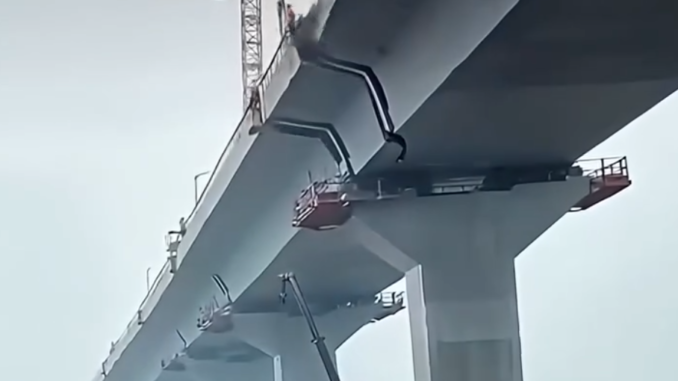
The first crack echoed through the construction site like a gunshot, sharp enough to stop conversations mid-sentence. Seconds later, the ground beneath the workers’ feet began to shift in a way no one could mistake for a normal vibration. In a single terrifying instant, everyone understood the same thing: the highway they had trusted moments earlier was no longer stable. Training collided with instinct as workers abandoned equipment, shouted warnings, and raced to safety, fully aware that a single wrong move could end in catastrophe.
Long after the danger passed, many would remember the sound before they remembered the fear itself. It began with the sharp snap of overstressed concrete, followed by the deep metallic groan of steel being forced beyond its limits. What started as a subtle tremor quickly intensified into a violent shudder that rippled through the structure. In a matter of seconds, an ordinary workday transformed into a desperate struggle for survival.
Construction crews reacted immediately. Men and women wearing orange safety vests dropped tools where they stood and focused solely on escaping. Some scrambled down scaffolding as quickly as their shaking legs would allow. Others jumped from machinery and temporary platforms, trusting instinct more than procedure. Orders and warnings filled the air as workers tried to ensure that everyone nearby understood the severity of what was unfolding.
Every second felt critical. Dust drifted through the air as parts of the structure shifted and groaned. The familiar sounds of construction were replaced by chaos, urgency, and the terrifying uncertainty of not knowing whether the next step would be on solid ground or collapsing concrete. Experienced workers who had spent years around heavy equipment suddenly found themselves confronting a danger that no amount of routine preparation could fully erase.
As the last workers reached safer ground, a different emotion settled over the scene. Relief mixed with disbelief. Many stood silently, staring back at the structure they had occupied only moments before, trying to process how close they had come to disaster. The danger had passed, but the reality of what nearly happened lingered heavily in the air.
For some, the event triggered memories of one of America’s most devastating infrastructure failures: the collapse of the I-35W bridge in Minneapolis in 2007. That tragedy claimed lives, injured countless others, and left emotional scars that still remain years later. The comparison surfaced immediately because the sounds, the sudden instability, and the terrifying uncertainty felt hauntingly familiar.
Leave a Reply