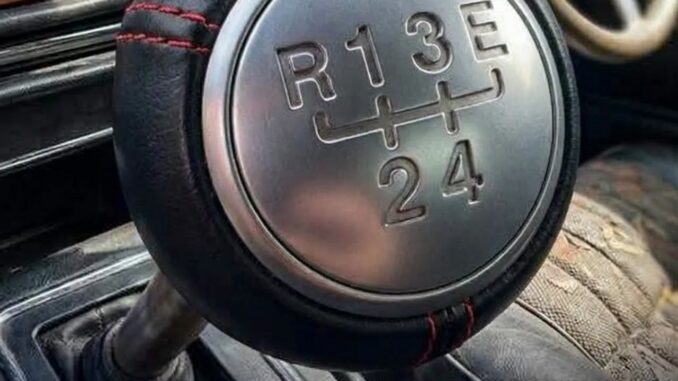
Before modern dashboards became glowing computer screens with automatic “Eco” modes, cars offered a much more tactile relationship between the driver, the engine, and the road. If you sat in the driver’s seat of certain vehicles from the 1980s and 1990s, you might have spotted a lone, mysterious letter “E” positioned right on or next to the gear shifter.
For many, it was a button or gear position they ignored entirely. But for those who understood it, the “E” was a gateway to a different kind of driving experience—one that prioritized quiet efficiency over raw speed.
Here is the real story behind what that mysterious “E” actually did, how it worked, and why it eventually vanished from our gear shifters.
What Did the “E” Stand For?
In almost every classic car equipped with this feature, the “E” stood for “Economy” (or “Efficiency”).
It was introduced during an era when car manufacturers were facing intense pressure to improve fuel economy, largely driven by the global oil crises of the 1970s. Rather than forcing a sluggish driving experience on everyone, manufacturers decided to give drivers a choice. You could either drive in the “S” (Standard or Sport) mode for normal throttle response, or switch to “E” (Economy) to conserve fuel.
How the “E” Mode Worked: A Tale of Two Systems
Depending on whether a car had an automatic or a manual transmission, the “E” functioned in two distinct, clever ways.
1. In Automatic Transmissions: Altering the Shift Points
On older automatic gearboxes—highly popular on classic European models like Mercedes-Benz—the “E” was typically a toggle switch next to the main shifter.
When you engaged Economy mode, it altered the transmission’s hydraulic programming:
-
Earlier Upshifts: The transmission would shift into higher gears much earlier in the RPM range, preventing the engine from revving highly.
-
Resisting Downshifts: If you pressed the gas pedal slightly to accelerate, the car wouldn’t immediately drop a gear and roar forward. Instead, it would use the engine’s natural torque to gradually build speed, saving fuel.
-
Second-Gear Starts: In many luxury automatics, selecting “E” forced the car to start moving from a complete stop in second gear rather than first, making acceleration incredibly smooth, quiet, and fuel-efficient.
2. In Manual Transmissions: The “3+E” or “4+E” Setup
The “E” also made a famous appearance directly on the shift knobs of older manual cars, most notably 1980s Volkswagens (like the Mk1 and Mk2 Golf/Rabbit).
Instead of a standard 4-speed or 5-speed pattern, the gear shift would list gears 1, 2, 3, and then “E” (or sometimes “4+E”).
[ Traditional 5-Speed ]   ──>   1  -  2  -  3  -  4  -  5
[ 1980s Volkswagen ]      ──>   1  -  2  -  3  -  E (Overdrive)
In these cars, the “E” gear was an extra-tall overdrive gear. It was engineered with a very low gear ratio meant strictly for highway cruising.
-
The Cruising Effect: Once you reached highway speeds in 3rd or 4th gear, you would pop the shifter into “E”.
-
RPM Drop: The engine RPMs would plummet, making the cabin incredibly quiet and stretching your fuel tank significantly.
-
No Acceleration: Because the gear ratio was so tall, “E” had virtually no acceleration power. If you needed to pass a truck or climb a hill, you had to shift back down to a standard gear.
Why the “E” Vanished from Our Shifters
As the decades progressed, the physical “E” began to slowly disappear from center consoles and gear shift knobs. This wasn’t because the automotive industry gave up on fuel economy, but rather because technology became smart enough to handle it automatically.
Several advancements phased out the manual “E” selector:
-
Electronic Control Units (ECUs): Modern cars are run by sophisticated computers that constantly monitor throttle input, speed, and engine load. The car automatically optimizes gear shifts for efficiency without requiring the driver to manually flip a switch.
-
Multi-Gear Transmissions: Early automatics had 3 or 4 speeds. Today’s automatics regularly feature 8, 9, or even 10 speeds, allowing the car to naturally sit in ultra-efficient overdrive gears whenever possible.
-
The Transition to “Eco Mode”: The mechanical “E” was eventually rebranded into the software-driven “Eco Mode” buttons we see on modern dashboards today, adjusting not just the transmission, but also climate control and throttle sensitivity.
A Forgotten Era of Mindful Driving
The “E” on those older shifters represents a fascinating era of automotive transition. It was a physical reminder that fuel efficiency wasn’t just something managed by an invisible computer algorithm—it was a conscious, mechanical choice made by the person behind the wheel.
For the drivers who used it, sliding that lever into “E” was a quiet decision to trade a bit of speed for a calmer, smoother, and far more deliberate journey.
Leave a Reply