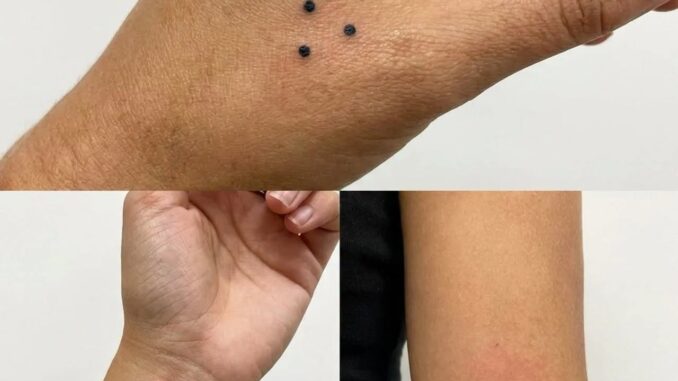
In a world driven by split-second judgments and viral warnings, fear has a way of traveling faster than the truth. I had seen the warnings online dozens of times, shared by well-meaning friends and sensationalized by local crime watch pages: “If you see someone with a three-dot tattoo, run as far as you can.” The internet had painted this tiny, inconspicuous symbol as an absolute mark of danger, a warning sign of criminal intent, and a reason to cross the street in a panic.
But life rarely operates in black and white. It wasn’t until a cold, rainy evening in late autumn that I learned how a tiny cluster of ink could carry a story far more human than the myths that surround it.
A Chance Encounter in the Rain
My name is Emerson. I have always considered myself a rational person, but fear is a powerful emotion. It bypasses logic and strikes straight at your survival instincts. That night, I was sitting in the corner of a dimly lit, 24-hour diner, nursing a lukewarm cup of coffee to escape a sudden downpour. The diner was nearly empty, save for the rhythmic hum of the neon sign outside and the soft murmur of the rain against the glass.
The bell above the door chimed, and a man walked in. He was tall, wearing a heavy, faded denim jacket with the collar turned up against the wind. His hands were calloused, the hands of someone who worked hard for a living. As he sat down two booths away from me, he pulled back his sleeve to check his watch.
That was when I saw it.
Etched into the pale skin of his right wrist, right below the joint, were three small, dark blue dots arranged in a neat triangle.
My heart did a sudden, violent flip in my chest. The viral warnings flashed through my mind in an instant. Run. Avoid them. It’s a sign of a dangerous life. I felt an immediate urge to slide out of my booth, pay my bill, and slip out into the rain. I stared at his wrist, my mind projecting a dozen dangerous scenarios onto a man who was simply ordering a slice of apple pie from the tired waitress.
But as I watched him, I hesitated. He didn’t look like a threat. He looked exhausted. There was a quiet gentleness in the way he spoke to the waitress, thanking her softly as she placed his plate down. When he noticed me staring, I quickly looked away, embarrassed.
Instead of getting angry, he caught my eye and gave a small, knowing smile. He looked down at his wrist, then back up at me.
“Don’t worry,” he said, his voice deep and calm. “It’s just ink.”
The Weight of Three Small Dots
Embarrassed but intensely curious, I ended up sliding into the booth opposite him after he invited me over. His name was Marcus. He was a carpenter, a father of two, and a man who had lived a lifetime of experiences before ever stepping into that diner.
“I know what people say when they see this,” Marcus said, tracing the three small dots on his wrist with his thumb. “They think it means trouble. They think it’s a warning sign. And to be fair, in some neighborhoods and during certain eras, it did have a specific association. But a symbol is just a vessel. The person wearing it is the one who pours the meaning inside.”
As Marcus explained, the three-dot tattoo is one of the most misunderstood markings in modern culture.
To many, especially in urban environments, the three dots represent the phrase “mi vida loca”—”my crazy life.” But contrary to popular belief, this phrase isn’t always a badge of criminal pride. For countless individuals, it is a badge of survival. It represents navigating through the chaos of poverty, surviving a turbulent youth, and making it to the other side of hardship. It is a symbol of resilience, a quiet acknowledgment that life was wild, difficult, and unpredictable, but they are still standing.
“For me,” Marcus said, looking out at the rain-slicked street, “it was about survival. I grew up in a place where you had to grow up fast. I got these dots when I was seventeen. To me, they didn’t mean I wanted to hurt anyone. They meant I was trying to survive the madness around me. Every time I look at them now, they remind me of where I came from, and how hard I had to work to build a quiet, honest life.”
A Multitude of Meanings
As we talked, I realized how incredibly vast the human experience is, and how foolish it is to reduce a person to a single mark on their skin. The three-dot symbol does not belong to any single group, culture, or story. It is a universal design, and its simplicity is exactly why it carries so many different voices.
For some, the three dots are deeply spiritual. They represent the Holy Trinity—the Father, the Son, and the Holy Spirit—worn as a constant, quiet prayer of protection on the skin. For others, they represent the past, the present, and the future, a physical reminder to remain mindful of life’s journey and to remember that whatever pain they are experiencing today is only a temporary point in a much larger timeline.
In other cultures, the symbol represents balance. Like a tripod, three points form the most stable foundation in geometry. It can represent the balance of mind, body, and spirit.
And for many, the meaning is incredibly personal and quiet. It can represent three children, three lost loved ones, or three major turning points in a person’s life that redefined who they are. Sometimes, it is simply an aesthetic choice—a first tattoo done in a moment of youth, a simple design that felt right at the time without needing a grand explanation.
The Danger of Judging by a Symbol
When we allow viral warnings to dictate how we view other human beings, we replace curiosity with fear. We begin to see threats where there are only people trying to get through their day.
If I had run out of that diner, I would have missed out on a wonderful conversation with a kind, hardworking man. I would have carried that irrational fear with me, letting it harden into a prejudice.
A tattoo does not define a person’s actions, their character, or their capacity for kindness. People define themselves through the choices they make every single morning when they wake up. Judging someone based solely on a tiny symbol on their skin removes their individuality, stripping away their personal history and replacing it with our own anxieties.
The real story of a human being is rarely visible at a single glance. It isn’t found in the ink on their skin, the clothes they wear, or the neighborhood they walk through. It is found in their words, their actions, and the way they treat the strangers they meet in the quiet, low-lit corners of the world.
As the rain began to clear, I thanked Marcus for his time and his honesty. Walking out into the cool night air, I felt a profound sense of relief. The world felt a little less hostile, and the warning that had once seemed so urgent now felt incredibly small. Before we assume the worst of someone, it is always worth remembering that symbols don’t carry meaning alone—we are the ones who give them meaning through the lives we choose to live.
Leave a Reply