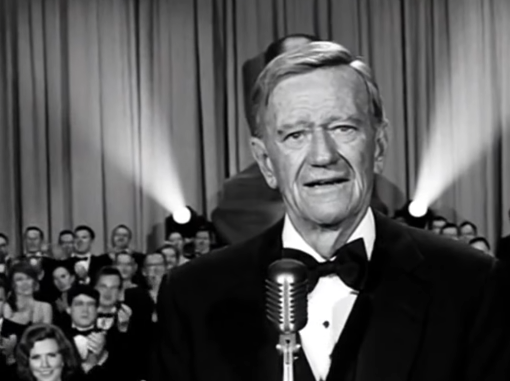
The glitz and glamour of the Academy Awards often feel manufactured, a carefully curated display of ego and expensive tailoring. But on the night of April 9, 1979, the Dorothy Chandler Pavilion witnessed something raw, human, and profoundly moving. It was a moment that transcended the industry’s typical vanity, centering on a man who had become the living embodiment of the American spirit. John Wayne, the legendary Duke, was dying. Yet, as the lights dimmed and the stage doors opened, he stood ready to deliver one final performance that would leave the most cynical power players in Hollywood weeping in their seats.
To understand the weight of that evening, one must look at the grueling months that preceded it. John Wayne was seventy-two years old, a veteran of nearly two hundred films and several brushes with the afterlife. He was a man who had survived the transition from silent films to Technicolor blockbusters, outlasting his peers and outrunning his own physical limitations. But by early 1979, the rugged exterior was beginning to crack. Just three months before the ceremony, Wayne had undergone what was supposed to be a routine gallbladder surgery. Instead, surgeons found themselves in a nine-and-a-half-hour battle for his life. The diagnosis was stomach cancer, a ruthless enemy that required the total removal of the organ.
This was not Wayne’s first dance with the “Big C.” In 1964, he had stared down lung cancer, losing a lung and several ribs in the process. He had spent years breathing with the help of oxygen tanks behind the scenes, only to step in front of the camera and project the image of a man who could outride and outshoot anyone on the frontier. In 1978, he had narrowly survived open-heart surgery to replace a failing valve. By the time the 1979 Oscars approached, the industry whispered that the Duke was finally down for the count. The invitation from his dear friend Bob Hope was more than just a request for a presenter; it was a lifeline, a chance for a legend to take a bow while he still had the strength to stand.
When the moment arrived, the atmosphere in the auditorium shifted. The audience was a sea of Hollywood royalty, men and women who had grown up watching Wayne’s silhouette define the horizon of the American West. They knew his politics were divisive and his persona was larger than life, but tonight, none of that mattered. As the announcer called his name, the silhouette appeared. He was noticeably thinner, his clothes hanging a bit more loosely on a frame that had once seemed carved from granite. Yet, he was tanned, his hair was perfectly swept, and that unmistakable, rolling gait remained intact. He ambled down the staircase with a grace that defied medical logic.
The reaction was instantaneous. It wasn’t the polite, rhythmic clapping usually reserved for industry veterans. It was a roar—a standing ovation that swelled from the front row to the back of the balcony and refused to die down. It was a collective acknowledgement of a man who had faced the ultimate darkness and decided to show up for work anyway. Tears streaked the faces of actors who had spent their careers trying to replicate Wayne’s effortless authority. As the thunderous applause finally subsided, Wayne approached the microphone, a faint, knowing smile playing on his lips.
He looked out at the crowd, his voice still carrying that gravelly, resonant tone that had echoed across cinematic battlefields for fifty years. He didn’t offer a scripted platitude or a rehearsed joke. Instead, he spoke five words that cut through the artifice of the evening: “That’s just about the only medicine a fellow would ever really need.”
Leave a Reply