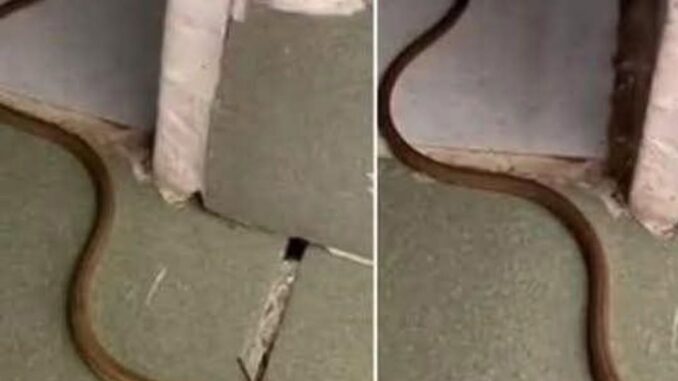
Your heart stops. A chilling, unmistakable hiss cuts through the silent room, and your worst nightmare comes true—there is a snake loose in your house. Panic instantly claws at your throat as adrenaline floods your veins. Is it venomous? Is it hiding right under your feet, waiting to strike? Most people completely lose their minds in this exact split second, screaming, running, or blindly grabbing a weapon—and making a fatal mistake that seals their doom. Do not move an inch until you read this urgent survival guide before a strike happens!
Finding a snake inside your living space feels like a scene straight out of a horror movie, but keeping your wits about you is the ultimate key to survival. Before you do anything else, try to identify the snake from a safe distance across the room. Note its color and pattern, whether solid, banded, blotched, or diamond. Look at its head shape, as triangular heads often indicate venomous species while rounded heads usually point to non-venomous ones. Check its size, ranging from small under 12 inches to medium or large over 3 feet, and observe its body shape.
The challenging reality is that most people cannot accurately identify snakes from a distance, especially when panicking. If you are ever unsure, always assume it could be venomous and keep your distance. Never get close to examine the head, never attempt to handle or capture the creature yourself, and never poke it with a broom or any other object just to see how it reacts.
In the first critical 60 seconds, your primary mission is to protect yourself and others using a calm, calculated method. First, isolate the snake by closing the door to the room where it is located. Slide a towel tightly under the door to prevent it from slithering into other areas of your home. Second, calmly move all people and pets out of the room without running or screaming. Snakes are acutely sensitive to ground vibrations, and sudden movements or loud noises cause massive stress, making a cornered snake far more likely to defend itself. Third, keep your eyes on the snake from across the room if you can safely do so, noting where it moves so you can inform professionals when they arrive.
What you must avoid doing is just as important. Never try to kill the snake, because a frightened and injured reptile is infinitely more dangerous than one left alone, dramatically increasing your risk of a painful bite. Never try to capture it yourself, as even non-venomous snakes possess mouths harboring bacteria capable of causing severe infections. Never corner it, because a snake with no escape route turns fiercely defensive. Give it space and let professionals handle the extraction.
When the unexpected happens, you do not need to handle the crisis alone. Call animal control if the snake occupies a living area like a kitchen, bedroom, or living room and you cannot safely isolate it, as officers are specially trained for capture and relocation. Call a wildlife removal service if the snake is venomous, exceptionally large, or stuck inside a wall or under a heavy appliance. Reserve 911 strictly for medical emergencies such as a severe bite, while animal control remains the correct resource for the animal itself. When you call, provide clear details to the dispatcher about the exact room location, size, color from memory, and whether anyone has suffered a bite.
If you suspect a venomous snake such as a rattlesnake, copperhead, cottonmouth, or coral snake, extra precautions are mandatory. Never attempt to capture or kill it under any circumstances, as the majority of venomous bites occur precisely when people attempt these reckless actions. Evacuate the room, seal the gap under the door, and keep all curious pets far away. Never attempt to flush the snake out by spraying water or making loud noises. Fortunately, even venomous snakes are rarely aggressive by nature and mostly bite only when accidentally stepped on, handled, or startled. Left alone, they will stay hidden until safely removed.
Leave a Reply