For months, I watched him from a distance.
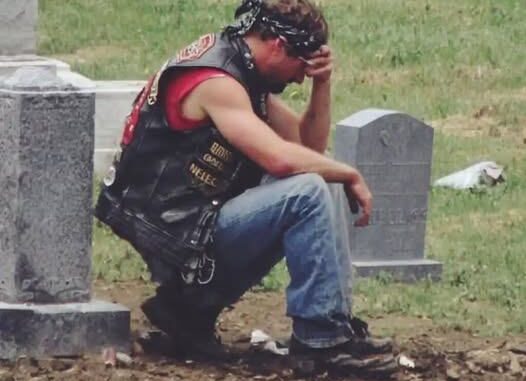
Every Saturday, right at 2 p.m., a man on a motorcycle would pull into the cemetery, park near my wife Sarah’s grave, and walk over with quiet purpose. He never brought flowers. He didn’t speak—at least not in any way I could hear. He would simply sit beside her headstone, head lowered, staying there for exactly an hour before leaving again.
At first, I assumed it was a mistake. Cemeteries are large places. People get confused. But when he returned the next week—and the one after that—I realized it wasn’t random. He was coming specifically for her.
And that didn’t sit right with me.
Sarah had been gone for over a year. She passed away at forty-three after battling breast cancer. We had built a life together—twenty years of marriage, two children, routines, memories, everything that makes a life feel whole. Losing her had left a silence in our home that nothing could quite fill.
So seeing a stranger show up week after week, grieving her in a way that felt deeply personal, stirred something in me I couldn’t ignore.
Who was he? How did he know her? Why did he seem to mourn her more consistently than some of the people who had known her for years?
It started to bother me more than I expected.
After a few months, curiosity turned into frustration. Eventually, I couldn’t just sit back and watch anymore.
One Saturday, I got out of my car and walked over.
He heard me approach but didn’t turn around right away. His hand rested on Sarah’s headstone, almost like he was grounding himself.
“I’m her husband,” I said, my voice firmer than I intended. “Can you tell me who you are?”
He stood slowly and faced me.
He was a large man—broad-shouldered, heavily built, with tattoos covering his arms and a long beard that gave him a rough appearance. But what stood out most were his eyes. They were red, like he had been crying
“I’m sorry,” he said quietly. “I didn’t mean to intrude. I just… needed to thank her.”
That caught me off guard.
“Thank her for what?” I asked.
He hesitated, then glanced back at the headstone.
“For saving my daughter’s life.”
We ended up sitting down right there, on either side of Sarah’s grave, as he began to explain.
His name was Mike. He worked as a mechanic and had a daughter named Kaylee. Years ago, when she was just nine, she was diagnosed with leukemia.
The treatment was overwhelming—not just emotionally, but financially. Insurance only covered part of it, and the remaining costs quickly became impossible to manage. He and his wife worked constantly, sold what they could, and asked for help wherever they could find it. But they still came up short.
They needed $40,000 to continue her treatment.
“I felt like I was failing her,” he said. “Like I couldn’t do the one thing I was supposed to do as her father.”
One day at the hospital, while his daughter was undergoing treatment, he broke down in the hallway. That’s when Sarah approached him.
She wasn’t even assigned to his daughter’s care that day. She just saw someone struggling and stopped to ask if he was okay.
“I told her everything,” Mike said. “Everything I was dealing with. And she just listened. No judgment. No fear. Just… kindness.”
Before she left, she told him something simple:
“Don’t give up. Sometimes things change when you least expect them.”
Two days later, he received a call from the hospital.
Someone had paid the remaining balance for his daughter’s treatment. All of it. Forty thousand dollars. Completely anonymous.
Kaylee was able to continue her care. Over time, she responded to treatment. Eventually, she went into remission. Today, she’s healthy—alive, thriving, and growing into her future.
For years, Mike tried to find out who had helped them.
He never got an answer.
Until recently.
While reviewing old paperwork, he noticed a reference tied to the payment. After some persistence—and a small slip from a hospital employee—he learned that the donor was a woman named Sarah.
From there, he did his own searching. Eventually, he found her—my wife.
But by the time he did, it was too late.
She had already passed.
“I never got to thank her,” he said. “So I come here. Every week. Just to tell her that it mattered. That my daughter is alive because of her.”
I didn’t know what to say.
Because until that moment, I didn’t know either.
Years ago, Sarah had used a large amount of money we had saved. She told me it was for something important, but she didn’t explain. We argued about it. I didn’t understand her decision at the time, and I carried that frustration for a long time.
Now I finally knew the truth.
She hadn’t wasted anything.
She had saved a life.
“I’m sorry if I’ve been coming here too often,” Mike said after a while. “I didn’t mean to overstep.”
I shook my head.
“No,” I said. “You should keep coming. She would want that.”
From that day forward, everything changed.
The following Saturday, I came back at the same time. This time, I didn’t watch from a distance. I brought a chair and sat beside him.
We talked.
Sometimes about Sarah. Sometimes about his daughter. Sometimes about nothing at all.
Eventually, he brought Kaylee with him.
She stood at the grave quietly, placed flowers down, and whispered a thank you.
It was a simple moment, but it carried more meaning than I could put into words.
Over time, Mike stopped being a stranger.
He became part of our lives.
He checks in on my kids. Helps out when things get overwhelming. His family and mine have grown close in a way I never could have expected.
And every Saturday, we still go.
We sit there together—not because we’re holding onto grief the same way we once were, but because we’re honoring something bigger than that.
A choice.
A moment.
An act of kindness that changed multiple lives.
People might look at us and wonder. The widow and the biker, sitting side by side at the same grave every week.
But what they don’t see is the connection behind it.
They don’t see the story.
I do.
My wife didn’t just live a good life—she made a difference in ways I never fully understood until now.
And now, that impact continues.
Every single week.
Leave a Reply