For a few seconds, everything around us seemed to disappear.
The forest trail we had been walking, the soft sounds of birds in the distance, even the wind through the trees—all of it faded the moment my son stopped in front of me. We had been out hiking for most of the morning on a familiar path not far from home. It was supposed to be peaceful, uneventful, the kind of outing where nothing unusual ever really happens.
That feeling shattered instantly when he tugged at my sleeve.
“Dad…” he said quietly.
There was something in his voice I hadn’t heard before—uneasy, sharp, almost afraid. He wasn’t pointing, but I followed his gaze anyway. My eyes dropped to the ground near the edge of the trail—and my stomach tightened.
Something was sticking out of the soil.
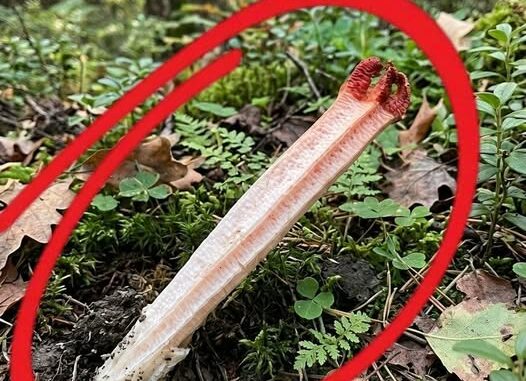
At first glance, it looked exactly like a human hand.
The shape was disturbingly convincing. Long, finger-like structures pushed up from the dirt at an unnatural angle, twisted and uneven. The color was a deep reddish tone, almost fleshy in appearance, with textures that seemed both soft and strangely rigid at the same time. It looked wrong in a way that made my brain hesitate to accept what I was seeing.
My son stepped closer to me without speaking, pressing against my side. I could feel his hand tighten on my sleeve.
“It’s okay,” I said, though I wasn’t fully convinced.
A second later, a faint smell reached us—damp, earthy, and slightly rotten. That made everything feel even more unsettling. My mind immediately started searching for explanations, most of them not good ones. Something dead. Something buried. Something we shouldn’t be standing near
For a moment, I just stood there, frozen between curiosity and instinct telling me to walk away. But curiosity won.
I pulled out my phone and crouched at a distance. The strange object didn’t move. That alone brought a bit of relief—no signs of life, no motion, nothing active.
I took a picture.
Then another.
My son asked again, “What is it?”
“I’m not sure yet,” I admitted.
I opened a plant identification app, not really expecting anything useful. I scanned the image and waited. After a moment, the result appeared.
Clathrus archeri.
Common name: Devil’s fingers.
A fungus.
For a second, I actually laughed in disbelief. My son looked at me like I had lost my mind.
“It’s not something bad?” he asked.
“It’s real,” I said, still looking at the screen, “but it’s not what we thought.”
I read the information more carefully. The fungus begins underground in a small egg-like structure. When it matures, it bursts open and produces several red, finger-shaped extensions that rise from the soil. The smell resembles decay, which attracts insects. Those insects then help spread its spores.
In other words, it was designed by nature to look exactly like something dead or dangerous.
I let out a slow breath I didn’t realize I was holding.
My son crouched closer, curiosity replacing fear. “So it doesn’t hurt you?”
“No,” I said. “Just looks terrifying.”
He gave a small nervous laugh, testing whether the fear had really gone. When nothing happened, his shoulders relaxed slightly.
Still, neither of us touched it.
We didn’t need to.
Some things in nature don’t have to be harmful to feel unsettling. They just challenge what we expect the world to look like.
We stayed there for a moment, watching tiny insects move around the strange structure. Life continuing its work, completely indifferent to how strange it appeared to us.
Eventually, I stood up and guided my son back toward the trail.
“Let’s keep going,” I said.
As we walked, he kept looking back over his shoulder.
“So it tricks bugs?” he asked.
“Yeah.”
“That’s actually kind of smart.”
I nodded. “Nature is full of things like that.”
The forest felt different after that. Not dangerous—just more mysterious. Like there was more happening beneath the surface than we ever notice. Every patch of ground suddenly seemed like it could hide something unexpected.
My son stayed closer to me for the rest of the hike, but not out of fear anymore. More like awareness. Like he understood the world was a little bigger and stranger than he thought.
And me?
I kept thinking about how quickly the mind can create fear from incomplete understanding. How easily something unknown becomes something threatening simply because we don’t recognize it yet.
By the time we reached the end of the trail, the moment had shifted completely. Not into fear—but into respect. For how strange and complex nature really is.
Before we left, my son asked one last question.
“Do you think there are more weird things like that out there?”
I looked back at the dense trees for a moment.
“I think,” I said slowly, “there are more things we don’t understand than things we do.”
He seemed okay with that answer.
And as we drove home, I realized something simple:
The forest hadn’t changed that day.
We had.
Leave a Reply