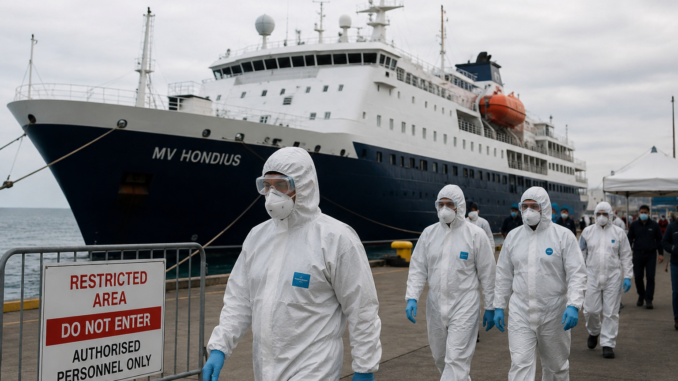
3 Dead and Over 140 Quarantined After Suspected Hantavirus Outbreak on MV Hondius Cruise Ship
A serious health emergency has been reported aboard the Dutch cruise vessel MV Hondius, where three people have died and three others are currently ill with suspected hantavirus infection.
More than 140 passengers and crew members remain under quarantine and are unable to disembark while health authorities investigate a possible strain of hantavirus capable of human-to-human transmission.
Officials believe the outbreak may involve the Andes strain of hantavirus, a rare variant known for its unusual ability to spread between humans in close-contact settings.
According to research supported by US Army Medical Research Institute of Infectious Diseases, the Andes strain has the potential to trigger “super-spreader” events, particularly in crowded social environments such as cruise ships.
A study published in New England Journal of Medicine documented a previous outbreak in Argentina in which a single infected individual transmitted the virus to multiple people during a social gathering.
Researchers believe transmission may occur through respiratory droplets or aerosolized particles during prolonged close contact, although hantavirus is more commonly spread through exposure to infected rodents.
Health Authorities on Alert
World Health Organization has identified hantaviruses among high-priority pathogens due to their outbreak potential and lack of widely available treatments or vaccines.
There is currently no licensed vaccine specifically approved for the Andes strain, although several vaccine candidates are under development.
Authorities are also conducting urgent contact tracing after one infected passenger reportedly disembarked and later died following a flight from St Helena to Johannesburg, raising concerns over additional exposure.
Passengers aboard MV Hondius have been advised to follow strict safety protocols, including isolation, mask use, social distancing, and in-cabin meal service while common indoor areas remain restricted.
The incident has raised renewed concerns about infectious disease management aboard cruise vessels, where enclosed environments and frequent social interaction can accelerate disease transmission.
Source: International media reports and health authority briefings.
Leave a Reply