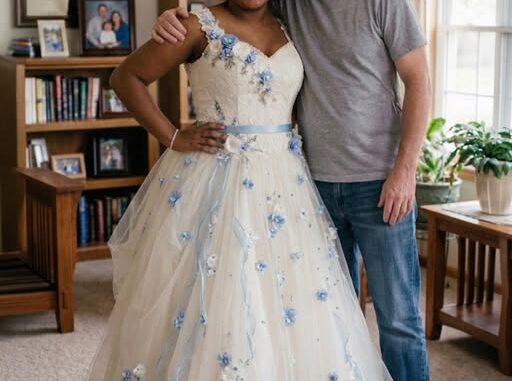
There are moments in life that don’t announce themselves as important when they happen. They seem ordinary at first—quiet, even forgettable—but later, they become the memories that shape how you understand love, family, and identity.
This is one of those moments.
It didn’t begin with something dramatic. It began with a sound.
The soft hum of a sewing machine coming from our living room late at night.
At first, I thought I was imagining it.
My father had never been the type of man you’d expect to sit down and sew. He worked with tools, not fabric. His hands were built for repairing pipes, tightening bolts, and fixing things that required strength and endurance rather than precision stitching. His routine had always been practical, physical, and predictable.
So when I first saw him sitting at that machine, carefully guiding fabric beneath the needle, I froze in the doorway.
For a moment, I genuinely thought I had walked into the wrong house.
He didn’t look up right away.
“Go to bed,” he said calmly, as if what he was doing was completely normal.
I stayed where I was. “Since when do you sew?”
His answer came without hesitation.
“Since I needed to learn.”
That was all he said.
And somehow, it was enough to make me more curious than ever.
Life After Everything Changed
I was very young when my mother passed away. I don’t carry many detailed memories from that time, but I remember the silence that followed. It wasn’t just the absence of sound—it was the absence of something familiar, something warm, something steady.
After that, it was just me and my dad.
We didn’t have an easy life, but we built one that worked. He took on everything himself—working long hours, coming home exhausted, and still finding a way to make sure I had what I needed. There wasn’t much room for extras or luxuries, but there was consistency, and there was effort.
That became our normal.
As I got older, I started noticing how much he sacrificed without ever making a show of it. He never complained. He just kept going.
By the time I reached my final year of high school, everyone around me seemed focused on prom. It was the big topic everywhere—dresses, plans, expectations, excitement.
For me, it felt slightly out of reach.
One evening, while we were cleaning up after dinner, I mentioned it casually.
“A friend said she might lend me a dress,” I said. “So I guess I’ll figure something out.”
My dad paused what he was doing.
“Why borrow one?” he asked.
I shrugged. “It’s just prom.”
He nodded slowly, as if making a decision in his mind.
“I’ll take care of it,” he said.
I laughed a little. “That sounds ambitious.”
But he didn’t laugh back.
He just said, “Trust me.”
Something Quiet Begins
After that night, I started noticing changes.
Small ones at first.
Boxes arriving that he quickly moved out of sight.
The closet staying locked more often.
And then, the sewing machine sound at night—steady, patient, unfamiliar.
One evening, I found him again sitting under a lamp, focused completely on his work.
“What are you making?” I asked.
“Something that’s not finished yet,” he said.
That answer told me nothing—and everything at the same time.
Over the next few weeks, I began noticing more signs that this project mattered deeply to him. Fabric scraps on the table. Small pricks on his fingers. Exhaustion he tried to hide behind routine conversations.
At one point, I noticed a bandage on his hand.
“What happened?” I asked.
He glanced at it. “Part of learning.”
He never explained more than necessary.
But I could feel the effort behind it.
School and Pressure
Around the same time, school started feeling heavier than usual.
There was a teacher who constantly gave feedback that sounded small on the surface but slowly built pressure over time.
“Try harder.”
“Not quite there yet.”
“You can do better.”
None of it was openly cruel. But it left an impression.
I started second-guessing myself more often.
My dad noticed.
One night, he saw me redoing an assignment I had already completed.
“You already finished that,” he said.
“I want it to be better.”
He leaned against the doorway.
“Did you try your best the first time?”
“Yes.”
“Then stop punishing yourself for it,” he said. “Not everything needs to be redone just because someone else expects more.”
I didn’t fully understand it then.
But I remembered it.
The Dress Appears
A few days before prom, my dad called me into the room.
He was holding a garment bag.
“Don’t react too fast,” he said.
That immediately made me nervous.
He slowly unzipped it.
And everything changed.
Inside was a dress unlike anything I had expected. It was carefully crafted, elegant in a way that felt deeply personal. The fabric carried a softness that made it feel almost timeless.
But what struck me most wasn’t just the dress itself.
It was something familiar inside it.
I looked closer.
And then I understood.
“Is that… Mom’s?” I whispered.
He nodded.
“I didn’t want it forgotten,” he said. “So I tried to turn it into something you could wear again.”
His voice lowered slightly.
“I hope I didn’t ruin it.”
I shook my head immediately.
“You didn’t ruin anything,” I said. “You made it alive again.”
That moment stayed quiet for a long time.
Because suddenly, it wasn’t just fabric.
It was memory.
It was love.
It was connection.
Prom Night Arrives
When the night of prom finally came, everything felt different.
Not because the world had changed—but because I had.
Putting on that dress felt like carrying something bigger than myself. It wasn’t just clothing. It felt like a piece of history, stitched together with intention and care.
When I arrived, people noticed immediately.
They complimented the dress, asked questions, admired the design.
For a while, everything felt easy.
Then someone made a comment that changed the tone slightly—something dismissive, suggesting it was unusual or out of place.
For a second, doubt crept in.
That familiar feeling of questioning myself.
But then I remembered something my dad had said.
Don’t change yourself just to fit expectations.
I took a breath.
And let it pass.
“I like it,” I said simply.
And that was the end of it.
A Shift in Confidence
After that moment, something inside me settled.
I stopped worrying about how everything looked from the outside.
Instead, I focused on being present.
On enjoying the night.
On being myself.
Friends gathered around to hear about the dress. When I told them my dad had made it, their expressions changed completely.
“That’s incredible,” one of them said.
“That’s really special,” another added.
And for the first time, I believed them.
I danced.
I laughed.
I didn’t overthink every moment.
Not because everything was perfect—but because I felt grounded in something real.
Coming Home
When I got home later that night, my dad was waiting.
Trying to act casual, but clearly curious.
“How was it?” he asked.
I smiled.
“It was exactly what it needed to be.”
He nodded slowly. “And the dress?”
I held it gently.
“It meant more than I can explain,” I said. “Not just because of how it looks—but because of what it represents.”
He didn’t respond right away.
But he didn’t need to.
Because we both understood.
What Stayed With Me
Looking back, it was never just about prom.
It wasn’t about the dress.
Or the event.
Or what anyone else thought.
It was about effort.
About patience.
About love expressed through action instead of words.
My father didn’t just make something for me to wear.
He created something that carried memory, care, and meaning stitched into every detail.
And in doing so, he gave me something far more lasting than a dress.
He gave me a reminder that the most meaningful things in life aren’t always the ones that look perfect from the outside.
They are the ones that are made with intention.
And those are the things that stay with you long after the night is over.
Leave a Reply