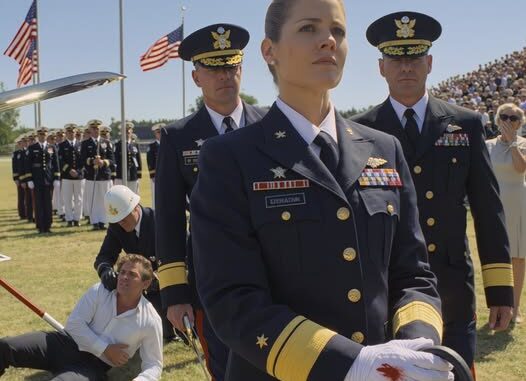
The North Carolina heat felt relentless that afternoon at Fort Liberty. Beneath the heavy layers of my Army Service Uniform, sweat pressed against my skin while rows of soldiers, officers, and families filled the ceremony grounds. It was supposed to be one of the proudest moments of my career — a formal military event marking years of discipline, sacrifice, and service.
The atmosphere carried the familiar sense of precision the Army is known for. Boots aligned perfectly. Commands echoed sharply across the field. Every detail mattered.
As I stepped forward to receive the ceremonial saber from the General, I tried to focus only on the moment in front of me. After years of hard work, I had finally earned a place I once thought impossible to reach.
Then everything shattered in seconds.
A voice suddenly cut through the silence.
“You don’t deserve to wear that uniform!”
Before anyone nearby could react, my stepbrother Ethan rushed forward from the crowd. His anger was immediate and explosive, fueled by years of resentment that had followed us since childhood.
He grabbed the saber directly from the General’s hands.
In the struggle, the heavy metal handguard slammed hard into my left hand. Pain shot through my arm instantly. I heard the crack before I fully understood what had happened.
My white dress glove quickly stained red with blood.
The entire field froze.
Hundreds of people watched in stunned silence as Military Police rushed toward Ethan and forced him to the ground. Shouting erupted from different directions, but for a brief moment everything around me felt strangely distant.
Instinct took over.
Military training teaches you to remain focused under pressure, even when chaos erupts unexpectedly. While medics moved closer and officers secured the scene, I concentrated on staying upright.
General Whitaker stepped toward me, his expression controlled but furious.
He looked directly at my injured hand before quietly asking, “Captain, can you still stand?”
It was more than a medical question.
It was an opportunity to step away with dignity if I needed to.
But after everything life had already forced me to survive, I refused to collapse in front of the people who had spent years trying to make me feel small.
I straightened my posture, lifted my chin, and saluted with my uninjured hand.
“Yes, sir.”
Photographs from that moment spread online almost immediately. News outlets focused on the image of a wounded officer remaining composed during a public attack. People called it strength, discipline, and professionalism under pressure.
But the truth ran much deeper than anyone outside my life could fully understand.
That moment on the parade field did not create my resilience.
It revealed it.
A Childhood Defined by Fear
Long before the Army, before medals and uniforms, my life revolved around surviving inside a home ruled by fear and silence.
I grew up in Charleston, South Carolina, in an old historic house where appearances mattered more than kindness. My stepfather, retired Navy Captain Douglas Porter, controlled the household through intimidation rather than affection.
Nothing was ever loud or openly violent.
Instead, the atmosphere itself felt heavy.
Every mistake became proof that I did not belong.
If I dropped something at dinner, I was called careless. If I spoke too much, I was disrespectful. If I stayed quiet, I was weak. There was never a way to win.
One Thanksgiving, I accidentally dropped a fork during dinner. Without saying a word, my stepfather scraped my entire plate into the fireplace while everyone sat silently watching.
No one defended me.
Not even my mother.
She spent years trying to keep peace in the house by avoiding conflict at all costs. Whenever tensions rose, she repeated the same phrase quietly:
“Don’t poke the bear.”
Over time, silence became survival.
My stepbrother Ethan learned quickly how power worked inside our home. He understood that cruelty often went unchallenged, and he used that knowledge constantly.
One memory stayed with me more than almost anything else.
After my biological father passed away, the only item I had left from him was a military dog tag. One afternoon, Ethan grabbed it from my room and threw it into the Cooper River while laughing.
I never got it back.
Finding Purpose in the Army
Joining the Army changed everything.
For the first time in my life, structure replaced chaos. Expectations were clear. Respect had to be earned, not demanded through fear.
At Fort Jackson, I discovered something important about myself.
The quietness I had been criticized for all my life was not weakness.
It was control.
It allowed me to remain calm under pressure while others panicked. It helped me focus during difficult situations. What had once made me feel invisible eventually became one of my greatest strengths.
Lieutenant Colonel Whitaker recognized that before I did.
He had served with my father years earlier and often told me I carried the same calm presence Henry had during difficult operations. Hearing someone speak about my father with respect changed me more than I expected.
For years, I had felt disconnected from his memory.
Whitaker gave me a way to reconnect with it.
The Army became more than a career. It became proof that my past did not define my future.
The Breaking Point
The final collapse within my family came shortly before the ceremony at Fort Liberty.
My mother’s health had declined significantly, and when I returned home to check on her, I discovered Ethan tightly controlling access to her life. Medications were being overused, security cameras monitored the house constantly, and isolation had become normal.
I became concerned enough to contact local authorities.
But years of fear had taken a deep toll on my mother. When police arrived, she defended Ethan and described me as unstable instead.
I was escorted away from the property like a stranger.
That moment hurt more than I can fully explain.
After she passed away, I returned one final time to sort through her belongings. Hidden inside her jewelry box was an old newspaper obituary for my father.
One sentence had been underlined carefully:
“He is survived by his daughter, Rowan.”
Despite everything, she had remembered me.
More Than Survival
Standing injured on that parade field, I realized something important.
Ethan believed public humiliation would reduce me back into the frightened girl he remembered from childhood. He thought one violent moment could erase everything I had built.
Instead, it exposed the truth.
The years of hardship had not destroyed me.
They had prepared me.
When the General returned the saber to my hand later that day, it felt heavier than before — not because of the injury, but because of what it represented.
It symbolized every battle that had brought me there.
Not just military service.
Personal survival.
Healing.
Identity.
And the decision to keep standing no matter how many times life demanded otherwise.
I did not remain standing for attention or recognition.
I stood for the younger version of myself who spent years believing she would never escape fear.
I stood for my father’s memory.
And I stood because resilience is sometimes built quietly, over years, inside moments nobody else ever sees.
The world did not break me.
It shaped me into someone stronger than the people who once tried to silence me.
Leave a Reply