A Design That Sparks Curiosity
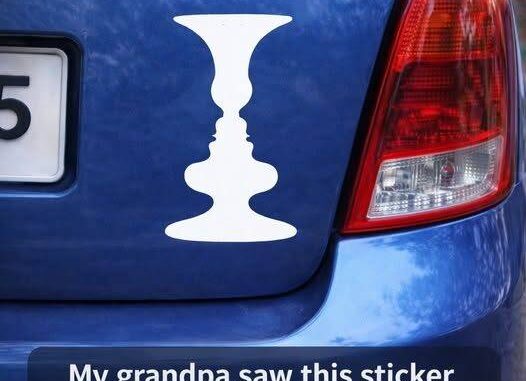
You may have noticed a simple black-and-white sticker on the back of a car that looks a bit unusual. At first glance, it might seem like a random graphic, a brand logo, or even a piece of abstract art. But this image actually has a much deeper meaning.
What you’re seeing is a classic visual concept known as Rubin’s Vase—a well-known example used in psychology and design to demonstrate how human perception works.
Where the Symbol Comes From
This image was introduced in the early 1900s by Danish psychologist Edgar Rubin. He created it as a way to study how people interpret visual information.
The design is carefully structured so it can be seen in two different ways:
- A central shape that looks like a vase or goblet
- Two human faces in profile, looking at each other
Both interpretations exist within the same image. The difference lies in what your brain chooses to focus on.
What It Actually Represents
The symbol illustrates a concept called figure-ground perception. This is the process your brain uses to separate an object (the “figure”) from its background (the “ground”).
In this case:
- If you focus on the center, you see a vase
- If you focus on the sides, you see two faces
Your brain can switch between these interpretations, but it usually can’t hold both at the same time. This makes the image a powerful example of how perception is not fixed—it’s flexible and constantly shifting.
Why Someone Would Put It on a Car
Unlike most car decals, this symbol isn’t tied to a brand, company, or organization. People typically choose it for more personal or aesthetic reasons.
Some common reasons include:
Visual Appeal
The clean, symmetrical design makes it eye-catching without being overwhelming.
Intellectual Interest
Because it’s connected to psychology and perception, it can reflect curiosity or appreciation for deeper ideas.
Conversation Starter
Many people don’t immediately recognize the image, which often leads to questions and discussions.
Not a Logo or Affiliation
It’s important to note that this symbol doesn’t represent:
- A car manufacturer
- A sports team
- A political or social group
Unlike most decals, it carries no official affiliation. It’s simply a widely recognized visual concept that belongs to the public domain.
Its Use Beyond Cars
This image appears in many different fields:
Education
It’s commonly used in textbooks and classrooms to explain perception.
Graphic Design
Designers use it to demonstrate how negative space can create multiple meanings.
Media and Marketing
Because it grabs attention quickly, it’s sometimes used in visual storytelling.
Why People Misinterpret It
Without context, the design can be confusing. People often assume it’s:
- A modern abstract graphic
- A cultural or symbolic image
- A custom logo
In reality, it’s over a century old and has a well-established background in psychology.
What It Reveals About Perception
One of the most interesting aspects of this symbol is how differently people interpret it.
- Some immediately see the faces
- Others only notice the vase at first
- Some don’t recognize both until it’s explained
This shows that perception depends on focus, attention, and past experience. Even when looking at the same image, people can see completely different things.
Why It’s Still Popular Today
Despite its age, the design remains relevant for a few key reasons:
Simplicity
Its clean structure makes it easy to recognize and display.
Universality
It doesn’t rely on language or cultural context.
Depth
It looks simple but carries a deeper meaning once understood.
The symbol on the back of the car isn’t random—it’s a classic example of how the human brain interprets visual information. Known as Rubin’s Vase, it demonstrates that what we see depends on how we look.
What appears to be a simple sticker is actually a small lesson in perception. It reminds us that even the most ordinary images can hold multiple meanings—depending on perspective.
And sometimes, understanding what we’re looking at just requires seeing it a little differently.
Leave a Reply