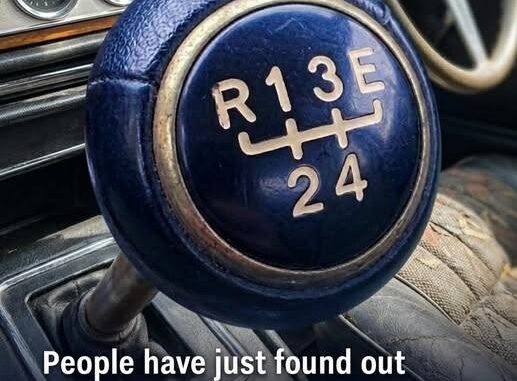
Modern vehicles are filled with sleek technology, digital dashboards, and automatic systems that quietly manage almost every part of the driving experience. Many newer drivers have grown up with push-button starters, touchscreens, and gear selectors that look more like computer controls than traditional car components. But older vehicles told a different story. Their interiors were mechanical, hands-on, and filled with symbols that represented how closely drivers once interacted with their cars.
Among the familiar letters found on older automatic gear selectors — like “P” for Park, “R” for Reverse, and “D” for Drive — there was once another letter that has largely disappeared from modern vehicles: “E.”
For many people today, seeing an “E” on a vintage car’s gear shift can feel confusing or mysterious. Yet decades ago, it served an important purpose. The letter stood for “Economy,” and it reflected a time when saving fuel became a major concern for drivers around the world.
A Feature Born During Fuel Concerns
The “E” mode became popular during the late 1970s, 1980s, and early 1990s, when fuel prices and energy shortages pushed automakers to focus more heavily on efficiency. Drivers were becoming increasingly aware of how much gasoline their vehicles consumed, and manufacturers searched for practical ways to improve fuel economy without completely redesigning engines.
Economy mode was one of those solutions.
When drivers selected “E” on the gear shifter, the transmission adjusted how the car behaved. Instead of allowing the engine to rev aggressively before shifting gears, the vehicle would switch into higher gears earlier. This kept engine speeds lower, reduced fuel consumption, and created a smoother, quieter driving experience.
The idea was simple: use less power whenever possible in order to save fuel.
While it may sound basic compared to today’s advanced automotive technology, it was considered a clever innovation at the time.
How Economy Mode Changed Driving
Drivers could immediately feel the difference after engaging Economy mode. The car became calmer and more controlled. Acceleration was softer, gear changes happened sooner, and the engine no longer pushed itself as hard during normal driving.
In many vehicles, pressing the gas pedal while in “E” mode produced a gentler response. Sudden bursts of speed were reduced, encouraging smoother driving habits that improved fuel efficiency over long distances.
This made Economy mode especially useful for highway travel or daily commuting. Drivers who wanted better gas mileage often relied on it during periods of expensive fuel prices.
Some people even treated it as a form of disciplined driving. Using “E” mode meant accepting slightly slower acceleration in exchange for spending less money at the pump.
Why the “E” Disappeared
As automotive technology improved, dedicated Economy gear positions slowly faded away. Cars became smarter, transmissions became more advanced, and onboard computers started managing fuel efficiency automatically.
Modern vehicles no longer need drivers to manually select an economy setting through the gear lever because the systems constantly optimize performance in real time.
Today’s transmissions can analyze speed, road conditions, throttle input, and engine load within fractions of a second. Many vehicles now feature eight, nine, or even ten-speed automatic transmissions designed to maximize efficiency without requiring any extra effort from the driver.
Instead of a physical “E” on the gear stick, modern cars may offer selectable driving modes such as:
- Eco
- Comfort
- Sport
- Snow
- Normal
In many cases, the car automatically adjusts itself behind the scenes without the driver even noticing.
As a result, the old “E” gear position gradually became unnecessary.
The Return of the Letter “E”
Interestingly, the letter “E” has made a comeback in the modern automotive world — but with an entirely different meaning.
In electric and hybrid vehicles, “E” now often refers to “Electric” driving or special energy-saving systems. Some vehicles use it to activate enhanced regenerative braking, while others use it to identify electric-only driving functions.
This creates an interesting connection between past and present.
Decades ago, “E” represented an effort to use less gasoline. Today, it often symbolizes vehicles designed to move beyond gasoline altogether.
The technology may have changed dramatically, but the underlying goal remains surprisingly similar: traveling farther while using less energy.
A Symbol of Automotive History
Older gear selectors reveal how much driving culture has evolved over the years. In the past, drivers were expected to actively manage many aspects of vehicle behavior. Cars required more direct input, more mechanical understanding, and more physical interaction.
The “E” mode reflected that era perfectly.
Rather than relying entirely on computers, drivers themselves chose when to prioritize efficiency over performance. It was a small but meaningful reminder that fuel economy once depended heavily on personal driving habits.
For many enthusiasts, classic cars equipped with an Economy mode represent a fascinating period in automotive history — a time when manufacturers experimented with practical solutions to growing fuel concerns long before modern hybrid systems existed.
More Than Just a Letter
At first glance, the old “E” on a gear shift may seem insignificant. But behind that small symbol lies a larger story about changing technology, economic pressures, and the evolution of transportation itself.
It represents an era when saving fuel became a serious priority and when drivers interacted with their vehicles in a far more mechanical way than they do today.
Even though the physical “E” has mostly disappeared from traditional gear selectors, its original purpose still lives on through modern efficiency systems, hybrid engines, and electric vehicles that continue pushing transportation toward a more energy-conscious future.
Sometimes the smallest details inside older cars reveal the biggest stories about how far automotive engineering has come.
Leave a Reply