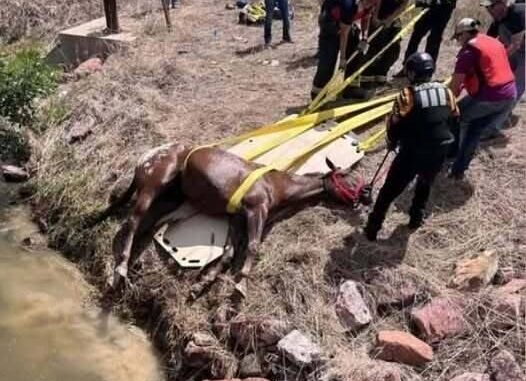
When emergencies unfold without warning, moments of courage and compassion often shine through, reminding us of the dedication of those who put themselves at risk to protect others, including animals in distress. A recent rescue in Colorado captured widespread attention after a team of firefighters carried out a remarkable effort to save a vulnerable horse from a dangerous situation, demonstrating not only technical skill but also deep commitment to preserving life in all its forms.
The incident began on a quiet morning when emergency responders were called to assist with a challenging and urgent situation involving a horse trapped in a canal. The animal, a female horse named Lacy who was in her twenties and blind, had somehow ended up standing in flowing water that reached up to her shoulders. Unable to see and disoriented by the current, she faced a serious risk of being swept away or succumbing to exhaustion. The conditions made the situation especially delicate, requiring careful coordination and specialized rescue techniques.
Firefighters from the Poudre Fire Authority responded quickly to the call, arriving prepared to handle the complexities of a large animal rescue in a water environment. They were joined by additional support teams, including a large animal rescue unit, veterinary professionals, and emergency medical personnel. Together, these groups formed a coordinated effort aimed at ensuring both the safety of the animal and the responders involved.
Rescuing a large animal from water presents unique challenges. Horses are powerful yet sensitive animals, and when they become frightened or confused, especially in an unfamiliar and stressful environment, they can react unpredictably. In this case, Lacy’s blindness added another layer of difficulty, as she could not rely on sight to navigate her surroundings or understand what was happening. This made it essential for the rescue team to approach her calmly and methodically to avoid increasing her stress.
One of the trained firefighters, experienced in both water rescue and animal handling, entered the canal to begin the delicate process. Moving carefully through the flowing water, the rescuer worked to secure a harness around Lacy in a way that would allow the team to guide her without causing harm. The goal was not only to keep her stable in the water but also to direct her toward a safer location where she could eventually exit the canal.
Instead of attempting to lift the horse directly from the steep area where she was trapped, the team made a strategic decision to guide her along the canal to a more accessible section. This required patience and precise coordination, as the responders slowly moved with her through the water, ensuring she remained as calm as possible throughout the process. Passing under a nearby bridge, they carefully led her toward a spot where the slope was gentler and more suitable for climbing out.
Throughout the rescue, communication and teamwork played a critical role. Each member of the operation had a specific responsibility, whether it was managing equipment, monitoring the animal’s condition, or ensuring the safety of those in the water. Veterinary experts were also on hand to assess Lacy’s health and provide support as needed, recognizing that prolonged exposure to cold water and stress could have serious effects on an older animal.
After a careful and steady effort, the team succeeded in guiding Lacy to a location where she could attempt to exit the canal. With encouragement and support, she was eventually able to make her way out of the water. The moment marked a successful conclusion to what could have easily become a tragic situation. Once safely on solid ground, she was evaluated to ensure she had not suffered any major injuries and was given time to recover from the ordeal.
Stories like this highlight the often unseen work carried out by emergency responders every day. While many people associate firefighters primarily with battling flames, their responsibilities extend far beyond that role. They are trained to respond to a wide range of emergencies, including rescues involving animals, natural hazards, and complex environmental situations. Their willingness to adapt and respond to unexpected challenges is a testament to their dedication and professionalism.
This rescue also underscores the importance of specialized training and collaboration between different organizations. Large animal rescues require knowledge, equipment, and coordination that go beyond standard emergency response procedures. By working together, firefighters, animal rescue teams, and veterinary professionals were able to combine their expertise and achieve a positive outcome.
In addition to showcasing skill and bravery, the story serves as a reminder of the strong bond between humans and animals. Many people view animals not just as property, but as companions and valued members of their lives. Efforts to rescue animals in danger reflect a broader sense of responsibility and compassion within communities, where protecting life extends to all living beings.
Although the situation was resolved successfully, it also highlights the importance of safety measures to prevent similar incidents. Ensuring that animals are kept in secure environments and away from hazardous areas such as canals or fast moving water can help reduce the risk of accidents. Awareness and preparedness can make a significant difference in preventing emergencies before they occur.
Leave a Reply