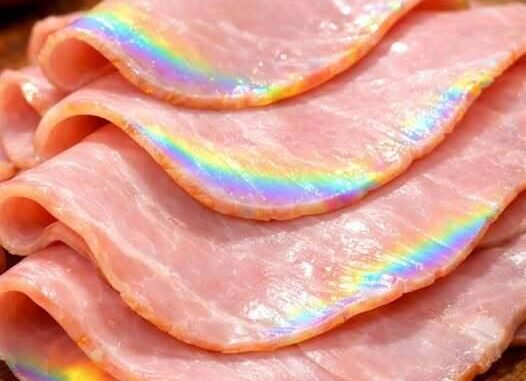
You open a fresh package of deli ham, expecting the usual pale pink slices. But under the kitchen light, something catches your eye—streaks of green, blue, or even purple shimmering across the surface.
At first glance, it can look alarming.
Many people immediately assume the meat has spoiled or been contaminated. Some throw it away without a second thought.
But surprisingly, that rainbow-like shine is usually completely harmless.
In most cases, the unusual coloring is caused by a natural optical effect called iridescence—a phenomenon linked to the way light interacts with the structure of the meat itself.
Why Deli Ham Sometimes Looks Rainbow-Colored
The colorful sheen seen on deli ham isn’t typically caused by mold, chemicals, or spoilage.
Instead, it happens because of the way light reflects off the meat’s surface.
Ham is made from muscle tissue containing tightly packed fibers arranged in repeating patterns. When deli meat is sliced very thinly and smoothly, those microscopic structures become exposed in a way that affects how light bounces off the surface.
As light hits the meat, it bends and scatters into different wavelengths, creating shifting colors similar to what you see on:
- Soap bubbles
- Oil on water
- Compact discs
- Peacock feathers
This effect is known as iridescence.
The colors may appear to change depending on the angle of the light or the position from which you’re viewing the meat.
Moisture Makes the Effect More Noticeable
Freshly sliced or vacuum-sealed deli meat often contains a thin layer of moisture on the surface.
That moisture can enhance reflectivity, making the rainbow colors appear brighter and more noticeable.
This is one reason why the effect is especially common in:
- Deli ham
- Turkey slices
- Roast beef
- Vacuum-packed lunch meats
The smoother and more uniform the slicing process, the more visible the shimmering effect can become.
Why Processed Meats Show It More Often
Processed and cured meats are particularly prone to iridescence because of how they are prepared.
Curing changes the structure of proteins slightly, while industrial meat slicers create extremely smooth surfaces. Together, these factors create ideal conditions for light interference patterns to form.
Salt used during curing also helps meat retain moisture, which further enhances the reflective surface.
In contrast, rough-cut or uneven meats scatter light more randomly, making the rainbow effect less visible.
Does Rainbow Ham Mean It’s Spoiled?
In most cases, no.
The rainbow sheen alone is not considered a sign of spoilage.
Food safety experts have long recognized iridescence as a harmless optical effect rather than evidence of bacteria or decay.
However, appearance should never be the only thing used to judge whether food is safe to eat.
The Real Signs of Spoiled Deli Meat
While iridescence is harmless, spoiled deli meat usually shows much more obvious warning signs.
1. Slimy or Sticky Texture
Fresh deli meat should feel slightly moist but still firm.
If it becomes sticky, slimy, or leaves a residue on your fingers, bacterial growth may be occurring.
2. Sour or Unpleasant Smell
Fresh ham typically has a mild, salty aroma.
Spoiled meat often develops:
- Sour odors
- Sharp smells
- Ammonia-like scents
- Rotten or unpleasant odors
Strong off-smells are one of the clearest indicators that meat should not be eaten.
3. Persistent Discoloration
Iridescent colors shift when the light changes.
Spoilage discoloration does not.
Be cautious if you notice:
- Dull gray patches
- Static green spots
- Fuzzy mold growth
- Darkened areas that remain unchanged in different lighting
Those are much stronger signs the meat may no longer be safe.
Proper Storage Still Matters
Even if deli ham looks normal, storage time is important.
Once opened, sliced deli meats are perishable and should generally be eaten within three to five days when refrigerated properly.
To help maintain freshness:
- Keep meat tightly sealed
- Store it in the coldest section of the refrigerator
- Limit repeated exposure to air
- Avoid leaving it out at room temperature for long periods
Refrigeration slows bacterial growth but cannot stop it completely.
Why the Rainbow Effect Is Still Common Today
Modern food processing has actually made iridescence more noticeable in some cases.
Today’s precision slicing machines create smoother cuts than ever before, which improves the conditions needed for light reflection and interference patterns.
Vacuum-sealed packaging also preserves moisture, making the effect more visible when the package is first opened.
In other words, the rainbow appearance is often simply a side effect of efficient food preparation—not a sign that something has gone wrong.
Understanding the Science Helps Reduce Food Waste
It’s natural to be cautious about unusual-looking food. In many situations, visual changes can signal spoilage.
But rainbow-colored deli ham is one example where appearance can be misleading.
Understanding the science behind iridescence can help people avoid unnecessary waste and make more informed decisions about food safety.
Rather than reacting immediately to the unusual colors, it’s better to evaluate the meat based on:
- Smell
- Texture
- Storage time
- Overall appearance
Those factors provide much more reliable clues about freshness.
Final Thoughts
The rainbow shine sometimes seen on deli ham may look strange, but it’s usually nothing more than light interacting with the meat’s surface structure.
This harmless optical effect—known as iridescence—is common in thinly sliced, cured meats and does not automatically mean the food is unsafe.
The real warning signs of spoiled meat remain the same:
- Slimy texture
- Strong unpleasant odors
- Persistent discoloration
- Mold or obvious decay
Sometimes food appears more dramatic than it really is.
And in this case, what looks like a problem is often just a fascinating example of everyday physics happening right in your kitchen.
Leave a Reply