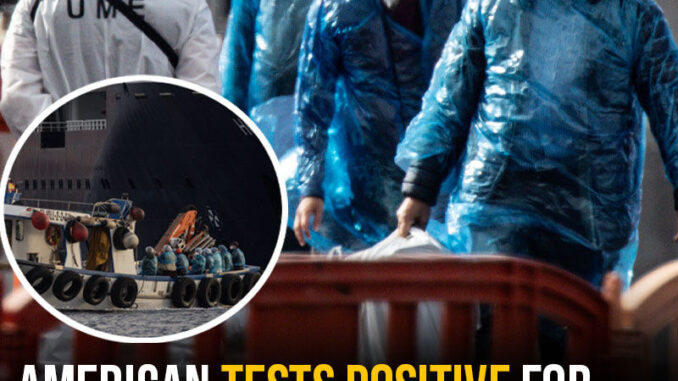
Panic spread across the dock as terrified passengers rushed off what was supposed to be a dream luxury cruise.
What began as a scenic voyage aboard the MV Hondius quickly spiraled into what many passengers later described as a floating biohazard nightmare. Floodlights cut through the darkness as emergency crews in full protective gear escorted frightened travelers off the ship one by one. Families clutched masks, children cried beside luggage piled hastily onto the pavement, and the sound of military aircraft overhead transformed the harbor into something that felt closer to a disaster zone than a vacation destination.
At the center of the growing crisis: one confirmed American case involving a dangerous viral strain authorities are still struggling to fully understand.
Officials continue insisting the public risk remains “low.”
But behind the reassuring statements, an entirely different reality appears to be unfolding.
More than twenty countries have already launched emergency coordination efforts as quarantines, medical evacuations, and containment protocols expand rapidly across multiple continents. Health agencies are racing to trace passengers, identify potential exposures, and prevent panic from spreading faster than the virus itself.
And many experts quietly fear the situation may still be in its earliest stages.
The scenes emerging from Tenerife shocked viewers around the world. Under harsh floodlights, masked crews wearing full-body hazmat suits guided passengers through controlled corridors toward waiting transport vehicles. Helicopter blades thundered overhead while military transport engines roared nearby, drowning out official instructions and adding to the growing atmosphere of fear.
For many passengers, the images felt surreal.
One moment they had been photographing ocean sunsets and enjoying luxury dining aboard an expedition cruise. The next, they found themselves caught inside an international emergency operation involving isolation zones, biosecurity teams, and rapidly changing government directives.
As nations scrambled to respond, passengers were reportedly separated according to nationality and redirected onto different aircraft heading toward different quarantine destinations. Some were flown home under strict medical supervision. Others were transferred to temporary isolation facilities for additional testing and monitoring.
The uncertainty has proven almost as frightening as the virus itself.
Officials from the World Health Organization have continued emphasizing that widespread contagion is not currently expected. Medical experts stress that containment systems exist precisely for situations like this and warn against panic-driven speculation.
Yet the emotional reality unfolding on the ground tells a more complicated story.
Invisible threats create a unique kind of fear.
Passengers describe not knowing who may have been exposed, whether symptoms could appear later, or how much authorities truly understand about the strain itself. The confirmed American patient is expected to be transferred into one of the world’s most advanced biocontainment units, where specialized teams will monitor and isolate the infection under maximum security conditions.
Meanwhile, fellow travelers face days — and possibly weeks — of testing, observation, isolation, and unanswered questions.
In cities like Madrid and Paris, emergency medical teams are now working around the clock to balance scientific caution with public reassurance. Airports, hospitals, and government agencies remain on high alert as officials attempt to prevent fear from escalating into widespread public distrust.
Because beyond the medical threat lies another growing danger:
The collapse of confidence.
History has repeatedly shown how quickly fear spreads when people believe information is incomplete or uncertain. Even when experts insist the overall danger remains limited, dramatic images — hazmat suits, military escorts, quarantined travelers, sealed aircraft — leave lasting psychological impact. People do not easily forget scenes that resemble the opening moments of a global crisis movie.
And that is why the story surrounding the MV Hondius has captured so much attention worldwide.
Not simply because of one infected passenger.
But because it taps directly into modern fears surrounding invisible threats, global travel, and how fragile normal life can suddenly feel when uncertainty takes over.
For the passengers stepping off those planes, the vacation is over.
But the waiting has only just begun.
Waiting for test results.
Waiting for answers.
Waiting to discover whether this frightening chapter ends as a contained health scare… or the beginning of something much larger.
Leave a Reply