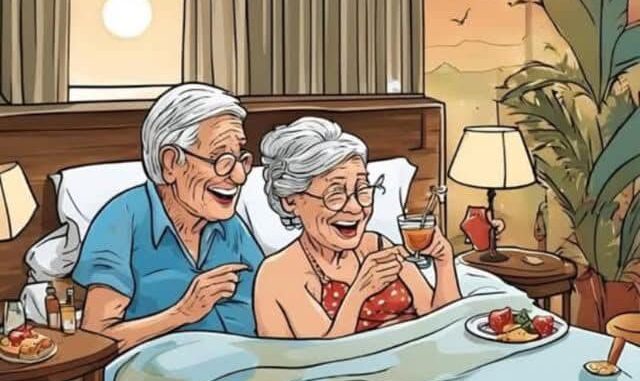
Laughter was the thing that saved them.
Not money.
Not luck.
Not some flawless romance untouched by disappointment.
Just laughter.
The kind that erupts at the worst possible moments because the alternative is breaking apart completely. The kind that slips through slammed doors, unpaid bills, hospital waiting rooms, and those long terrifying silences where both people secretly wonder whether love is still strong enough to survive what life keeps demanding from it.
For them, humor became more than personality.
It became shelter.
They married young, before either of them fully understood how heavy adulthood could become. Their wedding photographs showed two frightened hopeful kids dressed in borrowed clothes, standing beneath cheap decorations while holding onto each other like they had accidentally stumbled into something enormous.
The ring he gave her had been secondhand.
The apartment they rented afterward had unreliable heat and walls thin enough to hear neighbors arguing at night. They owned mismatched furniture, one frying pan, and exactly enough money to survive if nothing went wrong.
Of course things went wrong anyway.
But on their first night as husband and wife, while she sat beside him overwhelmed by fear disguised as excitement, he made her a strange promise.
Not grand declarations.
Not dramatic vows about eternity or perfection.
He kept it simple.
“I’ll make you laugh,” he told her quietly. “I’ll stay in the room when we’re angry. And I’ll keep choosing you, especially on the days you feel hardest to choose.”
At the time, she almost laughed at how small the promise sounded compared to the giant seriousness of marriage.
She thought love needed bigger words than that.
Life would eventually prove otherwise.
The years that followed looked nothing like the futures they imagined while young.
Dreams shifted. Some disappeared entirely.
There were months when money vanished faster than paychecks arrived. Hospital monitors beeped beside beds neither of them expected to see so early in life. Rejection letters came. Careers stalled. Parents died. Their children grew into strangers for a while during difficult teenage years. Some nights exhaustion turned simple conversations into sharp arguments over nothing at all.
And always, somewhere inside the chaos, one of them eventually said something ridiculous enough to crack the tension apart before it hardened permanently.
A joke during grief.
A stupid dance in the kitchen after a terrifying diagnosis.
Sarcasm whispered through tears while holding overdue bills.
Outsiders sometimes misunderstood that laughter.
They assumed humor meant things were not serious enough to hurt deeply.
But the opposite was true.
They joked because reality often felt too heavy to carry directly.
Laughter became proof that pain had not completely swallowed them yet.
Once, after a brutal argument that left both of them sitting silently in opposite corners of the house for hours, he walked into the kitchen wearing oven mitts like boxing gloves and announced:
“I’m emotionally available now if you’d like to continue destroying me.”
She laughed so hard she cried.
And somehow that laughter saved the marriage more effectively than pride ever could have.
Fifty years passed like that.
Not perfectly.
But faithfully.
By the time their golden anniversary arrived, their bodies carried time visibly now. His hands trembled slightly from age. Her knees hurt during cold weather. Their grandchildren filled the house with noise while old songs drifted softly through candlelit rooms crowded with family built slowly across decades.
Everyone wanted speeches that night.
Stories. Wisdom. Grand romantic reflections from a couple who somehow survived fifty years together in a world where marriages often collapse much sooner.
Near the end of the evening, he reached for her hand beneath the table.
Even after all those years, the gesture still felt instinctive between them.
Then he leaned closer and whispered softly:
“I meant every word.”
At first she looked confused.
Then suddenly she remembered.
That first night.
The tiny apartment.
The borrowed wedding clothes.
The secondhand ring.
The promise that once seemed too small to matter.
And tears immediately filled her eyes.
Because for years, part of her had secretly feared his vows were too light to carry a lifetime.
But now she understood something younger people often miss:
Love rarely survives through dramatic moments alone.
It survives through repetition.
Daily choosing.
Tiny acts performed over and over until ordinary loyalty becomes something sacred.
Still smiling, he reached into his jacket pocket and slid a folded piece of paper toward her.
A new “honey-do” list.
Wrinkled. Half-serious. Covered in shaky handwriting.
At the very bottom, beneath groceries and reminders and household chores, he had added one final line:
“Still choosing you.”
The entire table burst into laughter immediately.
But her tears revealed the deeper truth beneath the joke.
Because their marriage had never depended on fireworks or fantasy. It was built through surviving ordinary days together repeatedly — through humor during heartbreak, patience during failure, tenderness after anger, and the stubborn refusal to stop reaching for each other even when life made love feel fragile.
In the end, laughter had never made their relationship less serious.
It made survival possible.
And somewhere beneath fifty years of jokes, arguments, anniversaries, grief, and quiet mornings together, those simple vows from long ago had quietly become the strongest promises either of them ever made.
Leave a Reply