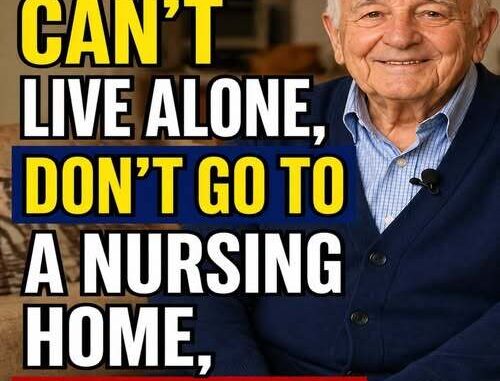
I came frighteningly close to disappearing from my own life.
Not through illness alone.
Not through age.
Not because I suddenly stopped being myself.
It almost happened quietly — through paperwork, polite conversations, worried faces, and one overwhelming belief repeated often enough that eventually even I started believing it too:
“You’ll be safer in a care home.”
At 87, people stopped speaking to me like a person making choices and started speaking about me like a problem waiting to happen. My daughter worried constantly. Doctors spoke gently but firmly about “planning ahead.” Friends hinted that staying alone in my house might no longer be realistic. Even the smallest mistakes — forgetting an appointment, moving more slowly, misplacing keys — began feeling like evidence in a case being built against my independence.
Eventually, I found myself standing at what felt like the edge of my own life.
One signature.
One room.
One unfamiliar bed waiting somewhere else.
And the terrifying part was not simply leaving my house.
It was the feeling that everyone expected me to quietly surrender pieces of myself along with it.
The books lining my shelves.
The creak in the hallway floorboards I could navigate in darkness.
The rhythm of my mornings.
The chair beside the window where sunlight always landed at four in the afternoon.
People called it safety.
But deep down, part of me feared it was erasure.
What no one explained clearly enough was that there might be another path between total independence and total surrender. The conversation always felt strangely absolute: stay home and struggle alone, or leave home entirely for professional care.
But life is rarely that binary.
The turning point came when I stopped asking, “Can I still do everything alone?” and started asking a different question:
“What do I actually need help with?”
The answer surprised me.
I did not need my entire life taken away.
I needed smaller things.
Someone to help with groceries occasionally.
A ride to appointments sometimes.
A check-in after difficult weather.
Help carrying heavier items.
Medication reminders during stressful weeks.
And once I separated the real needs from the larger fear surrounding aging itself, something unexpected happened.
People responded.
Not institutions first.
People.
A neighbor began knocking each morning during her dog walks just to say hello. A father down the street traded lawn help for my tutoring help with his son’s reading. Teenagers carried bags inside when they saw me returning from the store. Someone fixed my porch railing before I even asked. Slowly, quietly, a network formed around me — not out of pity, but mutual care.
And the strangest part was realizing I still had things to give too.
That mattered more than I can explain.
Because aging often makes people feel reduced entirely to needs, limitations, risks, and medical charts. But human dignity survives through contribution as much as care. I could still listen. Still teach. Still encourage. Still offer wisdom, conversation, company, and steadiness younger people around me often needed more than they admitted.
Suddenly, my house stopped feeling like a place I was trapped inside.
It became part of a living community again.
Now my days look nothing like the lonely future I feared.
There is coffee at my kitchen table shared with neighbors who no longer feel like strangers. Schoolbags pile briefly near the hallway while parents rush between obligations. My name is spoken warmly, naturally — not as a patient or a “case,” but as a person woven into everyday life around me.
And no, this arrangement will not work for everyone.
Some illnesses truly require professional care.
Some people face needs no neighborhood alone can safely manage.
This is not a fantasy pretending aging is simple.
But I also know many older people are pushed toward institutional care before every possible middle path has been explored. Fear accelerates those decisions. So does exhaustion. So does a culture that increasingly treats independence and community as opposites instead of partners.
What I discovered is that support does not always have to mean disappearance.
Sometimes safety grows best through connection rather than removal.
Through specific help instead of total surrender.
Through asking honestly what you need — and honestly recognizing what you still have to offer in return.
So if you are standing where I once stood, frightened and pressured into believing there are only two options, pause before signing anything permanent.
Make a list.
Not of everything you can no longer do.
But of what you still can.
Then list what support would truly help you remain yourself safely.
And after that, do something surprisingly difficult:
Knock on a door.
Because your care plan may not begin inside a facility at all.
It may already be waiting quietly on your own street.
Leave a Reply