The envelope slid beneath my apartment door on a Tuesday morning in October. I was still asleep, and the handwriting on the front was unfamiliar—delicate, almost too formal for the message it contained. My stomach tightened when I saw the return address: Riverside Memorial Hospital.
Inside was a short note:
“Mr. Davidson, your ex-wife Rebecca listed you as her emergency contact. She has been admitted and is asking for you.”
I read it three times before my legs remembered how to move. Three months had passed since the divorce became final. Three months since I walked out of the courthouse believing that chapter of my life was closed. I thought the story was over.
The drive to Riverside felt like a journey backward through every version of us I had tried to forget—Rebecca laughing on our first date, her waking me with coffee and off-key singing, her silent stares during the final year of our marriage that I misread as indifference.
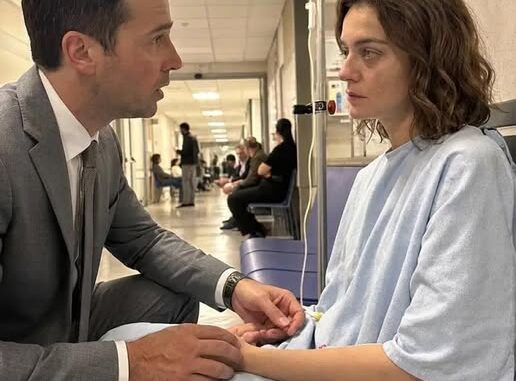
I found her in the cardiac unit. She looked smaller than I remembered, swathed in a hospital gown, dark hair falling around her shoulders. Her once confident demeanor was dimmed by exhaustion, fear, and something I couldn’t quite name.
“You came,” she whispered, relief and surprise mingling in her voice.
“The hospital contacted me,” I said. “They told me you were asking for me.”
She lowered her gaze. “I didn’t know who else to list. My parents are gone. My sister lives across the country. Old habits die slowly, I guess.”
I stayed near the door, hesitant. We had once shared a bed, a kitchen, a life—and now we barely knew how to share a room.
“What happened?” I asked finally.
Her voice was nearly a whisper. “My heart stopped, David. The doctors think it was connected to prescription use.”
As she told me about years of anxiety, panic attacks, sleepless nights, and mounting fear, my heart sank. The woman beside me had been quietly breaking while I misread every sign as distance, disinterest, or withdrawal.
“When one thing stopped working,” she said, “I kept looking for another answer. The morning I collapsed, I was already overwhelmed… I made a terrible choice because I didn’t know how to stop the panic.”
I listened, shocked, as she described a lifetime of hidden struggle—prescriptions, secrecy, and shame. I realized our marriage had ended not because love disappeared but because pain went unnamed.
“Why didn’t you tell me?” I asked.
“Because I was afraid you’d leave,” she said softly. “Then I was afraid you’d stay out of pity. Either way, I thought I’d lose you.”
In that hospital room, memories shifted. I saw the dinners she canceled, the friends she avoided, the ordinary moments that must have felt impossible to her. Her withdrawal had not meant she stopped loving me—it had meant she was surviving.
Over the next days, as she recovered, we began conversations we should have had years ago. I attended therapy sessions with her, learning about anxiety, dependency, and the quiet ways mental health struggles can erode relationships. Dr. Michael Roberts explained, “Fear of judgment keeps people from seeking help. Then the fear grows, and the condition worsens.”
I faced my role, too. My frustration had turned into criticism. My criticism had made her more afraid. Without meaning to, I had contributed to a home where she felt she had to hide even more. Accepting that was painful, but necessary.
Rebecca’s recovery was neither quick nor linear. There were setbacks, moments when panic returned, and days when progress felt impossible. But there were victories too: a calm night of sleep, a conversation without anxiety, a walk down the hospital corridor without stopping. She rebuilt herself with therapy, support groups, and medical guidance, and I became her advocate in ways I hadn’t known how to be as a husband.
Six months later, we had built something new. Not a repaired marriage—our romantic chapter was over—but a quieter, stranger, and more honest connection: friendship. A bond based on truth, compassion, and shared commitment to her healing.
Rebecca learned to navigate anxiety with tools and support. I learned to ask better questions, to notice silence, to assume nothing and observe everything beneath the surface.
The divorce had ended the marriage, but the hospital room had given us understanding, awareness, and a chance to care for each other in a new way. Sometimes love does not return in the form we want—it returns as a hand on a hospital rail, a ride to therapy, a quiet check-in after a tough day.
That room taught me that relationships fail not always from absence of love, but from the failure to see pain when it’s hidden. We still wonder what might have happened if we had spoken sooner, if we had noticed earlier. Perhaps some things could have been saved—but perhaps not.
What mattered now was compassion, presence, and humanity. Rebecca and I had found a different kind of love. And that, I realized, was worth everything.
Leave a Reply