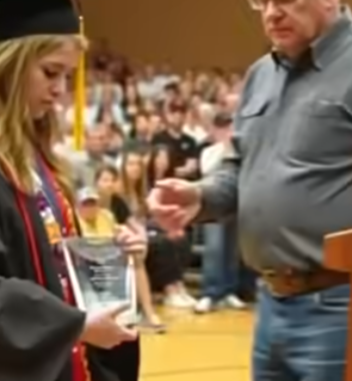
The day had started bright, full of pride and possibility. My graduation cap felt light on my head, the tassel swinging gently as I posed for photos, my parents standing on either side of me. But I already knew something was off. My dad’s smile was tight, his eyes distant, as if he were holding himself back from saying what he truly felt.
Later that afternoon, we were alone in the kitchen. My father held my freshly awarded trophy in his hands, turning it over slowly, almost like he couldn’t quite decide what to do with it. His lips moved silently for a long moment, as if chewing on the words he couldn’t quite say.
“This…this isn’t what you should be working for,” he finally whispered, his voice barely above the hum of the refrigerator. The frustration in his eyes was clear, but underneath it, I glimpsed something else—fear, regret, maybe even sorrow.
I wanted to argue, to demand why he couldn’t simply be proud, why he couldn’t see the value in what I had achieved. But the words failed me, lost somewhere between hurt and disbelief. Instead, I sat across from him, the kitchen table stretching like a canyon between us, impossible to cross.
The silence pressed down on me, thick and suffocating. It was the same silence that had haunted our house since Mom passed away—a silence filled with unspoken grief, half-formed regrets, and anger that had nowhere to go. I thought of the countless nights I had returned home late, moving quietly to avoid disturbing him, how he never asked about my day or checked if I needed anything.
“You know,” I began, voice tentative, “I didn’t do all this just for me. Mom always said—”
“Don’t,” he interrupted sharply, eyes flashing with an emotion I couldn’t place. “Don’t bring her into this.”
“But she believed in me!” I said, my voice rising, desperation creeping in. “She wanted this for me. She wanted you to want this for me too!”
For a moment, he looked at me—not just the surface, but really looked. In his eyes, I saw the shadow of the man I remembered from my childhood—the father who once laughed freely, loved fiercely, and seemed invincible. Now, all that remained was a shell, hollowed by loss and time.
“I’m trying, Sophie,” he said finally, his voice cracking. “But it’s hard.”
The admission hung in the air, raw and vulnerable. Something softened inside me, though the hurt was still fresh, still raw. I realized then that while a trophy could be replaced, the years of silence and unspoken pain between us couldn’t be so easily mended.
“I know it’s hard,” I said softly but firmly. “But I’m not giving up on us. I want us to be okay again. Can we try?”
He nodded slowly, a flicker of hope breaking through the hardness in his gaze. “Yeah…maybe we can. It’ll take time, though.”
Those words weren’t a promise of reconciliation—they were a fragile offering, a tiny thread of connection in the sea of shared grief and unspoken words. It was enough to hold onto.
Later that evening, I passed the remnants of my trophy in the hallway. The shattered pieces glimmered under the dim light, sharp edges biting into the carpet and, symbolically, into my heart. I knelt down, gathering them in my hands, feeling the weight of both the broken glass and the fractured relationship it represented.
Like our relationship, the trophy was broken—but not beyond repair. I carefully placed the pieces on my dresser, a quiet reminder that healing, though slow, was possible.
As I lay in bed that night, I thought about what truly mattered. Success wasn’t measured by accolades, trophies, or public recognition—it was measured by the people who loved you, supported you, and stayed by your side through triumph and pain alike. More importantly, it was about the bonds we fight to mend, even when the fracture seems irreparable.
I knew the road ahead would be long. Conversations would be awkward. Silences would linger. But for the first time in years, I felt a glimmer of hope that we could navigate it together. My dad’s hand had crushed a symbol of my accomplishment that day, but it couldn’t crush the hope I still held for us.
And in that quiet, fractured moment, I realized that healing wasn’t instant—but it was possible. One broken trophy, one small admission, one fragile conversation at a time, we could start to rebuild.
Because in the end, life isn’t about perfection—it’s about trying, even when the pieces are sharp, and learning to love through the silence.
Leave a Reply