It started with a knock at the door.
Not a normal knock either. It was fast, urgent, and repeated enough to pull me out of bed before sunrise. I wrapped my robe around myself and hurried downstairs, expecting maybe a delivery driver or a neighbor needing help.
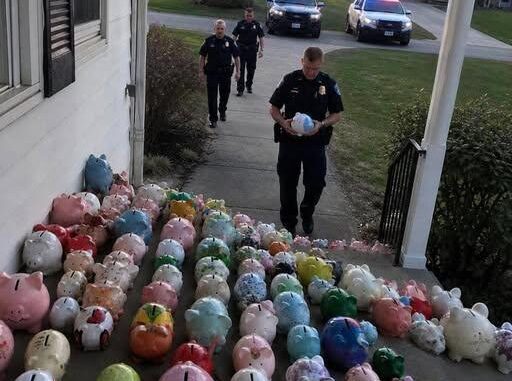
Instead, when I opened the front door, a police officer stood on my porch holding a bright red piggy bank.
Behind him, my entire front yard was covered in piggy banks.
Some were pink. Some blue. Others were cracked ceramic, old plastic, or decorated with stickers and faded paint. They lined the walkway, crowded the porch steps, and stretched across the lawn like some strange parade had stopped overnight.
At the edge of the street, two patrol cars blocked traffic while curious neighbors gathered nearby.
My six-year-old son Oliver shuffled into the hallway wearing dinosaur pajamas and rubbing his eyes.
“Mom,” he whispered nervously, grabbing my sleeve. “Did I do something wrong?”
I pulled him close immediately.
“No, sweetheart.”
The officer looked down at him gently.
“You’re Oliver?”
My son nodded carefully.
The officer’s face softened.
“I’m Officer Hayes,” he said. “Nobody’s in trouble.”
Oliver glanced toward the police cars.
“Then why are all the police here?”
Officer Hayes looked across the street toward the small yellow house belonging to our elderly neighbor, Mrs. Adele.
“Because yesterday,” he said quietly, “your son noticed something most adults ignored.”
Then he handed me the red piggy bank.
“Ma’am,” he added, “I need you to open this.”
I stared at him in confusion.
“What’s inside?”
His expression turned serious.
“Something more valuable than money.”
Everything had started a few days earlier.
Mrs. Adele lived alone across the street. She was in her eighties, sweet but independent, and the kind of woman who remembered everyone’s birthday. Oliver adored her because she always asked him about dinosaurs and spelling tests.
One afternoon, we spotted her standing by her mailbox holding several envelopes tightly against her chest.
Oliver waved enthusiastically.
“Hi, Mrs. Adele!”
She smiled warmly, though she looked tired.
“Hello, my favorite dinosaur expert.”
Oliver laughed proudly. “I still mix up the meat-eaters sometimes.”
I stepped closer.
“Everything okay?”
She hesitated before answering.
“Just bills,” she said lightly. “They arrive whether you invite them or not.”
I offered to help her sort through the paperwork, but she politely refused. She explained that her nephew Elias managed most of her finances online because her eyesight had worsened recently.
Still, something about the conversation stayed with me.
Three nights later, Oliver stopped brushing his teeth and stared out the hallway window.
“Mom,” he said quietly, “Mrs. Adele’s porch light is still off.”
I looked outside.
Her house was completely dark.
No kitchen light. No television glow. Nothing.
“She may have gone to bed early,” I said, though even I wasn’t convinced.
Oliver disappeared into his room and returned carrying his little green piggy bank.
“She says porch lights help people find their way home,” he told me seriously.
I glanced at the stack of unpaid bills sitting on our kitchen counter. Oliver noticed immediately.
“Are we out of money too?”
I forced a smile.
“No, baby. I’m just trying to make every dollar count.”
He hugged his piggy bank tightly.
“Then maybe some can go to Mrs. Adele.”
I explained gently that grown-up bills were expensive and complicated.
Leave a Reply