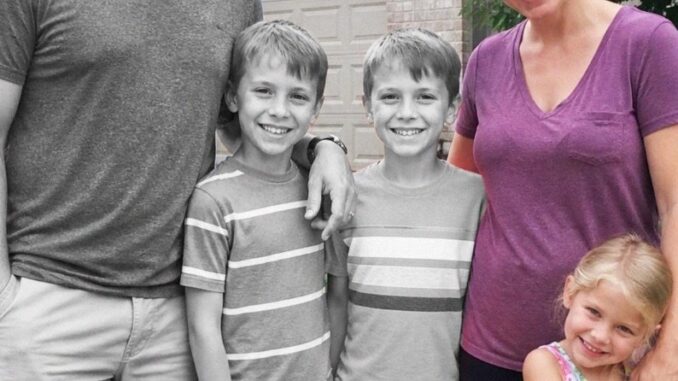
For seven years, I lived inside a question that never had an answer.
People say grief changes over time. They say it softens, settles, becomes easier to carry. But there is something uniquely painful about losing people without explanation. When there is no goodbye, no certainty, no body to bury, your heart never fully accepts what your mind tries to understand.
That was my life after my husband, Ryan, disappeared during a fishing trip with our twin sons, Jack and Caleb.
One ordinary summer morning, he packed the truck exactly the way he always did. The boys were ten then — loud, energetic, impossible to separate for more than five minutes. They raced around the kitchen arguing over who got the better fishing rod while Ryan laughed and poured himself coffee before sunrise.
Our daughter Lily, only five at the time, stood barefoot in the hallway pouting because she wasn’t old enough to join them yet.
“Next summer,” Ryan promised her, kissing the top of her head. “You’ll come too.”
Those were the last words she ever heard him say in person.
By nightfall, panic had replaced routine.
Ryan wasn’t answering his phone.
The boys weren’t answering theirs either.
Police searched the lake through the night. The next morning they found the boat drifting near the far shore. The life jackets were still inside. So were the fishing poles.
But there was no sign of my husband or my sons.
No bodies.
No evidence.
Nothing.
The town came together the way small towns often do after tragedy. Neighbors brought casseroles I barely touched. Volunteers searched wooded areas surrounding the lake. Divers spent days in the water.
Weeks later, the official assumption became unavoidable: Ryan and the boys had drowned.
People encouraged me to find closure.
But how do you find closure when nobody can explain what happened?
I spent years trapped between grief and disbelief.
At first, I kept expecting the front door to open.
Every knock at the house made my heart jump. Every unknown phone call sent adrenaline rushing through me. I would wake up in the middle of the night convinced I heard the twins running down the hallway.
But time moved forward whether I wanted it to or not.
I focused on Lily because I had no other choice.
She needed lunches packed, homework checked, nightmares soothed. We became each other’s lifeline in the aftermath of losing half our family.
Still, there were reminders everywhere.
Jack’s baseball glove remained on the garage shelf exactly where he left it. Caleb’s dinosaur drawings stayed pinned to the refrigerator for years because I couldn’t bring myself to take them down.
And Ryan…
I didn’t know whether to hate him for leaving us or mourn him for dying.
Somehow, I did both.
Seven years passed that way.
Then one quiet evening changed everything.
Lily was twelve by then — taller, quieter, carrying grief in the careful way children do when they grow up too fast. She had been cleaning out an old hallway closet when she called for me.
“Mom?”
Something in her voice made me stop folding laundry immediately.
When I walked into the living room, she was sitting cross-legged on the floor holding an old cellphone in both hands.
“I found this,” she whispered.
I recognized it instantly.
It had belonged to Ryan years ago.
“I think there’s a video on it,” she said nervously.
My stomach tightened.
I almost told her to throw it away.
Instead, we sat together on the couch while she pressed play.
The screen flickered for a second before Ryan appeared.
He looked exhausted.
Not physically tired — emotionally broken.
Behind him was the old garage workshop. I recognized the shelves instantly.
Then he spoke.
“I’m sorry, Lily,” he said quietly.
My chest tightened immediately.
“And if your mother is watching this…” He paused heavily. “I hope someday you can understand why I had to do this.”
I couldn’t breathe.
Ryan looked directly into the camera, eyes red like he had been crying.
“I’m taking Jack and Caleb to live with their biological mother,” he continued. “By the time this video is found, I’ll probably already be gone.”
The room spun around me.
Lily grabbed my hand.
The boys weren’t dead.
For seven years, they had been alive.
I replayed the video three times because my brain refused to accept it.
Ryan explained that years before I met him, he had fathered the twins during a brief relationship. The woman had struggled with addiction and instability, and Ryan had gained full custody when the boys were toddlers.
I knew pieces of that story.
What I didn’t know was that she had gotten sober years later and quietly re-entered their lives.
Then came the part that shattered me completely.
Ryan had been diagnosed with terminal cancer months before the fishing trip.
He never told me.
Instead, he made a decision entirely on his own.
He believed that after he died, the twins deserved the chance to reconnect with their biological mother. He thought disappearing would somehow spare everyone the pain of watching him deteriorate.
So he staged the accident.
The abandoned boat.
The unanswered calls.
The entire nightmare.
He erased himself from our lives intentionally.
And in doing so, he erased my sons too.
I felt sick.
Not relieved.
Not grateful.
Destroyed.
The next morning, Lily and I followed the clues Ryan had left in the video. A town name. A partial address. Mentions of an old cabin area near the state border.
After hours of driving, we finally found the house.
I knew immediately.
There were bicycles in the yard. Two basketballs near the porch steps. Family photos visible through the front window.
Signs of life.
My hands shook as I knocked.
When the door opened, I nearly collapsed.
Jack stood there.
Taller.
Older.
But unmistakably my son.
For a second, nobody moved.
Then Caleb appeared behind him holding a sandwich, staring at me in shock.
Lily burst into tears first.
The boys looked confused, overwhelmed, uncertain.
Because they hadn’t been told the full truth either.
Their biological mother — Hannah — invited us inside slowly, cautiously. She looked terrified herself.
That afternoon changed all of us forever.
Ryan had told the twins I knew where they were.
He made them believe I had agreed to let them go.
The betrayal hit in layers so painful I could barely process them.
He hadn’t only disappeared.
He had rewritten reality for everyone involved.
Later that evening, Hannah finally told me the rest.
Ryan died less than a year after arriving there.
Cancer.
Aggressive and fast-moving.
He was buried in a small cemetery nearby.
For seven years, I had mourned a husband I thought drowned while he had already been buried under a headstone only a few hours away.
I visited his grave the next morning alone.
I expected rage.
Instead, I felt exhaustion.
I knelt in the wet grass staring at his name carved into stone, trying to understand how love and betrayal could exist together so completely.
Part of me understood his fear.
But another part of me would never forgive the choice he made for all of us.
He stole years we could never get back.
Years of birthdays.
Christmas mornings.
School plays.
Late-night talks.
Everything.
And yet… standing there, I also realized something unexpected.
The story wasn’t over anymore.
For years, my life had been frozen at the moment that boat disappeared.
Now the truth — painful as it was — finally allowed us to move forward.
On the drive home, Lily looked out the window quietly before asking:
“Do you think we’ll really become a family again someday?”
I looked at her reflection in the glass.
“I don’t know,” I admitted honestly.
But for the first time in seven years, hope felt possible.
Not perfect.
Not easy.
But real.
And sometimes, after years of living with unanswered grief, reality — even painful reality — is the beginning of healing.
Leave a Reply