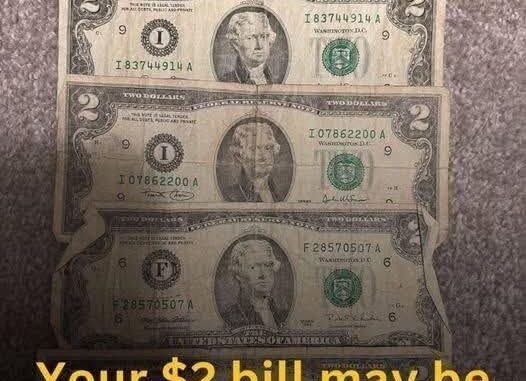
For many Americans, paper money is part of everyday life—used at stores, restaurants, and gas stations without much thought. But every now and then, a seemingly ordinary bill can carry unexpected value. The $2 bill is one of the most interesting examples of this.
Although it remains legal currency in the United States, the $2 bill holds a unique place in everyday use. Many people rarely come across one, some assume it’s no longer printed, and others treat it as a collectible or novelty item. However, certain $2 bills can be worth far more than their face value, especially to collectors.
To understand why, it helps to explore the history of the bill, what makes some versions more valuable, and how collector markets influence pricing. You might even discover that something sitting in your wallet has more value than you realized.
Why the $2 Bill Stands Out
Among U.S. currency, the $2 bill has always been a bit unusual. Unlike more common denominations such as $1, $5, or $20, it doesn’t appear frequently in daily transactions.
Despite popular belief, the $2 bill has not been discontinued. It is still printed by the Bureau of Engraving and Printing, part of the U.S. Department of the Treasury. However, because demand is relatively low, fewer are produced compared to other bills.
This limited circulation has created a sense of mystery around the $2 bill. Many people assume it is rare, which leads them to keep it rather than spend it. As a result, the bill circulates even less, reinforcing its reputation as something unusual.
Historical and Cultural Significance
The $2 bill is more than just currency—it also reflects American history.
The front of the modern bill features Thomas Jefferson, the third president of the United States. On the back, there is an image depicting the signing of the Declaration of Independence, inspired by a well-known historical painting.
This connection to a major moment in U.S. history adds cultural value beyond the bill’s monetary worth. For collectors and history enthusiasts, that significance makes it even more appealing.
Rarity vs. Perception
One of the biggest misconceptions about the $2 bill is that all of them are rare.
In reality, millions of $2 bills exist. What makes them seem rare is simply that they are not commonly used in everyday transactions. This creates a difference between actual scarcity and perceived rarity.
Only certain types of $2 bills are truly valuable—such as older editions, bills with unique serial numbers, or those with printing errors.
Understanding this distinction is important for anyone interested in collectible currency.
How to Tell If Your $2 Bill Has Value
If you find a $2 bill in your wallet or stored away at home, it’s worth taking a closer look before spending it. Several key features can influence its value.
1. Check the Series Year
The year printed on the bill indicates when its design was issued. Older bills are often more valuable.
Examples include:
- Large-size notes from the late 1800s and early 1900s
- Red seal notes from the mid-20th century
- The 1976 Bicentennial series
Older notes, especially larger ones, are typically more desirable to collectors.
2. Look at the Seal Color
The color of the seal can reveal important details:
- Green seal: modern bills
- Red seal: older U.S. notes
- Brown seal: issued by certain banks
Red seal notes are often more collectible due to their age and historical context.
3. Examine the Serial Number
Serial numbers can significantly increase a bill’s value, especially if they are unusual.
Collectors often look for patterns such as:
- Very low numbers (like 00000010)
- Repeating digits (like 88888888)
- Sequential patterns (like 12345678)
- Palindromes (numbers that read the same forward and backward)
These unique patterns are rare and can attract strong interest.
4. Consider the Condition
Condition plays a major role in determining value.
Bills are typically graded based on their appearance:
- Worn or heavily used bills have lower value
- Lightly circulated bills may have moderate value
- Crisp, uncirculated bills are often the most valuable
A well-preserved bill with rare features can be worth significantly more than its face value.
Why You Rarely See $2 Bills
Even though they are still valid currency, $2 bills are rarely used in everyday transactions.
There are a few reasons for this:
- Cash registers are designed for more common denominations
- Some people are unfamiliar with the bill and hesitate to accept it
- Many individuals choose to keep them instead of spending them
These factors contribute to the bill’s limited circulation and unique reputation.
The Market for Collectible Currency
There is a strong global market for collectible paper money. Enthusiasts buy and sell rare bills through auctions, dealers, and online platforms.
Interest in currency collecting has grown over time, especially with easier access to information and marketplaces.
While most $2 bills are only worth their face value, certain rare examples can sell for much higher prices, depending on their features and condition.
A Brief History of the $2 Bill
The $2 bill was first introduced in 1862 during the Civil War, when the U.S. government expanded paper currency production.
Early versions featured different designs, including portraits of notable historical figures. Over time, the design evolved to feature Thomas Jefferson.
In 1928, U.S. currency was standardized to the size we use today. Later, in 1976, the bill was redesigned to commemorate the country’s bicentennial, featuring the Declaration of Independence scene on the back.
Many people saved these commemorative bills, which further reduced their circulation.
Myths and Misunderstandings
Over the years, the $2 bill has been surrounded by myths.
Some people have believed it brings bad luck, while others have associated it with unusual or outdated practices. These ideas are based more on cultural perception than fact.
In reality, the bill is simply less common, which makes it feel unusual.
Practical Tips
If you come across a $2 bill, consider these simple steps:
- Take a moment to examine it closely
- Look for unusual features or older dates
- Avoid damaging it if it appears valuable
- Store it in a safe, dry place if you plan to keep it
If you believe your bill may be valuable, you can also seek a professional opinion from a currency expert.
Why Some Bills Gain Value
The value of collectible currency depends on a few key factors:
- Rarity
- Demand from collectors
- Physical condition
- Historical significance
When these factors align, a bill’s value can increase well beyond its original amount.
The Role of Changing Payment Habits
As digital payments become more common, physical cash is used less frequently.
Interestingly, this shift can increase interest in paper money as a collectible item. Older or unusual bills may become more appealing as fewer people use cash in daily life.
Final Thoughts
The $2 bill is a fascinating example of how something ordinary can become special under the right circumstances.
While most $2 bills are worth exactly two dollars, some may carry additional value due to their age, condition, or unique features.
The key takeaway is simple: pay attention to the details. That small piece of paper in your wallet could have more significance than you expect.
Next time you come across a $2 bill, take a closer look—you might be holding something more valuable than it appears.
Leave a Reply