Last Saturday, I stopped by a yard sale on the edge of town without expecting to find anything special.
There were the usual things spread across folding tables: old coffee mugs, dusty books, framed pictures, glass bowls, children’s toys, and a box of vinyl records that had clearly seen better days.
I was about to leave when something strange caught my eye.
It was a wooden object with two metal rollers and a handle on the side. At first, I thought it might be an old kitchen tool or maybe part of a broken machine. It looked simple, but also strong, like it had survived many years of hard use.
A small handwritten tag was tied to it with string.
“Vintage Laundry Wringer.”
I picked it up carefully.
The wooden handle was smooth from age. The metal rollers were heavy and cold. There were small scratches along the sides, tiny marks left behind by time and use.
For a moment, I just stood there holding it.
I grew up with washing machines and dryers. Laundry, to me, was something you started with the push of a button. You added detergent, pressed a setting, and walked away.
But this little tool reminded me that laundry was not always that simple.
Before modern machines, washing clothes was a full-day job. It was not something people did quickly between errands. It took planning, strength, patience, and a lot of hard work.
Families had to carry water from wells, pumps, or rivers. Then they had to heat that water, sometimes over a fire. Clothes were soaked, scrubbed, rinsed, wrung out, and hung up to dry.
And if the weather was bad, the job became even harder.
Today, we complain when the dryer takes too long. Back then, laundry could take hours and leave your hands sore, your back aching, and your whole body tired.
That is why tools like this wringer mattered so much.
A laundry wringer was used to squeeze water out of wet clothes. Instead of twisting heavy fabric by hand, people would feed the clothing through the rollers and turn the handle. The pressure pushed out extra water, making clothes lighter and faster to dry.
It may look simple now, but at the time, it was a huge help.
Beside the wringer, there were other laundry tools people used in the past.
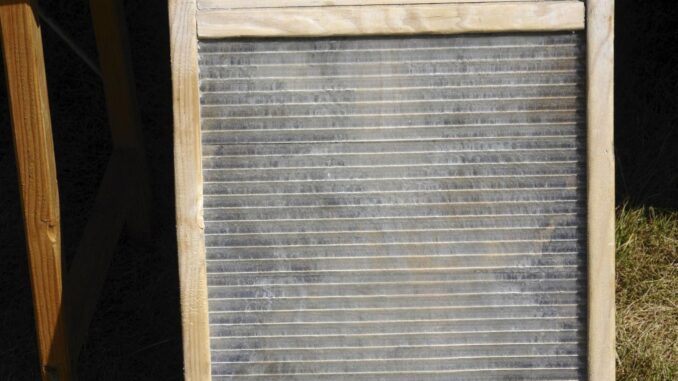
One of the most famous was the washboard. It usually had a wooden frame and a ridged metal or glass surface. People rubbed clothes against it with soap to remove dirt and stains.
There were also wooden paddles and hand plungers used to move clothes around in hot soapy water. These tools helped copy the movement of washing by hand, long before machines could do it automatically.
Every item had a purpose.
Every handle, groove, and metal piece was designed to save a little energy in a job that required a lot of it.
As I held the wringer, I started imagining the person who once used it.
Maybe it belonged to a mother with a large family, washing school clothes, work shirts, and blankets every week. Maybe it sat beside a wooden tub in a backyard. Maybe children ran around nearby while someone turned the handle again and again, trying to finish before sunset.
Laundry was not just a chore then. In many places, it was part of community life.
Women often washed clothes together near rivers, outdoor pumps, or shared washhouses. They talked while they worked. They shared news, family stories, advice, and laughter.
The work was hard, but it also brought people together.
That is something modern life has almost erased. Now we wash clothes alone, quickly, and quietly, usually without thinking much about it.
But this old wringer carried the memory of a different time.
A time when daily life was slower, but physically harder. A time when people repaired things instead of replacing them. A time when tools were built to last, not to be thrown away after a few years.
The more I looked at it, the more beautiful it seemed.
Not beautiful in a shiny, perfect way.
Beautiful because it had a life.
The scratches told a story. The worn handle told a story. Even the small rust marks seemed to say, “I was used. I was needed. I helped someone.”
When electric washing machines became more common, everything changed.
At first, the machines were still simple and required some manual work. But they made laundry much easier. Over time, washers and dryers became normal household items, and older tools like wringers, washboards, and laundry paddles were pushed aside.
Some were stored in barns or basements. Some were forgotten in garages. Some ended up in antique shops, flea markets, or yard sales, sitting quietly until someone noticed them again.
And that is exactly what happened to this one.
I asked the seller if they knew where it came from.
She smiled and said, “It belonged to my grandmother. She used it for years.”
That one sentence changed the way I saw it.
This was not just a random antique.
It had been part of someone’s real life.
Someone had turned that handle again and again. Someone had used it to care for their family. Someone had depended on it before machines made the job easier.
I bought it and brought it home.
Not because I needed it for laundry. I did not.
I bought it because it felt like a small piece of history.
Now it sits on a shelf in my home. Most visitors notice it right away.
“What is that?” they ask.
And every time, I get to tell them.
It is a laundry wringer. It was used before modern washers and dryers. It helped people do one of the hardest household chores of the week.
And suddenly, this strange wooden object becomes something more.
It becomes a conversation.
It becomes a reminder.
It becomes proof that history is not only found in museums or books. Sometimes, history is sitting on a yard sale table with a five-dollar tag tied to it.
Old laundry tools may seem ordinary, but they tell powerful stories.
They remind us of hard work, patience, creativity, and care. They remind us that comfort did not always come easily. They remind us that the simple things we use every day were once big improvements in someone else’s life.
So the next time you see a strange wooden tool at a yard sale, do not walk past it too quickly.
Pick it up.
Look closer.
You might not be holding junk.
You might be holding a piece of someone’s life.
Leave a Reply