I always believed my life was ordinary in the best possible way. Quiet streets, familiar neighbors, predictable routines—that was my world. I was Tanya, 38 years old, a mother of two, married, and living what I thought was a stable suburban life. Nothing about me suggested I would ever become part of a story filled with secrets, buried truths, or long-hidden family history.
That belief changed completely the day my elderly neighbor, Mr. Whitmore, passed away.
He had lived next door for as long as I could remember. A quiet man, polite but reserved, always tending to his yard or sitting near the old apple tree behind his house. I never thought much about him beyond that. He was simply part of the background of my life—until he wasn’t.
The morning after his funeral, I found an envelope in my mailbox. It wasn’t something expected or routine. It was thick, carefully sealed, and addressed to me in handwriting I recognized instantly: Mr. Whitmore’s.
At first, I assumed it was a note of gratitude or perhaps something sentimental left behind for the neighbors. But when I opened it, I quickly realized this was something far more serious.
Inside was a letter.
The message was simple but unsettling. He explained that if I was reading it, he was no longer alive. Then came the part that made my hands shake: he claimed he had hidden something important in his backyard, buried under the old apple tree nearly four decades earlier. He urged me to go there, promising that the truth I had always needed was waiting beneath the soil.
My husband, Richie, read the letter over my shoulder and immediately frowned.
“Are you seriously going to dig in his yard because of this?” he asked.
But something about the letter didn’t feel like a joke or confusion. It felt intentional. Personal. Final.
That night, I couldn’t stop thinking about it. Every time I closed my eyes, I imagined that old apple tree and what could possibly be hidden beneath it. By morning, curiosity had overtaken hesitation.
After the house grew quiet, I took a shovel and walked next door.
The yard looked exactly as it always had—neatly kept, slightly overgrown in places, with that same old apple tree standing at its center. My heart pounded as I began digging beneath its roots. The soil was surprisingly loose, as though it had been disturbed before or carefully maintained over time.
After several minutes, my shovel struck something solid.
Metal.
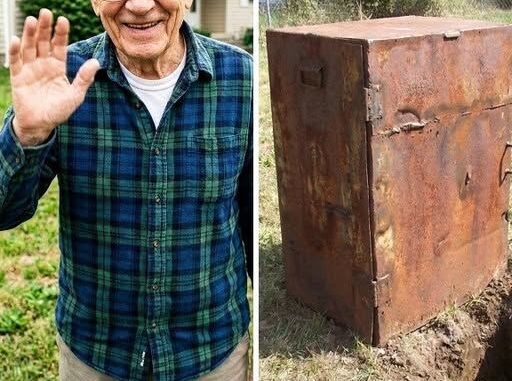
Carefully, I cleared the dirt away and pulled out a small, rusted box. My hands were shaking as I opened it. Inside was a collection of items that immediately made my stomach drop: an old photograph, a faded hospital bracelet, and an envelope with my name written on it.
The photograph showed a young man holding a newborn baby under hospital lights.
Me.
At least, that’s what everything suggested.
Confused and overwhelmed, I opened the letter inside the box.
What I read changed everything I thought I knew about my life.
The letter explained that Mr. Whitmore was not just my neighbor. He claimed to be my biological father.
He wrote that years ago, he had been separated from my mother due to family pressure and circumstances beyond his control. According to him, he never abandoned me willingly. Instead, he was forced to stay away while still living nearby, watching my life unfold from a distance he never crossed.
He described seeing me grow up, watching milestones from afar, and quietly ensuring I was safe without ever revealing who he truly was. Over the years, he had remained in the same house, just steps away, carrying the truth silently.
The realization left me stunned. The man I had seen every day, the neighbor I barely knew, had supposedly been connected to me in the most personal way possible.
There were also legal documents in the box indicating that he had left his property and belongings to me.
I sat on the ground for a long time, unable to process what I had just learned.
When Richie found me later, I could barely speak. All I could do was hand him the letter.
“This can’t be real,” he said quietly after reading it.
But I already knew it felt too detailed, too emotional, and too deliberate to be a mistake.
The following day, I called my mother.
When she arrived and saw the box, her reaction told me everything before she even spoke. The silence, the way her hands trembled—it all confirmed that this wasn’t something she had never expected to be confronted with.
Eventually, she admitted the truth.
She had been very young when she was involved with Mr. Whitmore. According to her, her family disapproved strongly and pressured her to end the relationship completely. They believed it was the best decision for her future and for me as a child. In the process, she cut ties, and he was pushed out of our lives entirely.
What she didn’t tell me—what she now struggled to say aloud—was that he had remained nearby all these years without my knowledge.
Her intention, she said, was to protect me from confusion and instability. But in doing so, she had also erased a part of my identity.
I didn’t know whether to feel angry, sad, or lost.
Everything I believed about my past suddenly felt incomplete.
Later that week, I visited his grave. I stood there quietly, thinking about all the years I had lived next to someone who may have been my father without ever knowing it. All the conversations that never happened. All the time that was gone forever.
“I wish I had known,” I whispered. “We lost so much time.”
Over the following days, the story spread through family and neighbors. Some sympathized with my mother’s decision, saying she was only trying to protect me. Others believed I had the right to feel hurt and confused. I found myself somewhere in between, unable to fully assign blame, but also unable to ignore the emotional weight of what had happened.
What stayed with me most was not anger—it was reflection.
The realization that people sometimes make difficult decisions believing they are protecting others, even when those decisions reshape entire lives. The understanding that silence can feel like safety, but also create distance that can never be recovered.
In the end, I chose not to view the discovery as purely painful. Instead, I saw it as a complicated truth finally coming to light after decades of silence.
Mr. Whitmore’s letter didn’t just reveal a secret buried under a tree.
It revealed a history buried in silence.
And while I can never go back and change what was lost, I can now move forward knowing the truth that was hidden for so long.
Some answers don’t heal everything—but they do bring clarity.
And sometimes, clarity is the only thing we are left with when the past finally speaks.
Leave a Reply